
Trending
"It is dry, hazy weather. We are more of the earth, farther from heaven these days."-- Henry David Thoreau
Words from 150 years ago never sounded truer. The past week has seen another round of scarlet discs at dawn, as the sun makes feeble attempts most days at cracking the horizon with some luminosity. Continued smoke from Canadian forest fires to the west have reduced the days when the sun has shone brightly.
Signs of June are all around just the same. Last week there was a giant ring around the tub. White, red, and jack pines began shedding tons of yellow pollen. Wind and water currents push the floating particles up to shore creating large, lemon yellow rings along the beach. Fortunately, it is all organic and breaks down in just a few day. It is another reminder of the transition that happens so quickly from spring and early summer to the rest of June!
Another sign of June can be found at varying distances from water involving snapping turtles. In early June large females lumber uphill to sandy areas to lay their eggs. Females can lay 20-40 eggs the size of ping pong balls. Only 5% will survive and make it to water. Skunks and raccoons will find most of the nests, dig up and eat the eggs. Once they hatch great blue herons and herring gulls may prey on them and turkey vultures will scoop up road kills.
A great place to see these large turtles is at Seney National Wildlife Refuge in Schoolcraft County. After a year of road and culvert improvements and the construction of a new office/visitor center, the refuge's seven-mile Marshland Wildlife and slightly longer Fishing Loop Drive are open again this summer. There is also several hiking trails, a Driggs River section, and opportunities to paddle on the Manistique River in the refuge. There are several section of the Marshland section where a number of turtles and their nests can be found in the early part of June. In the early hours of morning the turtles may still be laboring over their nests, to the sounds of winnowing calls of common snipe, mixed with the calls of sandhill cranes and trumpeter swans.
Trumpeter swans are a big attraction during the summer time, with four or five dozen usually there. The refuge has suitable habitat for around a dozen pairs to nest, but on the larger pools a large number of immature swans – usually less than three years old, moving around on the bigger waters, dabbling on the aquatic vegetation.
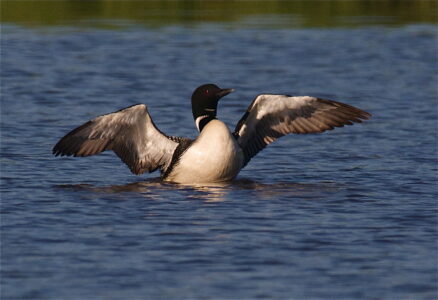
Seney is also well known for two of the oldest common loons. Two 30+ year-olds, a male and a female, had made the refuge their summer home and had been the most productive pair in the world tool Last year the older female, took a younger mate, much to the surprise of many. Loon nesting is a tricky proposition for any loon. Changes in water levels can flood nests, near the water's edge of bogs or small islands. Loons have legs located far back near their tails, great for swimming and diving, but not for walking on land, so loons rarely wander more than a few feet from water. An even bigger threat to nesting loons are blackflies. If they become too overwhelming, the loons will abandon their nests and not produce young that summer.
Pine and yellow-rumped warblers can be heard in the pines, along with red-eyed vireos, occasionally being chased by merlins. Higher up, osprey and bald eagles are also commonly seen as both nest on the refuge. Seney frequently has small hand-made signs to point out the locations of nests across the pools. The refuge also alters the water levels in pools each year to create additional habitat for different bird groups. Lower levels can produce mud flats for shorebirds and wading birds. Ring-necked and wood ducks nest at the refuge and river otters are sometimes seen tool American white pelicans, common and Caspian terns are summer visitors. Moose and wolves are occasionally seen there. It is a true U.P. treasure.
The refuge also manages a portion of Whitefish Point in Chippewa County. Waterbird and hawk counters associated with Michigan Audubon just recently completed their spring work May 31, but will return in mid-August. Owl banders also monitor migration.
Elsewhere, shorebird migration is finally winding down. There are still some good mornings, usually before 7:00 AM when up to seven different species may be seen at the mouth of the AuTrain River. Black-bellied and semipalmated plovers, semipalmated and spotted sandpipers and dunlins have been the most recent visitors. Also seen there are one of the rarer songbirds, bank swallows, nesting in the dunes there. They have all but disappeared at many locations in the U.P. in recent years. Shorebirds were still good finds at Peninsula Point with least sandpipers joining the last migrants and 13 warblers were still moving through on June 4.
It has been fairly quiet at the mouth of the Dead River in Marquette recently, possibly due to the local peregrine falcons that do hunt along the Lake Superior shoreline. Resting sandpipers and plovers, sometimes have short visits due to the hunting raptors.
In Marquette County another rarity, a least bittern was heard recently in the shoreline visitation at Harlow Lake. Although they are occasionally seen/heard on the Lake Michigan side of the U.P., at sites like Portage Point south of Escanaba, they are rarely seen/hear on the Superior side.
Weather continues its weird mix of heat, smoke, frost and guesses -- why not, it's June!
EDITOR'S NOTE: Scot Stewart is a teacher at Bothwell Middle School in Marquette and a freelance photographer.