
Future of Social Security discussed at PWPL
Trending
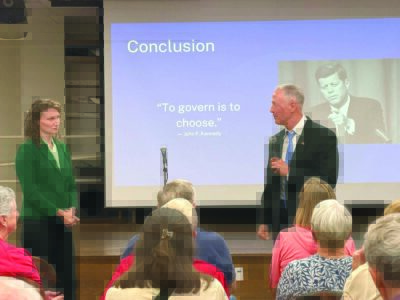
MARQUETTE -- Former Maryland Gov. Martin O'Malley and Congressional candidate Callie Barr recently held an event at Peter White Public Library on the future of Social Security. O'Malley served as the 17th commissioner of the Social Security Administration under President Joe Biden.
"People had good questions, and confirmed what I’ve heard all around the country, that people are very concerned," said O'Malley. "They want their Congress to act before what we now see as a 20 percent cut in benefits that is coming (in 2032)."
"We need Congress to act -- we need the right people in Congress," said Barr. "Of course, our incumbent, Jack Bergman, wants to privatize Social Security. I don’t agree with that. This is something we need to make sure is solid and isn’t gambled with on the private market."
Michigan's first district has the largest population of seniors in the state, with 200,000 people receiving Social Security.
O'Malley says that the problem began with changes to the tax code made in 1982, under the Reagan administration.
"The cause of it, really, is income inequality," said O'Malley.
Under the current system, the maximum amount of income which can be taxed towards Social Security is $184,000. That means that a person making $200,000 a year pays the same amount into Social Security that Elon Musk, Bill Gates or Jeff Bezos does.
"This is a solvable problem that does not require raising taxes on the vast majority of Americans,” said O'Malley. "It would require increased contributions from the wealthiest 6% of us, and it also can be done without adding a single penny to the deficit. Social Security is not a deficit funded program, say, like, the Defense Department or other entities in our federal government. It is a pay as you go program that is funded by people working in the economy."
"It's just a matter of fairness," said Barr. "…We've earned this. This is something folks have paid into their whole lives."
While Social Security is not in danger of going completely bankrupt, as some publications have suggested, there is a real danger of having benefits cut by a significant margin -- about 20%.
"For about 40% of us who are over the age of 65, the only income we have is Social Security," said O'Malley. "So if you're talking about a senior living alone, over 65 in Marquette, who gets $2,900 a month, and, by the way, Medicare copay comes out of that, and then you talk about taking out $600 because Congress fails to act ... That's a big chunk of monthly income for people that are seeing food prices go up, gas prices go up, and energy prices.
"It's a big deal for people who are dependent entirely on this promise that's been made to them by our country, and is a benefit they've already earned. They've already earned it. They worked their whole life to earn it."
Attendees of the event were interested in learning about why the problem has not been solved, and also wanted to know more about cuts to the Social Security customer service department, which had its funding reduced early in the Trump administration as part of the DOGE program.
"Customer service was damaged when Donald Trump and Elon Musk took a meat cleaver to (Social Security)," said O'Malley. "They've been reduced to a 63-year low in staffing, even as the Baby Boomer generations swells their active beneficiary customers to a new all-time high every day. The agency is really struggling."
Cuts in customer service mean longer wait-times and more online hoops to jump through, for many people who are not technologically literate or who don't even have the internet.
"It's not just making sure (social security) is solvent, it's making sure it's accessible," said Barr.
Annie Lippert can be reached at 906-228-2500, ext. 550. Her email address is alippert@miningjournal.net.