
Home again: Saw-whet owl released into the wild
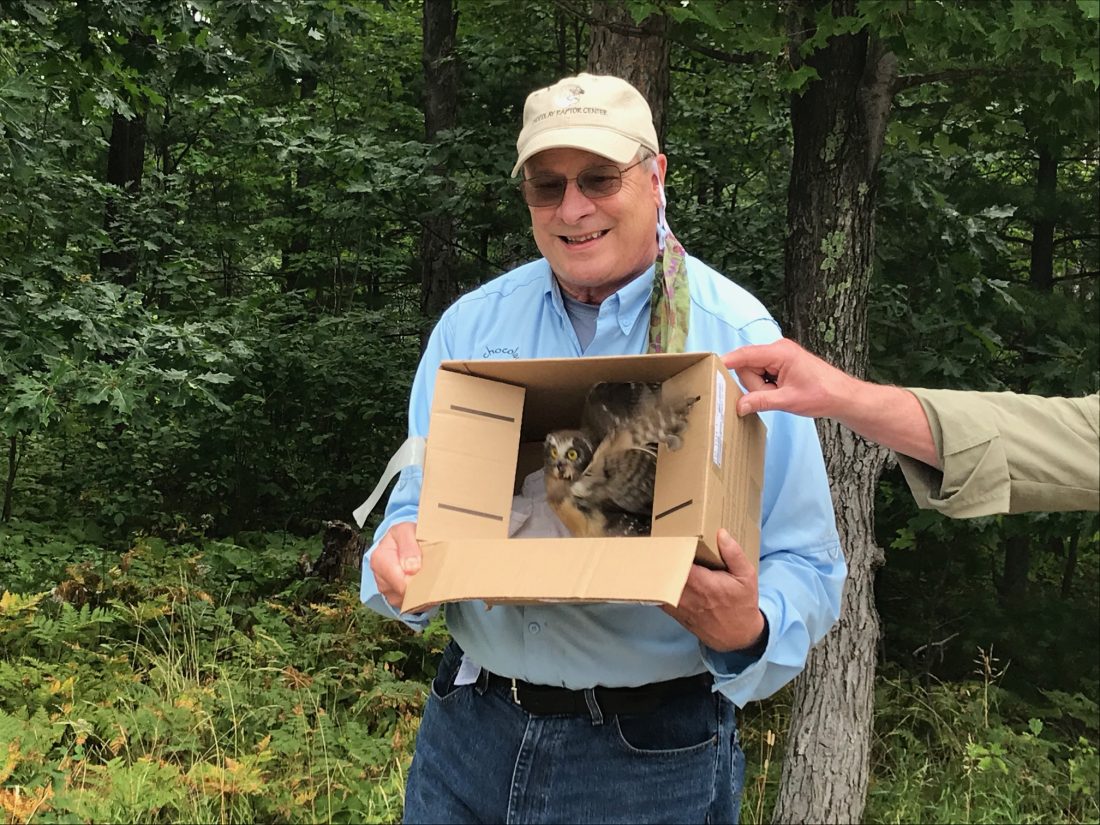
Jerry Maynard, cofounder of the Chocolay Raptor Center, holds a box containing a saw-whet owl the center had tended until it was released at the Northern Michigan University campus on Wednesday. The owl was let go in the vicinity it first was discovered. (Journal photo by Christie Mastric)
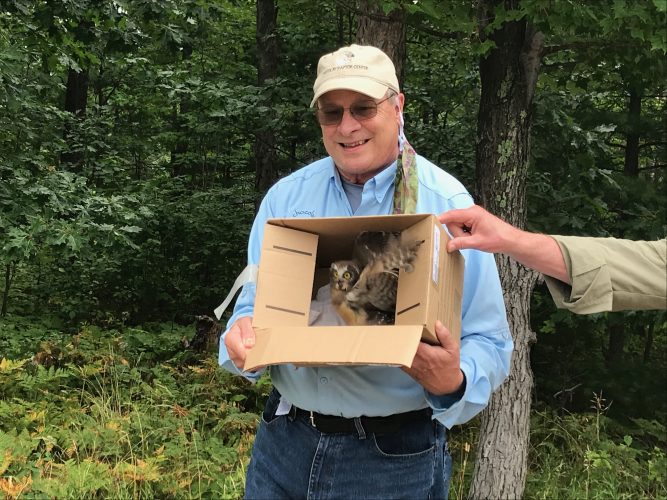
MARQUETTE — A little owl that “beeps” was released back into a wooded area on the Northern Michigan University campus on Wednesday, courtesy of the Chocolay Raptor Center.
Bob Jensen and Jerry Maynard, cofounders of the Harvey-based center, released a saw-whet owl into the wild just north of Jamrich Hall.
Jensen said the release compares with the center’s other releases of raptors, which have included species such as the American kestrel, barred owl, great horned owl and snowy owl.
“It’s thrilling,” Jensen said. “Any time we can take a bird in and rehab it and get it ready to go in the wild, we are just tickled pink.”
Jensen said the saw-whet owl, which is believed to be a male, came to the center about two weeks ago.
“He was just a fledgling,” Jensen said. “He was found right here in the woods by Jamrich Hall puttering around. We think that he just left the nest a little bit early and wasn’t sure how to fly and move around on his own.”
A local resident picked up the owl and called the center, he said, with a subsequent check determining there was nothing wrong with it.
The owl, which weighed 62 grams, then began to eat 22 grams of mice a day at the center, Jensen said, and in a few days, was able to fly.
“He’s fully fledged now, and he’s ready to go,” Jensen said just before the bird’s release.
Maynard carefully brought a box containing the owl to the edge of the woods, and after the box was opened, the bird hesitated just a bit before flying into the trees — and blending right in.
Jensen believes the chances of survival for the owl are good. What will change, though, is its appearance. The owl had dark-colored feathers at the time of release, but will molt and resemble a typical saw-whet adult.
Maynard said saw-whet owls usually molt quickly.
“Within a few months, he’ll look like the adult,” Maynard said. “You won’t be able to tell them apart.”
Jensen said saw-whet owls are common throughout the Midwest and Canada, and will migrate for the winter.
“They go south for the winter because they’re so little, they have a hard time in the snow,” Jensen said.
However, this saw-whet owl wasn’t the first of its species the center has rehabilitated and released. In 2016, it took in and let back into the wild two owls, both of which had been found in the city of Marquette.
Saw-whet owls, along with other raptors, are a subject of a study in the ongoing Mackinac Straits Raptor Watch. The owls are caught in mist nets and then banded so they can be studied if caught again.
According to the Cornell Lab of Ornithology, researchers use the “too-too-too” call to lure saw-whet owls, which typically are about 7 to 8 inches in height, into mist nets.
Depending on how someone interprets that sound, it sounds like beeping.
“Researchers say after three or four hours of hearing ‘beep, beep,’ they’re pretty tired of it,” Jensen joked.
Maynard pointed out that saw-whet owls, which have other calls as well, supposedly have that name because one of their calls sounds like a whetstone on a saw blade.
Jensen recommended people who find injured raptors to be careful and contact the center. The center can be reached at 906-249-3598.
Individuals should keep in mind, however, that raptors also are called birds of prey, and are equipped with sharp beaks and talons.
“The key thing is that these are predators that use their talons,” Jensen said. “That’s their business end. Whatever you can do, if you’ve got thick leather gloves and a box, you can pick it up, put it in a box. Sometimes they’re stunned, and they’re a little more docile, but you have to be really careful.
“So as long as you can get them in a box and keep them quiet, put some air holes in it and close it up. They’ll think it’s dark and they’ll stay quiet until you get them to us,” Jensen said.
Christie Mastric can be reached at 906-228-2500, ext. 250. Her email address is cbleck@miningjournal.net
Front Page News
Plan would allow Lower Michigan hunters to harvest ‘bonus’ buck

Pioneer Days!
Body recovered in Straits of Mackinac
ST. IGNACE — The body of the individual who was the focus of search and recovery efforts in the Straits of ...

NMU receives state funding for business building
Central U.P. Regional Housing Partnership urges residents to take statewide housing survey
ESCANABA – The Central U.P. Regional Housing Partnership is calling on residents, business owners, leaders, and ...