
Warmer weather really brings out bird sightings

Scot Stewart
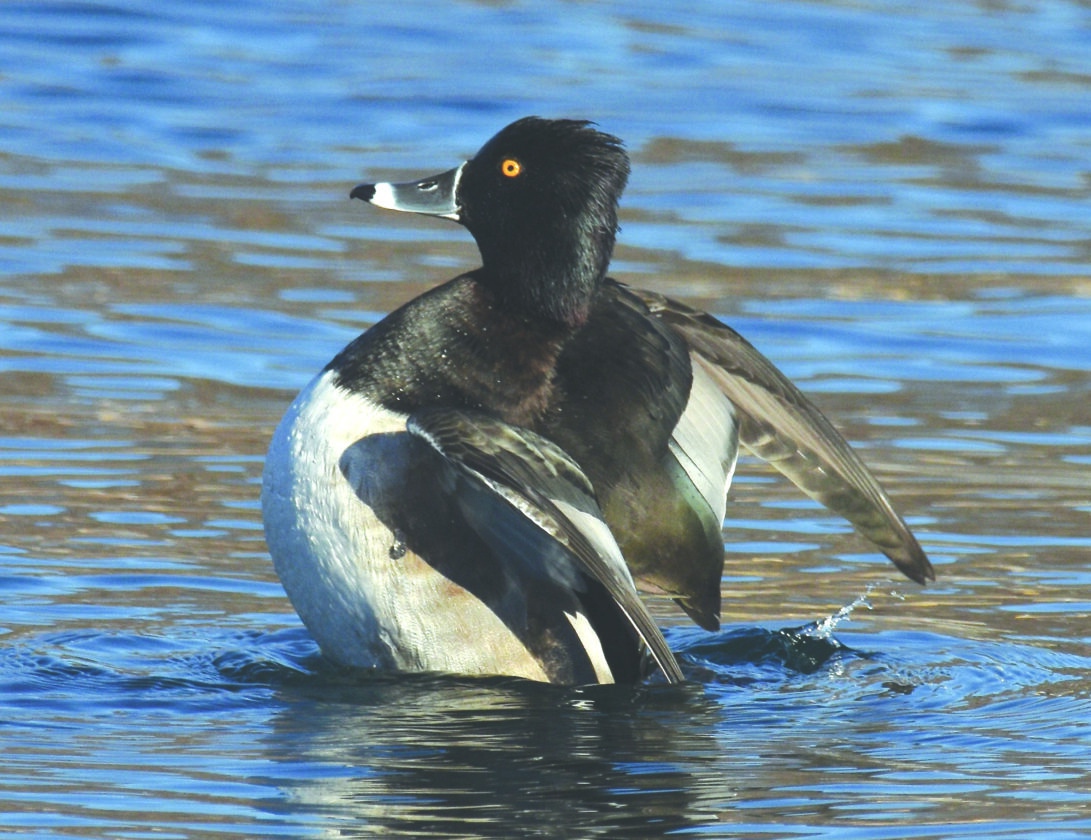
Ring-necked ducks like this one have been seen all along the Lake Superior shore in Marquette recently. (Photo courtesy Scot Stewart)
Scot Stewart
Ring-necked ducks like this one have been seen all along the Lake Superior shore in Marquette recently. (Photo courtesy Scot Stewart)
Trending
By SCOT STEWART
Marquette-area bird enthusiast
"April hath put a spirit of youth in everything." -- William Shakespeare
Nothing like some warm weather to really get things moving.
Young great horned owls are just about ready to leave their nests and start learning how to take care of themselves. Common grackles, robins, and house finches in town are collecting nesting materials. Grass, mud, and even string is all under inspection for its suitability for nests.
Eastern chipmunks, gray squirrels and cottontails have all ramped up their pursuits of each other as mating season is in full swing.
Birding in Marquette's Lower Harbor can be particularly rewarding this time of year. On calmer days the larger near-shore open part of the bay from Founders' Landing to the old Shiras Steam Plant coal dock can host a wide variety of diving ducks like all three species of mergansers, redheads, both scaup, ring-necked ducks, bufflehead, long-tailed ducks and common goldeneyes. Horned grebes also can be seen diving there, too.
On windier days, some of those species will move on to other areas, but a few will slide into the calmer areas between the nearby piers and the ore dock and the waters between the ore dock and Mattson Park. These slots sometimes offer remarkably good looks as some of these birds are usually seen much farther out away from shore.
Dabbling ducks and divers more often found in shallower waters, like blue-winged teals and ruddy ducks, show up, too.
Gulls also like these locations, with larger non-breeding flocks often seen perching atop the exposed pilings on both sides of the ore dock. Occasionally there have been wandering rarities like iceland, glaucous, slaty-backed, greater and lesser black-backed gulls.
Ripley's Rock is the summer home to a large number of American herring gulls, and they have already staked out their nesting sites. Some mating has already been noted there this week. Soon they will be making morning runs to the shore to grab mouthfuls of mud and grasses to line their nests in the depressions in the rocks.
Double-crested cormorants frequently join the gulls on the rock to rest and sun themselves during foraging activity in the harbor.
The harbor attracts raptors, too. During colder months, snowy owls may show up along the shore and ore dock. They are attracted to the smaller ducks, especially ones like buffleheads, pigeons living there, and a surprising number of cottontails and mice. Cooper's hawks have been noted there several times this spring, too. They are primarily bird hunters, so they were mostly after pigeons and possibly other songbirds in shrubs, trees and on the ground near the piers.
The best of the hunters frequenting the area now, though, may be the peregrine falcons, in the city for the summer. A pair was seen cruising through the harbor last weekend heading north along the lake and on Monday a single falcon was spotted flying in from the north at the end of the breakwall chasing a gull. It gave up the chase and disappeared.
A few minutes later it reappeared over the top of the ore dock and photos showed it was scanning the area below where there were several dozen gulls, several larger ducks -- mallards and ring-necked ducks -- but no pigeons. The peregrine circled around the area, spiraling higher before disappearing, apparently still looking for a meal.
Common grackles seem to be a newsworthy species in the area this spring as far as their numbers go. They have congregated in moderately large flocks at some area feeders. Migrating flocks have shown some size, too, with the total for the 8 1/2-hour census at Whitefish Point last Tuesday showing 304 counted.
Other migrants of note there this week have included sharp-shinned hawks, with 200 or more seen daily early in the week, and a steady stream of smaller numbers of many other hawks, including rough-legged, red-tailed, northern harriers and broad-wings. Both bald and golden eagles have continued through, too. All the falcons are beginning to ramp up their passage past the point, too.
Large flocks of Canada geese have also been seen overhead across the Upper Peninsula. Southerly winds will help ramp up their numbers along with many other species in the days ahead.
In ruby-throated hummingbird migration news, they are getting closer to the U.P. The current map from Hummingbird Central shows sightings on Tuesday as far north as Appleton and Door County in Wisconsin and Petoskey in the Lower Peninsula. Another two days of favorable conditions should draw the birds closer, but with the cooler weekend it might still be a few more days, and that would be good for the hummers. There are a good number of flies, midges and other insects appearing to provide some food for these early birds.
Swallows and winter wrens are also slowly returning and all rely on insects to survive. In Escanaba, purple martins are back on Aronson Island, where serious efforts have been made in recent years to re-establish a summer population.
Once a staple species at homes and parks adjacent to ponds and lakes where martin hotels dotted the landscape, their numbers have taken a serious dive. One of the next closest colonies is along Lake Michigan in northern Wisconsin between Peshtigo and Oconto, where residents have maintained houses for them for over 40 years. The martins are renowned for the abilities to consume huge numbers of flying insects like mosquitos and flies.
Sparrow and warbler diversity increased dramatically at the start of this week.
With an extended stretch of warm weather, the beginning of the color splash of neotropical songbirds will soon commence with the hummingbirds, tanagers, Baltimore and orchard orioles, indigo buntings, warblers, and other really colorful species.
Now if only the rest of that darn snow would go, spring will really feel like it's here!