
Whatever happened to Negaunee’s stump?
Trending
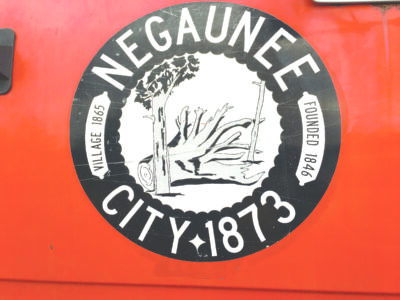
This is the Negaunee city seal as seen on the side of a city vehicle. (Photo courtesy Virginia Paulson)
Maybe on a cold, wintry day you saw one of these trucks spreading sand on an icy street, or plowing snow, maybe sweeping the streets or repairing downed lines.
If you look closely you will see a picture, actually the city seal. This seal represents something authentic, something significant. This stump pictured and the ore that was found under its roots was a discovery that would affect the lives of many people for years to come.
But whatever happened to the stump?
It was the year 1837 and Michigan had just become the newest state to join the Union, referring to the United States of America. When a state joined the Union, its land had to be surveyed to make sure boundaries were correct. William Burt was hired by the U.S. government to survey the land we know today as Michigan. Burt was the inventor of the solar compass and credited with discovering iron ore.
In 1844, Burt and his group of surveyors were measuring boundaries in the Upper Peninsula. As they worked near Teal Lake, something strange began to happen -- the magnetic needle began to spin crazily! What could be the reason? Burt was the first to say it must be iron ore buried in the ground.
This is how Burt may have told the story:
"The boys and I have been here up in the wilderness they call the Upper Peninsula of Michigan trying to do survey work. The weather has been cloudy and cold. Can you imagine five inches of snow in September?
"The branches and trees have torn our clothes to shreds as we work through thick brush. On September 18th, we camped at a place known as Teal Lake. The next morning we started running a line south of the lake. My compass man shouted, 'Come and see this crazy thing!' The needle was going all over the place."
Burt knew there was ore buried in the ground. He knew that his expedition was worth it.
"Yes sir, I see a great future for this land. I see people, mines, ships and railroads coming before long."
One year later, a group of explorers from downstate Jackson came to the area. Their leader was Philo Everett. They came to find the iron ore that they heard about. Chief Marji-Gezick, a Chippewa Indian, was their guide. It didn't take very long after that when ore began to be mined.
The Jackson Mining Company began digging a pit to see how much of this precious mineral they could find. Men began coming here from other countries to look for work.
Tools such as picks, shovels and sledgehammers were used to get the ore that was buried in the ground. Horses and mules were used to pull the wagons to get the ore out of the pit. Negaunee was now on its way to becoming a booming mining town.
By 1858, the population began to grow and the people decided that laws were needed. They called their new community Teal Lake Township. That too would change.
An old legend says that a small group of Chippewa Indians snowshoed across the wilderness, and the leader, tired from his long journey of trail-breaking, stepped aside and said, "negani" or "Negaunee," meaning "go ahead." Then taking turns, each Indian went forward and became the pioneer of the trail.
In 1865, the same year President Abraham Lincoln was assassinated, the streets of Negaunee were laid out.
But what happened to the stump? In 1873, Negaunee became an official city. A city council was elected to run the city. At this time there were 3,354 miners, loggers, storekeepers, saloonkeepers, blacksmiths, women and children.
What do you think happened to the stump? Have you seen it? Let's go back to Oct. 25, 1900, the week before Halloween. There were some boys looking for something to do. They decided to climb on the stump. But not only did they climb on it, but they decided to set it on fire. The famous stump became a pile of ashes!
Because the stump was such a part of Negaunee's history, it was replaced with a stone monument, built near the old Jackson Mine in Cornish Town. Years later due to caving ground, it was taken apart, stone by stone, and rebuilt in Miners Park, where it stands today.
The monument is a memorial to the great discovery of ore under the stump of a tree.
Virginia Paulson has been a trustee with the Negaunee Historical Society for more than two decades, previously having been on the Negaunee Public Schools board of education for 23 years and MARESA board for 17 years.