
Hunting season safety tips
Hunter’s orange a must during warmer-than-normal Nov. 15
Trending
By DREYMA BERONJA
Journal Staff Writer
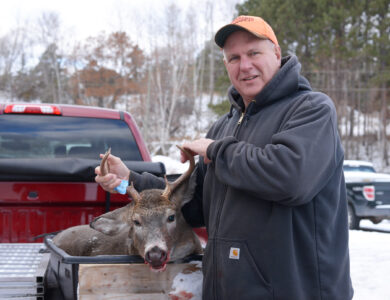
MARQUETTE -- Michigan's firearm deer season starts Wednesday and it's important to remember to stay safe while hunting.
Michigan Department of Natural Resources deputy public information officer John Pepin said in an email to The Mining Journal that the start of this year's hunting season is expected to be warmer than usual.
"Hunters should be extra mindful to dress in layers to accommodate cold mornings and warmer afternoons. Hunters should also remember not to overexert themselves when trying to drag harvested deer out of the woods," Pepin said. "It is better to get help from someone than risk suffering a potential heart attack."
While hunting, the DNR recommends wearing as much hunter orange as possible to increase visibility. On the DNR's hunting safety webpage, it says that orange and other colors do not impact deer's behavior.
"Hunter orange should be worn as the outermost layer of clothing and must be visible from all directions. Options include (a) cap, hat, vest, jacket or raincoat," the DNR said on its website. "Hunter orange garments (including camouflage) must be at least 50% hunter orange to meet the legal requirements. If you are recreating outdoors near hunting areas, wear hunter orange so you can be seen by hunters."
Hunters are reminded to let someone know when and where they are hunting in case of an emergency.
"As with most all activities that take place outdoors, hunters should leave a note letting someone know where they will be going and when they plan to return," Pepin said. "It's also best to bring a cell phone on a hunt to be able to text 9-1-1 for help, even if your phone does not have calling service."
The DNR also recommends hunting with a partner, knowing the safe zones of fires, carry a two-way communication device that receives service in remote areas (phone or two-way radio), and if hunting on or near water to wear a life jacket.
"Hunters should always remember to put safety at the top of their minds when out hunting," Pepin said.
Firearms safety
≤ Keep the safety of your firearm on until you are prepared to take your shot.
≤ Treat every firearm as if it is loaded.
≤ Keep the muzzle pointed in a safe direction at all times.
≤ Be aware of your surroundings -- know your target and what is beyond it.
≤ Put your finger on the trigger only when you are ready to shoot.
≤ Don't use your scope as binoculars -- only point your firearm at something you intend to shoot.
≤ Unload the firearm when crossing obstacles and/or getting in or out of a tree stand.
≤ Check the barrel and ammunition to ensure they are clear of any obstructions and use the proper ammunition.
≤ Do not drink alcohol or use any mind-altering substances when hunting -- including marijuana and/or medications.
≤ Firearms in the home should be unloaded and securely stored separate from the ammunition.
≤ When transporting firearms in vehicles make sure that they are unloaded and in a case.
Tree stand safety
≤ Using your hands and feet, maintain three points of contact at all times when ascending or descending into a tree stand.
≤ Always use a full body harness that is attached to a secure fall line positioned above your head.
≤ When lifting your firearm or crossbow into a tree stand, use a secure pull system (such as a rope) and make sure it is unloaded and the safety is on. Do not attach anything to the trigger guard.
≤ Refrain from using screw-in steps on tree stands that are located on public land.
≤ Ensure your tree stand is securely attached and stable prior to using it.
The DNR reminds hunters to obey no-trespassing signs and if your game goes onto property marked as "no trespassing," you must have the landowner's permission to retrieve your game.
According to the DNR, all first-time hunters born on or after Jan. 1, 1960, are required to take and pass a hunter safety course. Hunters will not be able to purchase a base license (other than an apprentice license) unless proving successful completion of a hunter safety course.
There are four options for completing hunter education in the state:
≤ Traditional classroom-based course (which includes the in-person field day)
≤ Online course and in-person field day
≤ Interactive online course and in-person field day
≤ Take-home study course and in-person field day
Nonresidents can purchase a Michigan hunting license with a valid hunter education safety certificate from another state.
For more information on hunter safety certificates or hunting safety, visit michigan.gov/dnr/things-to-do/hunting/safety.
The DNR's Report All Poaching hotline is 800-292-7800. Hunters can call to report illegal activity or contact a conservation officer after business hours. Callers can remain anonymous.
Regular firearm season ends Thursday, Nov. 30.
Dreyma Beronja can be reached at 906-228-2500 ext. 548. Their email address is dberonj@miningjournal.net.