
Hill talks energy efficiency
Trending
By CHRISTIE MASTRIC
Journal Staff Writer
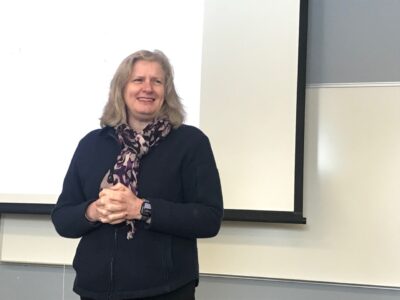
MARQUETTE -- Making the transition to energy efficiency will require a lot of steps, but it is possible, state Rep. Jenn Hill, D-Marquette, said during a Friday presentation of the Northern Climate Network at Northern Michigan University.
"The technology exists right now to do what we need to do to get off of fossil fuels," Hill said. "The question is: How do we pay for it?"
Hill, who represents the 109th District, serves on the Michigan House of Representatives' Energy, Communication and Technology Committee. She said the Upper Peninsula can lead the way in energy as it had in the past with copper mining.
"It is literally our ground that has electrified America, and our iron ore that built much of America," Hill said. "So we can do this. But what we did and the way we did it in the 1800s and the 1900s, where we sucked it all out of the ground and then moved on to the next place and left behind a mess, we don't have to do it that way. We can do it other ways."
One particular problem that wasn't anticipated at such a scale, she said, was burning fuel and putting carbon into the air, and as a result, changing the climate.
However, Hill pointed out that from 2010-22, Michigan Saves loans were given to people to put technology into their homes and businesses to be more energy-efficient, which saved them money in electricity and gas.
"We can still be comfortable and not have to waste so much energy," said Hill, who mentioned the switch from incandescent lights to LEDs and the subsequent drop in LED prices as an example.
"In this transition, there's early adopters, there's higher costs, then as it spreads out, costs go down and it can become easier and easier," she said.
Hill noted that many jobs in energy efficiency exist.
"Every house pretty much needs that work done," she said.
Hill also talked about the MI Healthy Climate plan, established by the Michigan Department of Environment, Great Lakes, and Energy, which has a "roadmap to 2030."
It listed these steps:
≤ ensuring that at least 40% of Michigan climate-related funding benefits the state's disadvantaged communities;
≤ generating 60% of the state's electricity from renewable resources and phasing out the remaining coal-fired power plants by 2030, and limiting the energy burden from powering and heating homes to not more than 6% of annual income for low-income households;
≤ building the infrastructure necessary to support 2 million electric vehicles on Michigan roads by 2030, and increasing access to clean transportation options, including public transit, by 15% each year;
≤ reducing emissions related to heating Michigan homes and businesses by 17% by 2030;
≤ encouraging innovation, tripling Michigan's recycling rate to 45% by 2030 and cutting food waste in half by 2030; and
≤ protecting 30% of Michigan's land and water by 2030.
The plan also includes goals from Gov. Gretchen Whitmer that include greenhouse gas emission reductions of 28% by 2025 and 52% by 2030, achieving economy-wide carbon neutrality by 2050 and maintaining net negative greenhouse gas emissions after 2050.
Hill acknowledged that people have different "feelings" about energy.
"Is a wind turbine something cool to look at, or is that an abomination that's an industrial facility?" she said.
Hill called that a "serious argument" in Michigan, but one that has a solution.
"Wind and birds go together," she said. "They do, but we can at least look and think about where we're going to put the wind so that we can take the birds into consideration. That is being done."
Christie Mastric can be reached at 906-228-2500, ext. 250. Her email address is cbleck@miningjournal.net.