
Trending
"In summer, the song sings itself" -- William Carlos Williams
The mild, dry weather, along with lights winds that have found their way through much of May and early June, seemed to speed along many spring events. Lilac bushed seemed to bloom a bit early, then slowed a bit but then just about wrapped up in a hurry this week. Sightings of shorebirds has dropped to zero in most places, but other birds are moving into new places as some work harder to find water in accessible places. Water dishes at feeder stations have been very busy with puddles, and small pools all but invisible through many areas, especially in towns.
Marquette and most of the Upper Peninsula continue to witness a decreasing number of insect eating birds returning each spring. Nighthawk, swallow, wren, and swift numbers have been on the decline for quite a while and the trends seem to have continued again this spring and summer.
There have been a group of swallows seen regularly at the mouth of the AuTrain River, including some bank swallows this spring and cliff swallows have been building nests again this year on the side of the Dead River Bridge near the river mouth.
Several birders posted recent reports about chimney swifts on the U.P. Birders listserve this week. Only a handful of chimney swifts have been seen with regularity over Marquette.
Other small flock sightings have been seen and/or heard in Dickinson County in Norway and Quinnesec recently as well. Before Europeans arrived, swifts nested on cliffs, in caves, and in cavities like hollow trees. "City" chimney swifts have been attracted to large chimneys in a number of Upper Peninsula towns over the years. In Marquette the roosted at the old Skill Center building on Rock Street in south Marquette and the Landmark Hotel during the years in was not open. At the hotel upwards of 400 swifts were roosting there in late summer. Five were reported flying there on Wednesday.
Munising also has some older buildings with large chimneys. Currently a flock is roosting at night in the chimney of the hardware store at the corner of Elm and West Superior Street. Chimney swift pairs nest alone but may occasionally let unmated swifts roost at the same site. When large groups roost together it is usually unmated individuals or groups formed after the nesting season is over. In colder weather they may be drawn together for added warmth.
Swifts spend most of their time in the air, hunting resting, and even catching raindrops in the air to bathe. They often fly in small groups, especially after the young have fledged, twittering as they circle over areas where there are clusters of aerial insects present.
The noise of June has arrived as a large number of European starlings and common grackles have fledged in Marquette creating large groups of noisy birds crowding lawns and feeders foraging for easy food. Mixed in with these groups are plenty of robins collecting food to take back to nestlings and northern flickers hammering away on ant hills in dozens of yards. The dry conditions have made working the tops of ant hills easier for flickers as the hammering they do near the colony openings brings more ants to the surface where they are eaten by these woodpeckers. Flickers spend most of each day on the ground hunting ants, and the insects seem to be quite numerous this year. Because of their preference for ground feeding, flickers migrate south in the fall. Occasionally one or two may linger in the area into the early winter, spending lots of time at suet feeders, and even make it on to some Christmas Bird Counts, but nearly all disappear by January.
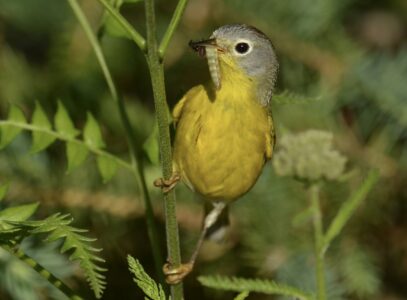
Warbler numbers have been decent this spring and now summer. Birders on the Peshekee Grade this week have seen up to eleven species on Wednesday. There were no surprises, but a Cape May is a good summer warbler for the area. Across the area the black-throated greens, common yellowthroats, American redstarts, chestnut-sided, yellow, and Nashville warblers are probably three of the most commonly found. Changes in habitat, moving from wetlands to pine forests, to mixed forests and forest edges will affect the ones more commonly seen so a little travelling will definitely add to the number of species seen on an outing. Most are currently foraging to feed either mates on nests or newly hatched young.
To hear most singing now requires early morning trips out to home ranges of most birds. In Marquette cardinals, red-eyed vireos, American redstarts, mourning doves, and song sparrows can be heard throughout the day, but on the warmer days when temperatures stretch into the 80's and 90's songs are less frequently heard.
Ducklings are beginning to show up on the area's waterways. In Republic, both hooded and common merganser young were seen on the Michigamme River two weeks ago, but in Marquette the common mergansers usually seen on the Dead River or near the Lower Harbor have remained hard to find. Most Canada geese seem to have hatched and are out grazing in Marquette along Lakeshore Boulevard, and out at Presque Isle. Mallard young have to show up in large numbers, although one clutch hatched out along the shore of Lake Superior last week.
The next few weeks should provide plenty of interesting sightings and some funny, awkward moments for birds as more fledgling take their first flights, do some loud begging, and begin to look for food on their own.
Should be good!
EDITOR'S NOTE: Scot Stewart is a teacher at Bothwell Middle School in Marquette and a freelance photographer.