
Trending
"I drifted into a summer-nap under the hot shade of July, serenaded by a cicadae lullaby, to drowsy-warm dreams of distant thunder." -- Terri Guillemets
The heat of summer and the waning days of June bring much of the forest's bird songs to a diminishing or silent end as many songbirds manage their one nest of young to its conclusion for the year. That is not to say the singing has come to an end. Cardinals are still up at day singing in Marquette and at least one on the east side of Marquette was still singing this week in the heat just before noon!
At Presque Isle singing gray tree frogs can be heard in the early afternoon through nighttime as they continue their serenades even though their young are successfully transitioning to young adults. One bright green youngster was found sunning itself last Tuesday on an alder leaf next to the Dead River at Lambros Park.
Soon a host of cicadas will begin their long, buzzing songs. Although their songs dip and rise in the summer heat, they are a comforting sound to remind U.P. residents of the joys of summer warmth, a luxury missed by many in January and February. Two are common in the U.P., dog-day and the northern dog-day cicada are both heard in mid- to late-summer usually high in the trees. It is another ironic insect life, where in this case the immature, nymph form spends its development underground attached to a plant root where it feeds, only to crawl out one warm summer day crack open its exoskeleton and after a few hours filling its wing veins with fluid, flies away!
There was one vagrant yellow-throated vireo that was found just west of Harlow Lake north of Marquette. During the summer red-eyed and blue-headed vireos are common across most of the U.P. Philadelphia and yellow-bellied vireos show up occasionally, but most Philadelphias continue on to Canada for the summer and yellow-bellied vireos usually find their homes near bogs and other boreal forest wetlands. Yellow-throated vireos are just the opposite of the Philadelphia vireos -- preferring to stay in the Lower Peninsula or northern Wisconsin, rarely poking around in the U.P. and if they do, rarely staying very long.
There have been a few over the past few years, but it will take a longer stretch of global warming or some other changes to bring more here to stay in summer.
The many young Canada geese are growing fast, and many are beginning to get their adult markings. A quick walk around their feeding areas will reveal more than short grass and droppings, but plenty of goose feathers too. In summer many ducks and geese go through a molt stage, called eclipse, when they are unable to fly as new primary feather grown in after old ones fall out.
Many adults in wilder areas are often hidden in the thick vegetation near water to avoid detection by coyotes, bobcats, and other larger predators. They continue to be formidable, protective parents, hissing their warnings before charging and biting foes. Their wings are still strong enough to break a man's arm when fully feathered.
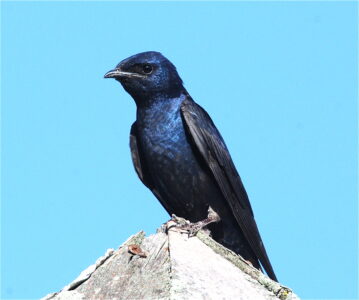
Large numbers of Canada geese are also being seen at Ludington Park in Escanaba. 150 were reported there last week. Another species has drawn much more attention at the park that last few summers though. A conservation project initiated by the city and Common Coast Research and Conservation, Inc. placed nesting structures in the park and have successfully brought a return of purple martins to the shores of Lake Michigan in Delta County. Five or six are seen regularly there daily.
Once a common swallow seen across most of the U.P. near water, it has all but disappeared from the entire area. There are a few strong colonies farther south between Oconto and Peshtigo, in Wisconsin, but few through the rest of the region today.
Martin houses, while multi-family dwellings on tall poles, were once a staple along lake shores to low insect numbers as large colonies of the martins made a serious dent in flying insect numbers. Gourds were hung by Native Americans before the arrival of Europeans, and by the early 1800's martin housed were common sights across most the eastern states.
As the martins disappeared, so did the nest houses. Like the numbers of many other swallows and swifts, martin number decline is blamed on a variety of problems, from habitat loss, competition with starlings, to the use of pesticides in their winter range, across most of the northcentral parts of South America. Males are a deep purplish blue in color with black wings, while females are grayish blue with grayish white breasts.
This is the season for cutting hay in the Upper Peninsula. It is a tenuous time as many grassland birds use these fields to nest and raise their young and must beat the haying time or lose their clutch. Grasshopper, clay-colored, and savannah sparrows all nest in tall grasses as do red-winged blackbirds, bobolinks, and occasionally dickcissels when they wander into the U.P. to nest some years when drought hits central plains states.
In Alger County a reports of 19 turkey vultures, a bald eagle and 10 common ravens was posted last week. Birds aren't the only victims in these fields. A similar cast of birds was noted last year in Delta County over the edge of an alfalfa field recently mowed.
A check revealed a young whitetail fawn had been killed there and the scavengers had descended to attend to the remains. Lots of lively youngers to watch this week.
EDITOR'S NOTE: Scot Stewart is a teacher at Bothwell Middle School in Marquette and a freelance photographer.