
What’s Flying: Were birds misled by recent warm weather?
Trending
"Getting an inch of snow is like winning 10 cents in the lottery." -- Bill Watterson
What is a little snow in April? It is like a snowstorm in Denver in February, right? Just a day or so and the snow is usually close to being gone. It is an unsettled time with the current seesaw of Summer-like weather and winter blizzards in the Upper Peninsula. No need to worry about being swing back into winter's past. Even with the big Spring storms, Spring manages to make at least a weak return fairly quickly, most of the time. There was a time a few years back where April was filled with snow and storms after an incredibly mild March Those recent warm temperatures did much to turn snow banks into unfortunately high river levels in some places.
Trees and birds have treated the recent snow relatively lightly. While the pussy willow flowers did slow a bit, their new flower tips, the parts producing the bright yellow pollen are trying hard to make their first appearances. Other tree buds are just about ready to burst open, with maples peeking out ever so slightly to see if the sun is going to get warm again any time soon.
The foul weather can produce some rather remarkable sights this time of year. Last Sunday as the north wind blew strongly off Lake Superior, many ducks chose to just settle in on the lake until the winds died down, setting up an impressive congregation of green-winged teal, gadwall, redheads, greater and lesser scaup, canvasbacks, ring-necked, bufflehead, common goldeneye and mallards. An estimated total of more than 540 ducks rafted up along the shore near Hawley Street.
As the weather slowly let up, the ducks began to depart for more northerly sites, but there were still near 50 redheads and greater scaup still there Tuesday afternoon. Significant flocks were also seen on the ponds adjacent to Campeau Creek off Co. Rd. 550 south of the Sugarloaf parking lot. These large flocks are not unusual to find during spring migration when severe weather does set in across the area. Large flocks have appeared in the Lower Harbor of Marquette in years past.
Blustery conditions, rain and snow can also push gulls to spend less time on the Big Lake and onto shore around Marquette. More than 240 ring-billed and herring gulls were seen at the mouth of the Dead River on Tuesday and more than 400 were on the South Beach the same day. Iceland, greater and lesser black-backed gulls have been seen in the mix too in Marquette. These vagrants are usually present for a day or two before moving on.
Trumpeter swans have continued to hang around on the Dead River this week and were joined around April 16 by a tundra swan. These are much rarer in the county during spring migration and usually follow a more southerly route west from Chesapeake Bay on the east coast to their summer range in northwestern Canada and Alaska.
Birders have also been checking feeders at a residence between Arch and Ridge Street on the east side of Marquette where a large flock of house sparrows have been joined by American tree, chipping and fox sparrows. What brought the interested ones there though was the arrival of a very unusual species -- a European tree sparrow.
This bird is unusual because its current range is centered along the border between Illinois and Missouri where a dozen were introduced from Germany in 1870. They had been brought there to help immigrants feel more at home. While the current range is still relatively small 150 years later, they do wander around in the Midwest, and have appeared in Marquette, Whitefish Point and other spots over the years. They don't seem to stay very long before moving on, so they create a great deal of interest when they do stop off, usually at a set of feeders where other sparrows are present.
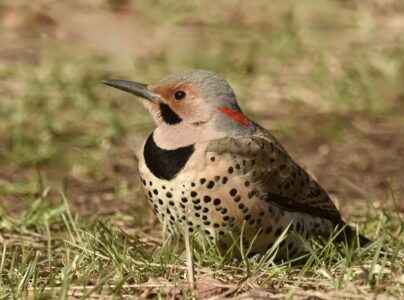
The morning air does feature a growing chorus of morning singers, usually started by the cooing of mourning doves. Woodpeckers have added a very noticeable array of percussion and some chatter. Northern flickers, yellow-bellied sapsuckers, downy and hairy woodpeckers are all contributing to the drumming.
In the eastern Upper Peninsula snow buntings have been able to find enough food to remain there all Winter. In the central U.P., fall snow buntings stop to feed if weed seeds are available, but then continue on farther south. They only stop back in the area occasionally in the Spring, much to the delight of birders. A handful were at Lambros Park earlier in the week, but 50 were seen at South Beach, a tremendous number for spring.
The extremely warm weather earlier this month may have given some birds false hope about Spring's arrival. At least two ruby-throated hummingbirds even made it to the Upper Peninsula last week, one in Quinnesec and one near the Sault. If they are able to find hummingbird feeders already up, they may have a chance to hold on until warmer weather again opens some flowers and gets insects moving. Natural help can also come from yellow-bellied sapsuckers and their sap wells on the trunks of maple, birch and other trees. The sap and flies can draw other birds to the food like warblers, kinglets and the hummingbirds.
It will still be a slow process moving forward to get back to some warmer days, but Spring is so short most years and gradual progress is definitely fun to watch.
EDITOR'S NOTE: Scot Stewart is a teacher at Bothwell Middle School in Marquette and a freelance photographer.