
Psychedelic retreats come with caveat: Beware!
Trending
WASHINGTON -- Surging interest in the purported benefits of psychedelic drugs has given rise to books, documentaries and conferences dedicated to the mind-altering substances. Now add one more business to the list: psychedelic retreats.
Hundreds of outfits across the world are offering multiday trips where attendees pay for drug-assisted experiences claiming to promote psychological healing, personal growth and other benefits.
Many have safety procedures in place, but they still carry “potential for physical, psychological, and interpersonal harms,” researchers who surveyed dozens of retreats wrote in a recent paper in JAMA Network Open.
Currently no psychedelics have been federally approved in the U.S., although that may soon change. On Saturday, President Donald Trump signed an executive order directing the Food and Drug Administration to accelerate reviews of psychedelics that show potential for conditions like post-traumatic stress disorder. The order also directs law enforcement agencies to quickly lower restrictions on any psychedelic approved by the FDA.
The only drug to come before the FDA thus far, MDMA, was rejected as a PTSD treatment in 2024 due to concerns about its safety and effectiveness.
Dr. John Krystal, a Yale School of Medicine psychiatrist who has followed the field, says psychedelics should be approached as “a serious medical procedure that carries risks that must be carefully managed.”
People who work in the field say today’s retreats are far safer than those of prior decades, when psychedelic experiences were almost always conducted underground with few safety precautions.
“The sheer visibility of psychedelics has led to more demand for these retreats,” said Brad Burge, who has worked with psychedelic nonprofits, drugmakers and retreat operators for nearly 20 years. “That growing market has allowed retreats to expand their services, hire more medical and coaching staff and take safety more seriously than we’ve ever seen in the past.”
Here’s what to know about the trend:
Currently illegal in US
Virtually all the drugs offered at retreats are illegal under U.S. federal law, including magic mushrooms, ayahuasca, MDMA and LSD.
Retreat companies will not always make that explicit or sometimes claim that they are protected by a rare legal exemption for religious organizations that traditionally use psychedelics.
But only a handful of groups have formally obtained that legal status, including the Native American Church, which uses peyote in its ceremonies.
Some retreats are held in countries that don’t restrict psychedelics, including Peru and Brazil, where ayahuasca -- a psychedelic brew of Amazonian plants -- has been used for centuries by Indigenous cultures.
No matter where they operate, experts say there are no industry-wide standards or regulations for how participants are screened, prepared or monitored afterward.
“If there is no regulation, what does that mean about the quality of care you’re going to have?” said Joshua White, founder of the Fireside Project, which runs a hotline for people experiencing distress during psychedelic trips. “I certainly fear that there could be a race to the bottom where there is no liability or accountability.”
Procedures vary
With essentially no oversight, potential attendees are on their own when vetting different options.
“It’s really important that somebody interested in a psychedelic retreat do their research, talk to the organizers or facilitators to get more information about what is being offered and how,” said Amy McGuire, a biomedical ethicist at Baylor College of Medicine and co-author of the JAMA Network Open study.
McGuire and her colleagues documented a wide range of practices, including some companies offering multiple psychedelic drugs over the course of their retreats.
Many retreats have health professionals on site, but their roles and responsibilities are often vague. In some cases, they take psychedelics alongside participants, which could impair their ability to respond in an emergency.
Screening not rigorous
One of the most important safety steps happens before any retreat begins: screening out people with serious medical conditions who shouldn’t take psychedelics.
More than half the retreats surveyed for the study excluded participants with mental illnesses such as schizophrenia.
“Psychedelic drugs may worsen symptoms of psychotic disorders, such as schizophrenia,” noted Krystal, who was not involved in the research. “It is important that patients are carefully screened to ensure that appropriate patients enter treatment.”
___
The Associated Press Health and Science Department receives support from the Howard Hughes Medical Institute’s Department of Science Education and the Robert Wood Johnson Foundation. The AP is solely responsible for all content.
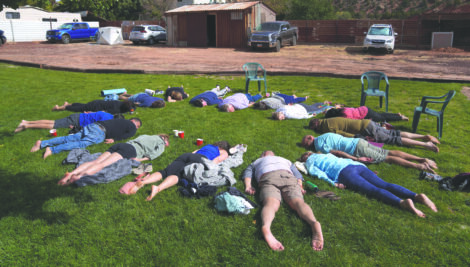
Participants lay face down on the grass during an integration circle at an ayahuasca retreat in Hildale, Utah, on Oct. 15, 2022. (AP file photo)