
Trending
"Ornithologists concluded that migratory birds take hundreds of naps as they fly; they also practice unilateral eye closure, in which one eye closes, thereby permitting half the brain to sleep." -- Bill Jay
Sleeping on the wing with one eye open might explain a lot about how so many birds reached the Upper Peninsula so quickly riding on a southerly wind, despite the plethora of snow still providing some white-covered land below. Even some experienced birders were a bit surprised by the huge wave of birds reaching the Upper Peninsula this past week. Last weekend there were sure signs birds were on the move. Birders conducting migration counts at the ski hill in Gladstone noted an impressive number, 1648, of sandhill cranes, during the afternoon passing along the Lake Michigan shoreline.
A number of hawks were also seen during that count, including 39 sharp-shinned hawks, a northern goshawk, a rough-legged hawk and a red-shouldered hawk The highlights for the counters was a short-eared owl and two Bonaparte's gulls.
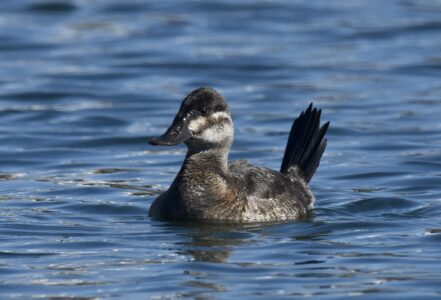
In Marquette two female ruddy ducks were discovered in the Upper Harbor adjacent to the marina. One may be an immature male but usually males have a bright blue bill, black cap, white cheeks and chestnut colored body by April. These are unusual for Marquette, with just a couple showing up in Marquette in a given year. Although they overwinter across the southern U.S., they pass quickly to the western U.S. where they mostly nest in the pothole country out west.
Divers, they are most easily identified when they point their stiff tails upward. A third female ruddy duck was spotted in the Lower Harbor on Monday just south of the new visitors' dock. All three were seen on Tuesday, a rather extended stay for the two in the Upper Harbor.
Sightings of birds out of their normal range are often given to wondering – how did they get off the migration course usually taken by most birds and there are several ideas about their off course wandering. Weather, especially storms and changes in the jet stream can definitely blow birds off their chosen courses. The U.P. has seen a lot of windy days with speeds of 40-50 miles per hour. It is thought some birds may get an internal compass in their brains turned around, sometimes 180o sending them in the opposite direction of normal migration.
Some individual birds do wander beyond their normal range, possibly looking for better habitat. The changes in the ranges of red-bellied woodpeckers, northern cardinals and other species into this area are evidence birds have explored beyond their historic ranges, possibly driven by climate change. Other birds like dickcissels, a grasslands species, wander beyond their summer range when drought creates unfavorable conditions and can in some years be seen in the U.P. in large numbers nesting in fields here, even in the Marquette city limits.
Monday and Tuesday saw an incredible rise in the birds arriving in the Marquette area following some good indications that large numbers were on the way. One birder found more than 75 species during the day Tuesday in
Marquette. Included in the sightings for Lake Superior and the Dead River was a long list of ducks, including northern shovelers, blue-winged teals, bufflehead, ring-necked ducks, both scaup, hooded and common mergansers, common goldeneye, American wigeon gadwall and the ruddy ducks. Double-crested cormorants, pied-billed and horned grebes and common loons are also back.
The bike/hiking trail over the Chocolay River in Harvey has also offered up great ducks and waterfowl too. A remarkable sight of 25 pied-billed grebes there earlier in the week was notable as well. There are usually a few grebes around during migration, and several pairs stick around for the summer, but a flock of 25 is not something anyone could remember seeing in Marquette before. Single and pairs have been noted in the Upper Harbor and at several places on the Dead River, but that is the usual thing to see for them here. Both northern flickers and yellow-bellied sapsuckers have been reported at multiple sites. Winter wrens, eastern phoebes, and a variety of sparrows including song, fox, vesper, American tree sparrows, and dark-eyed juncos have been reported. The song sparrows offer a special extra element to spring migration because they come singing. Many will stay to nest here this summer so when they arrive they come ready to establish their summer territory and add a bright note to the singing, now very noticeable in the morning, joining American goldfinches, house finches, robins, mourning doves and norther cardinals.
With the promise of the return of some wintry conditions later this weekend and into next week the hope for birds will be the temperatures stay close to normal for this time of year. The long-range forecast shows forties for next week with another chance of snow the following weekend too. Forties will keep some insects going to feed wrens and flycatchers, especially if they stay close to open water. A heavy blanket of snow would make it particularly challenging for a number of early arrivals.
Hummingbird migration has made significant strides in the past week, with some making it all the way to the Wisconsin-Illinois border and to the Detroit area downstate. The upcoming cooler weather will definitely slow them down again this coming week though as the cooler temperatures slow the development of flowers and the nectar they produce, slow the appearance of small insects like aphids and midges as well as spiders. Spring is on the move!
EDITOR'S NOTE: Scot Stewart is a teacher at Bothwell Middle School in Marquette and a freelance photographer.