
Trending
"In February there is everything to hope for and nothing to regret." -- Patience Strong
It is a month into the "New Year" already and thoughts are beginning to turn to Spring. In around a month Sugar Bushes will come alive with the flow, capture and boiling of maple sap. Buds of some maple trees already appear to be swelling a bit and this week's mild temperatures will only encourage more thoughts of changing seasons.
February can also be a time when more watches go out for wandering birds moving about as days and daylight grow longer and a few brief thaws occur. In Marquette a sizable number of robins linger on, buoyed by the extensive number of crab apple trees still bearing fruit in town. At least eight were seen on the east side of town last Sunday. It may seem surprising to see so many robins in Marquette, and it is. Occasionally a couple may try to stick it out during the winter here, and when the weather turns severely cold, and the crab apples run out, they usually disappear. It is assumed they move to places with more favorable temperatures and more food. Some may perish if they have stayed due to health issues such as wing injuries or other infirmities.
There is some research done to follow or track these common birds during winters this far south. It is known they do more around in search of their cold weather food -- fruit -- and they will stick around in the colder weather if food is available. In spring the main population will more north as more food is available, following the 37 degree Fahrenheit line of daily temperatures clearing the ground of snow and the soil softens providing more food for foraging birds. Robins that do successfully stick it out during the winter can lay claim to the better summer territories for nesting.
The robins in Marquette had lots of company this past weekend though and some of those crab apple and mountain trees are losing their fruit quickly. Flocks of nearly 50 pine grosbeaks and a mixed flock of bohemian and cedar waxwings numbering around 50 were diving in and out of the fruit trees with the robins. One pine grosbeak flock left trees on the east side Sunday afternoon and just a few minutes later a similarly large flock was seen in the crab apple trees on Fisher Street across from the Michigan Veteran Homes D.J. Jacobetti. As winter continues and birds pick clean trees with tall trees or with good cover nearby or in quieter spots with little vehicle traffic, they turn to trees in less advantageous spots like busy Fisher or Seventh Street or the lower branches of tree that feel less secure to them.
Changes in the ice on Lake Superior have been dramatic this past week. On the bay west of Presque Isle there was plenty of open water a week ago on Thursday afternoon. The cold temperatures did create a large amount of lake ice and when the winds shifted overnight, an impressive amount blew into the bay and filled it, drawing small crowds out to explore the ice cover. Friday night the wind continued and by morning the bay was open again, with most of the ice piled up on the beach. A few mergansers have been using the open waters there to fish this winter.
The ice on the Lower Harbor has seen some changes too. For a brief period, ice skaters were able to glide over the very smooth surface before the late week snow came. The winds accompanying the snow the ice broke up the sheet in the more open areas bringing a return of open waters where mergansers, common goldeneyes, and a few long-tailed ducks have been seen foraging.
Inland on the open waters of the Carp, Chocolay, and Dead Rivers ducks continue to feed and rest where there is open water. For the Dead River, while most are mallards, there is a sprinkling of American black ducks and common goldeneyes seen with them from time to time. In late winter other species may occasionally wander through the area, possibly eyeing possible nesting areas for spring or waiting patiently to held north for the summer, Northern pintail, canvasback scaup, American wigeon and wood ducks are all species that have been seen in the area in recent years.
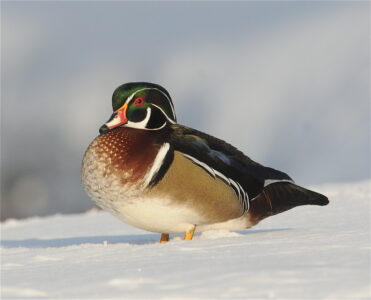
The wood duck may be one of the more popular ducks to see at any time, but especially in winter when other species are also rare or absent. Drake plumage is among the most colorful of all North American bird species and their activity can be more relaxed in winter in a large flock of mallards and easier to observe. It is different in summer at places like Seney National Wildlife Refuge in Schoolcraft County where they nest in summer. There they are quick to duck into cover (pun intended) during their eclipse time when new flight feathers are still growing, or take flight and leave at the slightest disturbance.
Out east birders are still searching the Pickford-Rudyard Loop in Chippewa County for snowy owls and rough-legged hawks. The number of sightings of both seemed down last week with just a couple showing up in some birders' logs on ebird. Pine and evening grosbeaks were also showing up in some reports for the area. In Marquette, several large flocks of evening grosbeaks are also still being reported. As the next two months proceed the changes in the trees, weather and snow cover will help dictate the birds accompanying them. It is definitely a time of hope and no regrets.
EDITOR'S NOTE: Scot Stewart is a teacher at Bothwell Middle School in Marquette and a freelance photographer.