
Trending
"Life can only be understood backwards; but it must be lived forwards." -- Soren Kierkegaard
Last week began a look at birding in the Upper Peninsula in first half of 2022. This week will wrap up the highlights from the past year. The transition from winter to spring last year was slow with many overcast, dreary days, but once spring kicked in, the birding scene turned electric.
Sandhill cranes really got migration going at Whitefish Point in the eastern U.P. with nearly 13,000 counted by May 15. Added to that, more than 2000 common loons flying over the point, 4000+ broad-winged hawks and 5800+ sharp-shinned hawks there created many busy spring flight days!
Great spring migration days were also seen at Peninsula Point in Delta County. On May 15th, 96 species were seen that included five species truly rare to the entire Upper Peninsula. Two were introduced to the U.S., Eurasian collared dove, and Eurasian tree sparrow. A southern species of vireo, the white-eyed, was seen just a day after one had been seen farther east at Seul Choix Point.
Another southern visitor, an orchard oriole was seen along with several summer tanagers. These vagrants are often seen at Peninsula Point in the spring. They usually arrive there, apparently look around, and presumably turn around and head back to Wisconsin, maybe Illinois and in the case of the summer tanagers may head all the way to Kentucky and Missouri. Two days previous, two other southern warblers, a hooded and a yellow- throated, were seen in Ishpeming. With a solid number of really accomplished birders in the area more and more unusual birds are being reported here each year.
Ruby-throated hummingbirds were just a few days behind their normal arrival times in the U.P. this summer with most on territory by May 13. Common merganser hatchlings were also a bit late this past June showing up around the middle of the month instead of the first week at some sites.
Mid-June did see another spike in interesting birds. In Negaunee Township an unusual hybrid showed up at a residence that stuck around all summer and may have fathered a brood. The bird was a cross between an indigo and lazuli bunting and was seen singing atop a birch tree daily most of late June and July. It is one of the most common bird hybrids and appears capable of producing young, something not all hybrids are able to do.
Summer seems a successful time for breeding peregrines in Marquette again this year. With both nesting boxes used in past years in power plants gone, the falcons did need to find new nesting sites. A nesting box on the new hospital in Marquette was one site peregrines used and did seem to be successful. It also appears peregrines turned to cliffs in north Marquette for a second year and were successful. Since young at the nests were not intensively followed or apparently banded, their survival was not known.
Piping plovers also had a good year, with 48 pairs in Michigan fledging young. The Lake Superior shoreline from Grand Marais to Whitefish Point has been the most productive region in the U.P. Also, near the Lake Superior shoreline in Alger County near Shelter Bay was a broad-billed hummingbird in late June. This stretch has attracted several out-of- range hummingbirds over the years. Sightings of several least bitterns occurred in the marshlands on the southern side of the U.P. this summer were also pleasant surprises this summer.
The sometimes unseasonable temperatures of late summer and fall seemed to slow the departure of many migrants this year. Warblers, sparrows, and shorebirds all seemed to dribble southward during migration without any large waves of any of them turning up at usual places.
Late October saw a trio of really exciting birds show up in the Marquette area. First, an eared grebe appeared in the Lower Harbor and stuck around for around a month. It was frequently seen near the breakwall with several horned grebes. A sagebrush sparrow appeared for about a day on the beach at Wetmore Landing north of town. Both of these are western vagrants, but the sparrow is a first for the U.P. The third special bird was a vermillion flycatcher appearing for a day along the Dead River between Powdermill Road and Schneider Mill Court. It is a flycatcher from the southcentral states occasionally appearing in the area in the fall. Three rarities in a week in the area is spectacular.
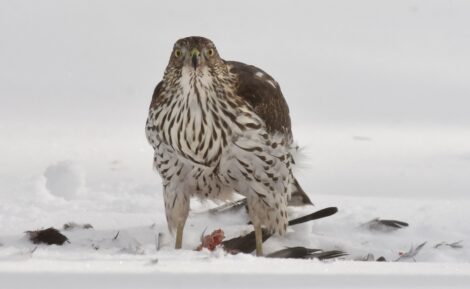
The end of the year brought about a number of new birds that either made the Christmas Bird Count or the Count Week in Marquette. A tufted titmouse was reported by several east side residents at feeder stations but was not seen on count day. A lark sparrow, a southern vagrant did show up at a feeder in north Marquette and did make the count as did a large flock of bohemian waxwings seen at Presque Isle and several pine grosbeaks that had dropped down from Canada. The waxwings and grosbeaks brought back memories of the winter of 2021-22. A Cooper's hawk topped it all off with sighting all through the week. In eastern U.P. a quartet of snowy owls appeared on the Pickford-Rudyard Loop repeating the appearances of owls there last winter. Although there were considerably more there last winter, the season is still developing so more be on their way.
This winter has seen many similarities to last, especially in Marquette, and in this first week of January yet another returning bird, a Townsend's solitaire also appeared in town, making it look like another good birding year.
EDITOR'S NOTE: Scot Stewart is a teacher at Bothwell Middle School in Marquette and a freelance photographer.