
What’s Flying: Bird count should be interesting
Trending
"How many lessons of faith and beauty we should lose, if there were no winter in our year!" – Thomas Wentworth Higginson
The Upper Peninsula has worked through many issues this fall to approach winter in a civil way. The western counties have borne the brunt of the early storms, with several feet of snow already. Except for those who love several feet of snow for six plus months, the warm spells wedged in between these storms have served as a welcome way to keep the blanket on the ground at a manageable level. Thursday's storm seemed totally unsure of its responsibilities as the snow came wet and heavy, willing to pack and even melt a bit as it fell in most locations. Freezing temperatures this weekend are sure to put a hard polish on the current layer, making it more challenging for ground feeders like snow buntings to forage, and tough for owls trying to dive into that snow to pluck mice and voles from beneath.
Tomorrow is the Marquette Christmas Bird Count. After some worry about ice build-up in the Lower Harbor, the favorable winds and warmer temperatures have cleared most all of it, out leaving a promising bay of open water for waterfowl. On Monday single hooded, red-breasted mergansers, seven common mergansers, eleven long-tailed ducks., three lesser scaup, seven golden-eyes, a white-winged scoter, and a red-necked grebe were seen there during the day. Two different observers saw some of the same birds and just some of the others just an hour apart, showing why several checks during day the count and take the high number for the day for each species. The large gull flock will also get many thorough checks for vagrant iceland, glaucous, lesser and great black-backs that have shown up in some past counts. Several other gulls will also be sought with wistful hopes – slaty-backed and ivory gulls, two that have been very rare visitors to Marquette in the past.
The movement of waterfowl in Lake Superior along the shore is quite fluid, especially if there are changes in the weather and systems moving through the Great Lakes, so monitoring the birds on the water around the breakwall and ore dock can be quite interesting to watch during the day. The edges will also be watched for a possible arrival of a snowy owl or two also. They often show up along the Lake Superior shoreline hunting small ducks, rabbits, and mice along the water's edge.
In year's past, the possibilities for owls in Marquette were fairly limited, with snowy owls and resident barred owls most likely. Recently though, the population of great horned owls has noticeably grown. They should make the sighting list tomorrow in Marquette too.
Marquette is not the only place where lots of waterbirds can currently be found. The bays of Munising and Gladstone have been equally fluid this week too. Munising has seen a nice variety, including American coots, redheads, long-tailed ducks, and two common loons. Two great places for watching ducks and other waterfowl there are at the mouth of the Anna River and at Bayshore Marina at the west end of town.
In Little Bay de Noc off Gladstone hundreds of ducks are still residing. On Wednesday more than 600 mergansers, goldeneyes and buffleheads were observed. The mild conditions seem to have encouraged ducks to continue on in the area, possibly reducing the feeding pressure in their winter ranges by arriving later. This follows an even bigger set of rafts of 850 common goldeneyes and mergansers seen farther north off Peninsula Point on the Stonington Peninsula December 8. These ducks will eventually move farther south to the bottom of Lake Michigan and into Lake Erie even farther south where open water will should continue.
Waterfowl can really increase the number of species counted for their area. Feeding stations can also add a good number of species at one site. At feeders on Presque Isle, four species of woodpeckers, red and white-breasted nuthatches, chickadees, blue jays, crows, American goldfinches, mallards, and even wild turkeys and bald eagles overhead can be added in half an hour or so. Marquette will be shooting for around 50 or so species. Fifty-six is the record for the Marquette CBC count
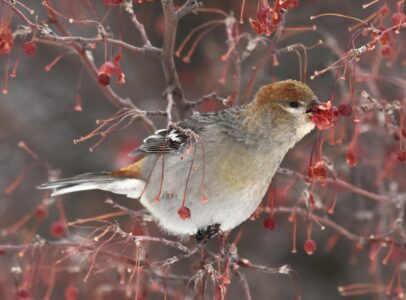
Bohemian and cedar waxwings, pine and evening grosbeaks have all been reported across the Upper Peninsula in the past two weeks so counters will be checking crab apple and mountain ash trees in town and to winterberry bushes along wetland edges like Harlow Lake. Counts in the eastern U.P., especially near Drummond Island, Rudyard, and Pickford still look good for at least one snowy owl or two, sharp-tailed grouse, and rough-legged hawks. Counts in the eastern U.P., especially near Drummond Island, Rudyard, and Pickford still look good for a snowy owl or two, sharp-tailed grouse, and rough-hawks. Keweenaw County birders are hoping for the large numbers of bohemian waxwings, a dozen robins robins, and a red-winged blackbird.
Birders living inside a count circle, but not able get out can conduct a feeder count and report their findings to the local count coordinator and have their species and numbers included. For information on the Marquette, Gwinn and AuTrain CBC check the Laughing Whitefish Audubon website at https://laughingwhitefishaudubon.com/lwas-events/bird-counts/ . For information on the other 13 CBC's in the U.P. and those across the country, check the National Audubon CBC webpage at https://audubon.maps.arcgis.com/apps/View/index.html?appid=ac275eeb01434cedb1c5dcd0fd3fc7b4. Join in if you can for a great social day and a chance to see some great birds.
EDITOR'S NOTE: Scot Stewart is a teacher at Bothwell Middle School in Marquette and a freelance photographer.