
What’s flying
Waiting on April sun to bring its warmth
Trending
"Shining through tears, like April suns in showers, that labour to overcome the cloud that loads 'em." -- Thomas Otway
Sometimes in April those showers are made of snow in the Upper Peninsula. And so, it is this year! Luckily the weekend will dispense with most of the whitish portion of those showers and begin to get the U.P. again on track on the journey towards Spring. What better way to improve residents' resolve, perseverance, and patience! In the meantime, there are maple sap buckets to empty, tulip shoots and skunk cabbage to search out, and snow piles to be slowly moved to the streets in small shovelfuls in the warming streets. Remember, those shovelfuls must be small!
Birders have much to keep them busy. They need to keep up with some great birds that continue to linger in the area because conditions have apparently improved enough to urge them on. A snowy owl still occasionally pops up rather erratically between Washington Street and the by-pass in Marquette. It does appear to be the same owl that has been seen in the area since mid-November. A Townsend's solitaire was seen on campus in Marquette last week also. This may be one first seen in Marquette around the first of the year off Wright Street near the Dead River. Common redpoll numbers do seem to be dwindling in Marquette but some sizeable numbers, in the 30-50 range are still showing up at some area feeders.
Birding reports and birders traveling north from the Chicago area have reported signs of migration stalling to the south. With many ponds still at least partially frozen over to the north of Green Bay waterfowl movement has been limited to mostly diving ducks heading north. Even Big Bay de Noc is still mostly ice covered north of Green Bay. Some ring-necked ducks and scaup have moved with buffleheads, sticking to the big lakes but most dabblers are still far to the south.
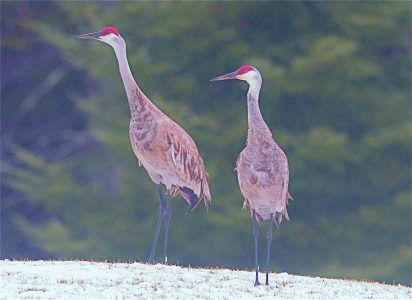
Even sandhill cranes are difficult to come by so far, even though the official North American count will be held tomorrow. Just a handful have been seen and heard so far this spring in Marquette County, and only four have been counted at Whitefish Point as of Wednesday so far this spring. Few have been reported through northern Wisconsin as well, so it is not a big surprise as the ground through much of the area is still frozen and in many places still snow covered. This makes it nearly impossible for them to find.
Since the Hawk Count started at Whitefish Point Bird Observatory in Chippewa County, only 34 species have been added to the official data so far, with only 552 individuals as of Wednesday. Highlights continue to be mostly Great Lakes wintering birds heading north, like white-winged crossbills, common redpolls, bohemian waxwings, and snow buntings with a few bald and golden eagles to spice things up. Other migrants include some robins and hawks.
More expected migrants are arriving in the area though. Red-winged blackbirds had hit some area feeders, and more than a dozen have shown up near a feeding station along the Dead River off Schneider Mill Court. Hard to know if the few robins in the central U.P. were ones that spent the winter in the area, but hundreds are feeding in yards in northern Illinois. Robins usually follow the 36oF soil temperature gradient in the spring, giving them access to a thawed surface and the invertebrates the ground provides.
The best "migrant" so far in Marquette though has to be a leucistic bald eagle. Leucistic individuals lack pigmentation in parts, but not all of their body covering, skin, hair, feathers, or scales. Not true albinos, they have some areas of natural coloration and usually have pigmented pupils. A nearly all white bald eagle was seen in southern Marquette, near Arnold, late last week, and another, probably the same one, was spotted on a lake in northern Marquette County near Big Bay this past weekend. Both were white, with some brownish coloration to the undersides of its wings. At the latter site it was seen flying and roosting with four other bald eagles and feeding on deer carcasses. The leucistic individual was seen at least once flying with an immature bald eagle in courtship-like maneuvers. Since it had only been at its current location a few days as of Wednesday, its future will be quietly monitored to see it does stick around or continue on northward.
Other soon to arrive migrants like song sparrows, killdeers, American woodcocks, turkey vultures, and yellow-bellied sapsuckers are beginning to show up in a few spots, but the weather forecast is not too promising yet. It looks like mostly 40- degree temperatures again next week, and does not bode well for robins, cranes and woodcocks that need plenty of warm ground and for insects the phoebes, wrens and tree swallows will need.
On that note, it is clear birders will definitely have to be patient, even if there is a brief warm-up, because a prolonged cold stretch and late snow can make it extremely difficult for early arrivals several years ago following an extremely warm month of March. A very cold, snowy April seemed to decimate the numbers of a large list of birds like wrens and swallows that summer, and that can have an amazing effect on the numbers of insects with fewer birds to eat them. Let's hope that April sun brings its warmth soon!
EDITOR'S NOTE: Scot Stewart is a teacher at Bothwell Middle School in Marquette and a freelance photographer.