
Trending
"The spring air just on the cold side of perfect, the late-afternoon light heavenly in its hurtfulness." -- John Green
It is April in the Upper Peninsula, after all, but hope always runs high as the snow slips away, the days should be running off to spring. Nature most often seems to have other ideas. As is natural in human behavior, people look around to see what others have. Birders look south to see what is coming, what is waiting and who is still far off.
In Wisconsin wetlands along the shore of Lake Michigan north of Green Bay thousands of diving ducks -- scaup, ring-necked ducks, canvasbacks, redheads, buffleheads, and common goldeneyes along with hundreds of tundra swans have arrived. They have been resting and feeding in the shallows as they wait for warmer conditions before continuing north and west.
Duck diversity continues to be stagnant on the Dead River above the Tourist Park. Mallards, American black ducks, common goldeneyes, and hooded mergansers have continued to be joined from time to time by trumpeter swans and more Canada geese, but little else. Mallards are clearly paired up for spring, and some mating behavior has already been observed.
Near the mouth though more duck species have been seen as the waters have opened up. Lesser scaup and ring-necked ducks have joined hooded and common mergansers and the other winter residents. An early pied-billed grebe was seen there this week too. The broad waters of the lower Dead, referred to by birders as the Dead River Marshes, has been an increasingly great place to see a wide variety of spring migrants, including more unusual spring species like the grebe, American coots, northern pintails, American wigeons, blue and green-winged teal.
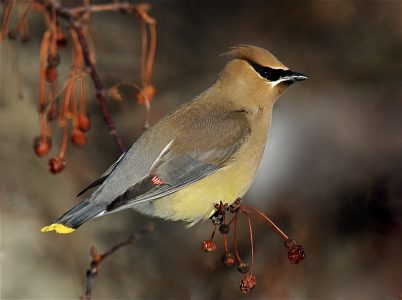
In Marquette a good number of winter birds continue as they too wait for better conditions before they too head north back to their summer ranges. A few snowy owls, rough-legged hawks and northern shrikes are still being reported in the eastern Upper Peninsula. The snowy owl seen near the by-pass in south Marquette this winter and again recently was seen irregularly earlier this week. Common redpolls are still crowding around many feeders in Marquette as they wait to head north. Bohemian waxwings have been joined by early cedar waxwings and have been attacking both crab apples and even some soft apples hanging from trees on the north end of Marquette.
Gull numbers have continued to build in Marquette with more than 650 counted earlier this week. As the ice around Picnic Rocks has diminished this past week many gulls have moved from there to spend afternoons in the Lower Harbor where they have rested mostly on the ice, but also on harbor rocks and old dock posts. A few glaucous and iceland gulls have continued to be seen in the flocks.
With the mostly wintery weather migration has been relatively slow at Whitefish Point in Chippewa County. Hawk and other raptor counts https://dunkadoo.org/explore/whitefish-point-bird-observatory/hawk-count-spring-2022 have reflected some movements of both golden (9 for the season so far) and bald eagles. As of Wednesday, thirty-two species had been included on the official daily counts, including red-tailed, rough-legged, red-shouldered, sharp-shinned hawks and American kestrels. Most of the other species were winter residents except sandhill cranes and red-winged blackbirds.
In Marquette, one new development sure to change the birding scene a tad this summer is the installation of a peregrine nesting box on the top of the hospital off the by-pass. This may have altered the movements of the snowy owl that has been seen there, as a pair of peregrines has already arrived, scouted out the site and appeared inside the box. Peregrines and snowy owls typically do not get along well, and several videos have been posted in recent years of visiting owls being divebombed by peregrines along Lake Michigan.
When peregrines nested at the Shiras Steam Plant, they were regularly seen hunting along the bike path parallel to Washington Street in Marquette, where there are usually plenty of rock pigeons, European starlings, and other birds during the summer, so peregrines should be quite visible along that route. When both power plants were operating in the city they each had nesting boxes, and two pairs of peregrines were able coexist in the city limits. Last year a pair did apparently nest on the north side of town, so it will be interesting to see if two pairs nest again in town this summer.
One happy arrival in Marquette and a number of other locations in the Upper Peninsula is song sparrows. These are usually the first of the sparrows to return to the area, and while there is still snow on the ground. They truly live up to their name, beginning to sing almost as soon as they arrive, and continuing on throughout the summer months. They are usually one of the last to stop at summer's end. Because they often nest right in town they are a welcome addition to the morning chorus.
A fair smattering of robins has also rolled into the area and in some places, like Gladstone, they too have begun singing. As the weather does finally warm, house finches, mourning doves, cardinals, chickadees, and nuthatches will add more of their notes to the morning music and remind us yet again of the power of the sun -- the angle, brightness and newly found warmth will be sure to bring a rise to the spirits of birds and man.
EDITOR'S NOTE: Scot Stewart is a teacher at Bothwell Middle School in Marquette and a freelance photographer.