
Trending
"You can't get too much winter in the winter."- Robert Frost
Winter continues to bear down on the Upper Peninsula with much colder temperatures and some regular LES. Yes, lake effect snow. It is an entertaining to watch all the new acronyms developing as the world attempts to abbreviate everything to deal with short attention spans. But the weather has definitely provided a greater challenge to wildlife in the area.
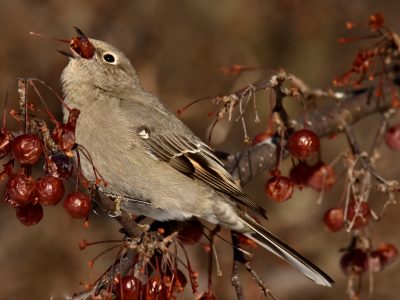
The Townsend's solitaire seen in north Marquette this month has continued there, spending most of each day in a pair of crab apple trees. In its remarkable time there each day it has sat either in one of the trees, or on one of a couple of wooden shrines between periods of time feeding on the fruits in the trees. The trees stand in a large opening exposed to the winds. With the low temperatures and recent wind chill reading the solitaire's presence feeding there has been a testament to its durability and resiliency, feeding almost exclusively on the crab apples on the nearby trees.
Spending time with a durable new "friend" over a few weeks in winter provides insight into its routine and how it has kept going. Wintertime hosts a different period for most birds. Unlike summer when most birds are holding tightly to their nesting territories, feeding "close to home" and frequently perching close to nest site, in winter most birds are foraging over areas large enough to provide the energy they need.
Solitaires are a bit different though. During the warmer months solitaires feed mostly on insects and spiders in the summer range, even doing some flycatching from treetops. In winter they switch over to a diet primarily consisting of cones and fruits. In the west, and some locations in the east if they become winter migrants, they zero in a group of juniper trees with mature fleshy cones, and aggressively protect their claim until the cones are gone. Other winter berries in their diet include serviceberry, hackberry, currents, elderberry, winterberry and here in the U.P. mountain ash and crab apples.
Solitaire digestive systems work in a way similar to those of grosbeaks and waxwings, working quickly to extract low amounts of fats, proteins, and carbohydrates from the fruit, so they must eat frequently. Some estimates predict solitaires can eat 40,000 to 80.000 juniper cones and berries in a single winter. The solitaire here has picked at crab apples partially eaten by pine grosbeaks or swallows whole fruits, two to four at a short session, then has paused to swallow and begin digestion.
On sunny days it has sat facing the sun or on wooden structures radiating small amounts of heat, especially in spots out of the wind. It does leave the crab apples trees occasionally, especially when flushed by loud vehicles and has flown to large oaks nearby. At night it has gone to a stand of large white pines near the Dead River ostensibly to roost in the shelter of the conifers out of sight and out of the night winds. With the large flocks of bohemian waxwings in the area recently and multiple groups of hungry pine grosbeaks all across the U.P. it seemed unlikely the four crab apple trees where the solitaire has spent most of its time would hold out for it, but they have kept the solitaire fed. With the even colder weather, it will be interesting to see how long the bird remains there.
Currently pine grosbeaks and common redpolls seem to be spread out across most of the entire U.P. Most mountain ash trees in Marquette have been stripped of their fruits, with the few remaining on trees near busy streets like Washington. Many crab apple trees are currently looking the same, with several flocks of about a dozen grosbeaks and some smaller flocks hitting those fast. For the redpolls, thistle and sunflower feeders are seeing plenty of visitors. Regular winter residents are also hanging out around feeding stations to keep their metabolisms going. Red-bellied woodpeckers have joined hairy and downies at feeders more to in an effort to get more food. Even a family of red-headed woodpeckers have been making regular visits to feeders in Gladstone.
Red-bellied woodpeckers are one of the few birds actually expanding their range northward, like northern cardinals. Red-headed woodpeckers have been quietly disappearing from the Upper Peninsula as their habitat has changed and starlings have pushed them out of the rare nesting sites they have had in many areas where habitat is good. A family of red-headed woodpeckers was prominent on the north side of Gladstone this past summer and apparently, they elected to stay for the winter. Four are currently being observed there.
Over in the eastern U.P. birding has seen similar trends, with lots of pine grosbeaks and common redpolls, plus mergansers and common goldeneyes in the open waters. Twelve bald eagles and 18 common ravens were found at the Dafter landfill last Tuesday. Some large flocks of snow buntings and sharp-tailed grouse have also been seen between the Soo and Rudyard. In Delta County, 400 bohemian waxwings and handful of cedar waxwings were seen in Escanaba last week, but they have become scarcer across the area in recent days.
With the colder weather full feeders, especially in groups with a variety of suet, thistle, sunflower seeds, and peanuts, to accommodate larger flocks can provide a good site for larger flocks of hungry birds and plenty to watch. For those braving the cold, the outdoors can provide plenty to watch with good friends.
EDITOR'S NOTE: Scot Stewart is a teacher at Bothwell Middle School in Marquette and a freelance photographer.