
Trending
"Winter forms our character and brings out our best." -- Tom Allen
Winter seems to be finally landing and the Upper Peninsula and the landscape shows signs the new season is all in. The Dead River Marshes is a place described by birders just west of the Lakeshore Boulevard bridge on the Dead. It has developed the character of winter with plenty of ice and has been a great spot to see bald eagles and other birds looking for patches of open water and food. Last week an eagle stopped in the middle of the Dead River on an uprooted tree. At the other end of the root complex was a snowy owl. Eagles have been seen there several times since.
Mallards staged an unusual feeding event last Tuesday at the edge of Picnic Rocks parking lot apparently drawn into the shallow snow by the bumper crop of acorns dropping from the oaks. This was on the day after the thermometer dropped to just a scant bit above zero. The mallards have spent a fair amount of time coasting in the waters around Picnic Rocks this fall and somehow discovered the acorns in the grass there. It's the carbohydrates in the acorns the ducks seek. In some areas acorns are found they become a major food for ducks in fall and early winter, they just have to beat the squirrels to them.
Snowy owls have also been present at Picnic Rocks too, actually on the Picnic Rocks. They have also been seen this past week at Presque Isle near the marina, near Hawley Street, and continuing on the rocky portion of the Lower Harbor Breakwall. In Marquette near Hawley Street on Dec. 7 one was spotted on a residence near the corner of Washington and Lincoln streets acting very presidential.
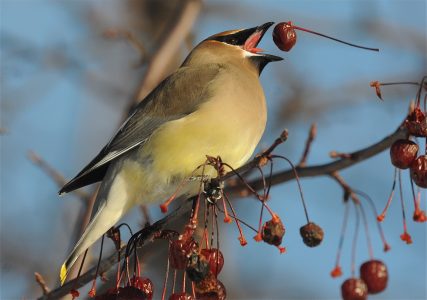
The big snowstorm last Sunday chased some birds to local crab apple trees on Hawley Street too. Just a couple blocks from Lake Superior nine American robins and five cedar waxwings dipped in and out of a crab apple on Hawley through the blowing snow Sunday afternoon. In typical fashion, both species grabbed a couple fruits, swallowed, then headed back up to greater safety in the large willows across the street to digest, before returning for more -- carbohydrates.
Robins in Marquette in December are not unusual. Although it is not certain where they have spent the summer, there is usually a stretch of time in the late fall when few or no robins are seen before a few late flocks seem to appear. Some of these flocks are around for a day or two and then they continue south.
There are usually a few robins around until the end of the year when weather gets more severe and then they are gone. Occasionally one or two may brave it out for the entire season.There are large numbers of crab apple trees in Marquette to tide them over until weather warms, and a few have even found a cozy spot like a sheltered corner of the Marquette County Courthouse next to the county jail where they are close to food and out of the wind. Waxwings, like robins, also migrate south for the winter but some flocks also hang around some years. Feeding on mountain ash and small crab apples, occasionally joining bohemian waxwings migrating here from the Rockies and Canada.
It always seems puzzling why some crab apple trees are visited immediately when robins, waxwings, pine grosbeaks and other fruit eaters arrive in early winter. Fruit size definitely plays a part. Robins and waxwings prefer smaller fruits they can swallow whole, grosbeaks can bite into the larger fruits. Later in winter all of these species may turn to whole apples still clinging to trees, soft and sweeter from freezing and thawing several times as last resorts before the ground thaws, new buds start to open and other springtime foods appear.
I may seem odd to refer to the robins so formally -- American robins, but like chickadees, goldfinches, goldeneyes and the waxwings, there are related species, usually from other parts of the country, and only can be rare visitors or unusual local cousins, and birders do like to know when they do make it to the area and only know if their full names are spelled out or announced.
One rarity for this time of year, an orange-crowned warbler, is still hanging out along Whetstone Creek at Founders' Landing. First seen during the last week of November, it was still being spotted on Dec. 6. Off shore 14 common goldeneyes, a horned grebe, and a dozen long-tailed ducks were still plying the Lake Superior waters.
Just a week or so away now from the start of the area's Audubon Christmas Bird Counts. Marquette's will be on Saturday, Dec. 18, when counters will be in the field before dawn in search of calling owls and organizing the four quarters of the 7.5-mile radius count circle at 8 a.m. at Mattson Park. Feeder counters can start early too and count until midnight. There is also a count week to catch rarities and other unusual birding events. Contact Melinda Stamp at
mstamp@mstamp.net or check the national circle map, http://www.upbirders.org/cbc_mqt_feeder_form_10.pdf to see if you are in a count area.
There are a total of 17 announced U.P. counts https://audubon.maps.arcgis.com/apps/View/index.html?appid=ac275eeb01434cedb1c5dcd0fd3fc7b4 that include one at the Mackinac Straits and one covering both sides of Sault Ste. Marie. The contact, location and date information are can be found by clicking on the individual circles on the map.
Be a character and get out to enjoy all winter has to offer!
EDITOR'S NOTE: Scot Stewart is a teacher at Bothwell Middle School in Marquette and a freelance photographer.