
Open-air classroom
ND’s school forest more than revenue
Trending
FELCH TOWNSHIP -- Some of the learning spaces at North Dickinson County School District have no walls or ceiling.
But they do have trees. Lots and lots of trees.
The district maintains about 1,000 acres of school forest, parts of which date back almost a century, when the Kimberly Iron Company sold 40 acres for $1 to the Felch School District in the early 1930s.
Those tracts generate revenue for the district through periodic tree harvests. North Dickinson gains the additional benefit of having a ready source to feed the wood-fueled boiler that heats its school building.
But these extra funds are perhaps secondary to the forests providing a natural setting for teaching about conservation, studying the different habitats on those lands -- or simply getting students into the outdoors, said Darrell Oman, director of support services at North Dickinson County School.
"The properties," Oman noted in news release, "provide students with a hands-on laboratory."
The school has taken field trips to the larger forest parcels. Students have walked the trails and even snowshoed in the winter.
And they've planted tens of thousands of trees, said Chris Mattson, who teaches science, including environmental and biology, at North Dickinson.
"It gets them outside the school and into nature," Mattson said of having classes visit the school forests, adding, "we live in an area where we have a lot -- and sometimes we take it for granted."
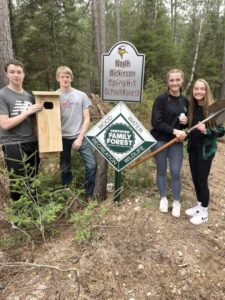
He also is the woodworking instructor at North Dickinson, so has had his students build nesting boxes for ducks in the school forests. Coordinating with the Dickinson County Chapter of UP Whitetails, they've done habitat enhancements such as planting apple trees.
Mattson promotes cleanup chores as well -- the forests have roads and trails that get used, with some visitors being careless about toting out what they bring in -- as part of that stewardship role.The school forests, he noted, are a natural fit in an area where many families derive their income from the timber industry. Both Sagola LP and Sagola Hardwoods are in the district, along with private logging companies.
North Dickinson is far from alone in having a school forest. They're common in the region, on both sides of the Michigan-Wisconsin border. Neighboring Forest Park Schools in Crystal Falls has more than 2,000 acres, the largest school forest in Michigan, said Brock VanOss of VanOss Forestry Services LLC in Crystal Falls. He developed a stewardship plan for Forest Park and assists that district in managing harvests on their forest land.
But North Dickinson does have the distinction of having the state's earliest school forest management plan, VanOss said. Written in 1932, with a white birchbark cover, it's still on display at the school.
That plan dealt only with the former Felch school forest, which eventually grew from 40 to 440 acres. Some of the other additions came when North Dickinson was formed by combining the Felch and Channing districts in 1966. The district also includes Breen Township, which had a school forest as well.
In all, the district now has four forest areas: the 470-acre Spring Hill tract near Norway Lake, 360 acres on Turner Road outside Channing in Sagola Township, 40 acres behind the hotel in Sagola and a pair of 2-acre parcels near Randville. They feature not just hardwood and conifer forests -- with at least 52 different types of trees -- but wetlands, rock formations, different minerals and other types of ecosystems, VanOss said.
Over the decades, students and staff have planted and tended trees on the school properties, in some years harvesting cones to raise seedlings in a nursery, Oman said. Both the Felch and Sagola forests once had cabins used by the schools and other local groups. Students and staff would have overnight forestry field trips at the Felch School forest cabins, hunting small game they would have for supper in the evening, Oman said.
That plan last was updated in 2015, using a state Department of Natural Resources grant to pay part of the costs and the Dickinson County Chapter of UP Whitetails and the Louisiana Pacific Foundation covering the rest, Oman said.
The school district has a commission, headed by Oman, that oversees use and management of the forest, guided by the stewardship plan.
"It's our compass," Oman said.
A North Dickinson alumnus, VanOss has provided his services for free to his former school. He's a major advocate for school forests, part of the reason he recently was honored as Michigan's 2023 Stewardship Forester of the Year. For more on that award, see the spring 2023 Logging Today section inside today's newspaper.
The many roles they can play in education, plus providing revenue for the schools, without having to pay taxes on the land makes setting the forests up a good investment for districts, VanOss said. He estimated Forest Park has earned $1.2 million from timber sales over the years.
A harvest in the North Dickinson school forests may bring in up to $15,000 to $20,000, money that has paid for new textbooks, Oman said.
But both again stressed the importance of having these "outdoor classrooms." VanOss noted an event several years back when Forest Park shuttled almost the entire student body to its school forest, where 16 educational stations had been set up on topics ranging from invasive species to a simulated heron rookery.
Some North Dickinson activities at its school forests had to be halted during the pandemic, Mattson and Oman said, but they hope to get students out there this spring.
"We try to utilize it as much as we can," Mattson said.
These forests so benefit the districts that VanOss suggested the public consider helping expand their local school's acreage.
"If anybody's looking to donate land," VanOss said, "that would be a great place to do it."