
What’s Flying: Grab a coat and get out there
Trending
"If April showers bring May flowers, do May flowers bring snow showers?" - Anonymous
The season is like an old car that just won't go. Must need a new starter, or something. Warmer, sunny days have been precious so far this spring in the Upper Peninsula. Even Whitefish Point has shown mostly slower numbers of spring migrants this past week with most daily totals for individual birds species in lower double digit. The exception is for sharp-shinned hawks again this week with two days over the weekend with over 1000 hawks daily!
Things have picked up in Delta County, especially on the points jutting into Lake Michigan. The Portage Point Marsh has been a great place for diversity and some good numbers too. Fifteen species of ducks were found their last Saturday along with a lone snow goose and a half-dozen trumpeter swans. They included both dabblers and diver, all in single or double digit numbers too. The single snow goose, a blue phase, was seen there over several days with mostly grayish blue plumage.
A pair of female Wilson's phalaropes was also found in the marsh there. Phalaropes are smaller members of the sandpipers, found mostly in the ponds of the western states in summer, but do spend summers in lower Michigan and southern Wisconsin. They are unusual in a number of different ways. Females are more colorful, with a darker rust tint in their necks, throats, and wings than males and darker backs and wings. After laying eggs, a female will leave the nest duties to the male and move on to find another male and repeat the process. In fall, they are one of only two species to stop during migration to molt into fall plumage. Their winters are spent in western South America and across most of the southern half of South America.
Th highlight of this past weekend at Portage Point though was a one-day appearance by a ruff. Although an extremely rare bird in North America – with just a couple seen in the Great Lakes Region in the past few years, a million may all end up the Senegal National Bird Sanctuary during the winter in western Africa each winter.
Ruffs are definitely a different bird. Males have a great ring of feathers around their necks they can erect to make "ruff". They can also be rough, getting into tussles with other males at display grounds. Most striking is their plumage. Studies have found over 1,800 different variations of their plumage, especially their ruffs. Those can be bright white, like the one seen at the Portage Marsh, to brilliant rusty brown. A good number of birds go word of its appearance and rushed to the marsh that day and got a chance to see it right into the early evening. Unfortunately, it was gone the next morning.
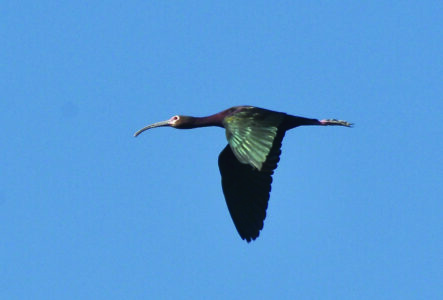
Early Wednesday morning another great "pretty sure" sighting came just east of Rapid River at the top of the Stonington Peninsula. A flock of probable white-faced ibises was seen in flight. Inflight birds, busy traffic, and other conditions can often make birding by car, especially of moving birds difficult and no further sightings appearing right after the sighting.
Ten American white pelicans were seen in the same area this past Monday too. The Upper Peninsula gets two chances to see pelicans each spring. Some migrate north from the Gulf Coast and may get gently pushed off course by strong winds or storms on their way to the potholes of the Prairie States and Province and end up at sites east of their normal summer range.
The second chance or chances come from young, mostly non-breeding pelicans wandering from their summer breeding area near the mouth of the Fox River in Green Bay. In the past 20+ years the summer population has increased dramatically to around 4000 pairs there. During the summer pelicans usually at the age of three to five years begin breeding for the first time. The "teenagers" just hang out in that part of Lake Michigan but sometimes start wandering around the northern part of Lake Michigan. Some of that exploration may help younger pelicans scout out potential nesting sites for future colonies and wander even further north to Marquette and other sites north of Lake Michigan. Frequently in small flocks, pelicans are easy to identify in flight, with large white bodies and black tipped wings. They flight pattern though makes it even easier. The frequently glide, circle and move in a synchronized pattern, like fish in a school.
Migration arrivals at Peninsula Point, at the southern tip of the Stonington, are beginning to pick up as well. On Wednesday a birder spent four hours there and picked up 47 species. Sighting included 100 blue jays, four species of hawks, a brown thrasher, two blue-gray gnatcatchers, five species of sparrows, and five species of warblers, including Nashville, pine, yellow-rumped, black-throated green warblers and a northern parula.
A wide variety of sparrows and both lesser and greater yellowlegs are appearing in larger numbers all across the U.P. A nice group of eight yellowlegs, both species, was seen on Monday at a small pond just south of Co. Rd. 480 in Chocolay township. Farther down the same road a flock of five sandhill crane was also seen.

STEWART
A white-faced ibis takes flight. (Scot Stewart photo)
And finally, last Monday the first ruby-throated hummingbird was reported in Marquette. Six have also been added to the Hummingbird Migration Map this month. It is still not the best time for them to appear in most of the U.P. but there have been some fair insect hatches already and a few willow, cottonwood and red maple flowers opening to attract insects and hummingbird. Grab a coat and check it all out.