
‘Conversations and Coffee’
Fisheries biologists talk with public

This young boy shows off a crappie. Michigan Department of Natural Resources fisheries staff says crappies are becoming more common in many lakes. (Photo courtesy of the DNR)
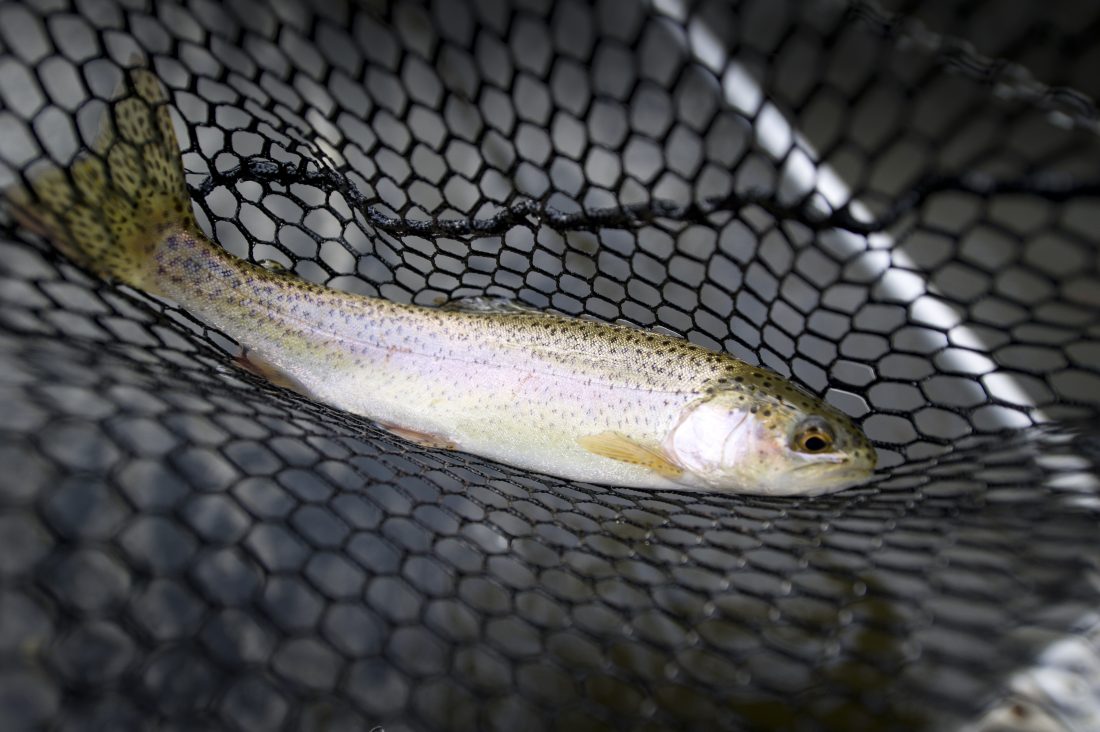
Rainbow trout are a popular and carefully managed fish species in Michigan. The species was a topic of discussion at Tuesday’s virtual “Conversations and Coffee” event sponsored by the Michigan Department of Natural Resources. (Photo courtesy of the DNR)
This young boy shows off a crappie. Michigan Department of Natural Resources fisheries staff says crappies are becoming more common in many lakes. (Photo courtesy of the DNR)
Rainbow trout are a popular and carefully managed fish species in Michigan. The species was a topic of discussion at Tuesday’s virtual “Conversations and Coffee” event sponsored by the Michigan Department of Natural Resources. (Photo courtesy of the DNR)
Trending
MARQUETTE -- Fisheries regulations and invasive species control evolve over time, and those issues and others were discussed at Tuesday's virtual Conversations and Coffee.
Michigan Department of Natural Resources biologists talked with the public about fisheries management, focusing on the Western and Eastern Lake Superior Management Units.
The annual Conservations and Coffee events allow communities to ask questions about topics that concern them, and allow fisheries officials to provide updates and reports.
One of the topics brought up dealt with crappies, a popular panfish.
"With the warming of our lakes, we're seeing more of what we call centrarchids -- the panfishes -- which include crappie," said George Madison, biologist with the Western Lake Superior Management Unit.
Madison said crappies, which have a "tremendous mouth gape," are piscivores that eat juvenile walleyes and other gamefish.
"Langford Lake in Gogebic County is a good example," Madison said. "It was one of our best walleye lakes. Crappie became firmly established in there, and dominated that lake, diminishing the walleye population. We're seeing similar effects in the Lac Vieux Desert flowage.
"We are looking at crappie only in the relation of their competition with other piscivore fishes -- fish that eat fish -- so that would be walleye, pike and bass and your other top gamefish."
It wasn't always this way.
"It's interesting -- 20, 30 years ago, a person found a good crappie lake, it was like finding a morel mushroom patch," Madison said. "You keep it secret, and you had great fishing. And now, crappie are just becoming present in a lot of lakes."
He said a survey of Lake Gogebic would take place this spring.
Cory Kovacs, biologist with the Eastern Lake Superior Management Unit, said the U.S. Forest Service is involved in many inland lake habitat projects that include large bundles filled with smaller brush that act like "crib" structures.
"Those are targeted for a lot of the panfish populations we have and black crappie populations," Kovacs said.
As crappies' range expand with warming in the region, more of these populations will thrive, he said, adding that they're "very adaptable."
Madison called crappies an "interesting fish."
"When you catch them, a 5- or 6-inch crappie, they're so thin," he said. "We used to laugh that you could almost see through them. There's just no meat on them. But up in the Portage/Torch waterway and then up in Lac La Belle, they get so big, the locals have given them the nicknames of 'hubcaps' because they're just as shiny as a Buick hubcap.
"These great big 12-, 14-inch fish -- you've have got a lot of shoulders on them, a lot of meat on them. They're quite an impressive fish at that size."
Madison also addressed splake, a hybrid of lake and brook trout, noting people have mixed feelings about the species.
"There's fear that they may be providing some competition or inter-aggression with some of our native fishes such as brook trout or lake trout, but they are well loved," Madison said. "They're a near-shore fish. Over here in Keweenaw Bay, you can catch them through the ice. Same with Munising and Copper Harbor. They're easy to catch and they taste great."
Madison, who pointed out that all Lake Superior splake are clipped, said the DNR urges people to report to the DNR where they caught a clipped fish, which will help the agency understand splake movements.
Anglers can report their catches to the DNR online or call local staff.
Kovacs said they also can report them at the Great Lakes Angler Diary, located at glanglerdiary.org, or its app.
Splake currently are stocked near Copper Harbor, Keweenaw Bay and Munising Bay, he said, with each of those groups of fish getting an individual mark.
Madison said officials hope to have a draft of the Lake Superior Fisheries Management Plan by fall.
Patrick Hanchin, DNR unit manager and Lake Superior Basin coordinator, said the DNR, as part of the Great Lakes Fishery Commission, cooperatively manages the Great Lakes with other states, provinces and tribes.
"There are some obligations to meet collective objectives," Hanchin said.
However, he noted the objectives are generally good, so that's not an issue for the DNR.
Madison acknowledged that people want to see more stocking of about every fish species, but the DNR wants to maintain a predator-prey balance to have healthy, sustainable lakes and be aware of what other management agencies are doing.
Invasive species work
The DNR announced on Wednesday that the Michigan Clean Boats, Clean Waters program has awarded $26,000 to fund aquatic invasive species education projects across the state this summer. One of the recipients was the Marquette County Resource Management Department, which will be installing Clean Boats, Clean Waters Decontamination Station signs at the Big Bay Harbor of Refuge on Lake Superior and at the Perkins Park and Campground boat launch and fishing pier on Lake Independence.
It will host boat cleaning demonstrations on popular days throughout the summer and will distribute educational materials at their park facilities and campground.
Some of the discussion in Tuesday's "Conversations and Coffee" centered on the DNR educating the public about invasive species.
Madison said its Aquatic Invasive Species program "fine tunes" itself annually to determine the most appropriate messages regarding invasive species, whether they be billboards, signs at boat launches, or handouts at sporting and fishing events.
Kovacs said Cooperative Invasive Species Management Areas partner with the DNR and help with education and outreach efforts.
"With the additional enforcement with our law enforcement folks, we have the word out there," he said. "We have folks looking at trailers and we have more opportunities. There's more funding."
For instance, Kovacs noted the National Park Service received funding for a boat wash at AuTrain Lake.
"These transportable, or mobile, boat wash units are something that are going to be pretty prominent here in the very near future," he said.
Regulation changes
The public should check out the new DNR Fishing Guide, particularly online, to see new regulations, which are highlighted in red.
The regulations include new rules for steelhead in the Carp and Manistique rivers. On the Carp from Morgan Creek downstream to Lake Superior, only one rainbow trout is allowed in the daily possession limit from March 15-May 15.
On the Manistique from the paper mill dam downstream to Lake Michigan, only one rainbow trout is allowed in the daily possession limit, also from March 15-May 15.
Kovacs discussed Marquette County's Big Trout Lake, which has been managed as trout lake since 1938 and stocked with rainbow trout since 1953.
However, 2017 and 2021 surveys combined to capture only two rainbows. So, DNR will cease management for rainbow trout in Big Trout Lake this year, he said.
"I think the lake is telling us it doesn't really want to have rainbow trout there," Kovacs said.
Instead, the lake will be managed for largemouth bass, black crappie, bluegill and brown trout, said Kovacs, who noted that the DNR plans to start stocking brown trout this year.
The DNR also proposes a change from the lake being a non-classified body of water to a type E lake, which would restrict the daily harvest to three trout of 15 inches or greater each, to keep the brown trout at a larger size and foster foraging opportunities for panfish.
Christie Mastric can be reached at 906-228-2500, ext. 250. Her email address is cbleck@miningjournal.net.