
Migrants integrate into German society
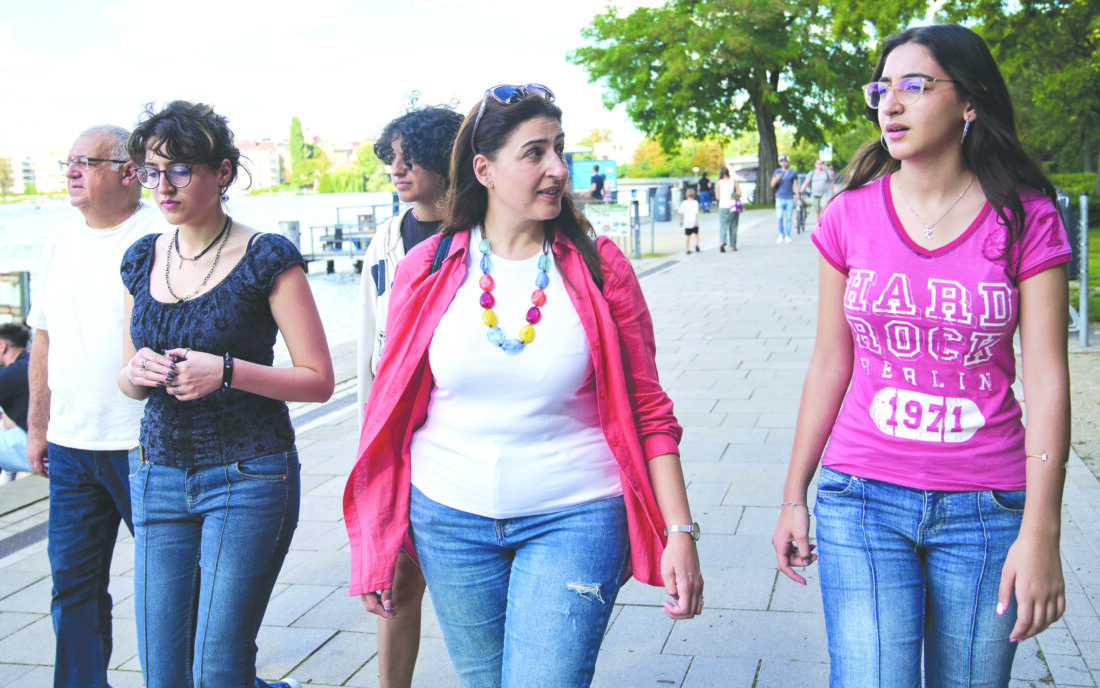
Members of the Wahbeh family, who immigrated to Germany from Syria, walk along a river in Berlin on Aug. 31. (AP photo)
BERLIN — Nearly a decade after fleeing Syria’s civil war, Rahaf Alshaar sat on her couch in a leafy suburb of Berlin sipping Arabic coffee spiced with cardamom.
When she, her husband and their three daughters arrived in Germany as refugees, they adapted quickly to their new country: learning the language, finding jobs and attending school.
“It was a lot of hard work, but I’m proud of what we achieved,” Alshaar, 44, told The Associated Press in a recent interview.
Earlier this year, the whole family became German citizens and bought a house with a nice garden.
“We are Germans,” said 52-year-old Basem Wahbeh, Alshaar’s husband.
Their family arrived among an influx of migrants from war-torn Syria, Iraq and Afghanistan who took refuge in Germany, peaking at more than 1 million in 2015. The arrival of so many asylum-seekers in a single year strained the country’s resources and brought consequences that Germany is still wrestling with a decade later, most notably the rise of far-right anti-immigration parties.
Even though the family’s integration into German society was a success, it was not without sacrifice. They and many others had to leave behind their homes, culture and language, sometimes shedding traditions dear to them.
Germany opens doors
On Aug. 31, 2015, as Europe faced what was by then being called the refugee crisis, Chancellor Angela Merkel opened Germany’s borders to migrants. Facing criticism at home and abroad, Merkel famously promised citizens that “we will manage it.”
Refugees were initially welcomed with applause as they arrived at train stations. German families opened their homes to put them up for months as overwhelmed cities struggled to find accommodation.
In a massive effort, schools and community colleges quickly created tens of thousands of “welcome classes” for children and integration classes for adults to help them study German, get a job and find a home in their new country.
“A lot of things worked out surprisingly well,” said Jonas Wiedner, an expert on migration from the Berlin Social Science Center.
Starting new life
Before the outbreak of Syria’s civil war in 2011, the Wahbeh family had a good life. He worked for many years at a company that made cookies, chocolate and juices while his wife raised their daughters. But as the war intensified, so did concerns about their family’s safety.
In December 2012, a bomb hit oldest daughter Rajaa’s elementary school while she was in class. She wasn’t injured, but the close call convinced them to leave.
“No more school. We have to leave,” Alshaar told her husband.
Alshaar and Wahbeh said the new beginning in Germany was difficult: They didn’t know the language, the winters were much colder than back home and the authorities initially did not recognize their university degrees.
Polarizing society
Anger over migration has propelled the rise of the far-right Alternative for Germany party, or AfD, which would be the second largest party if an election were held today, according to polls. Voters elsewhere in Europe have increasingly been empowering far-right nationalist parties that promise to restrict immigration.
“It is a highly contentious political issue and has repeatedly provided ammunition for the far right,” Wiedner said.
In a recent poll that asked how well Germany “coped overall with the influx of almost 1.5 million refugees between 2015 and 2020,” only 21% answered “good,” 41% said “less good” and 37% said “not at all.” The data were collected by Forsa Institute on behalf of RTL Germany from Aug. 22 to 25. They questioned 1,006 people and the margin of error was plus/minus 3 percentage points.
During Germany’s election campaign at the beginning of this year, AfD’s candidate for chancellor, Alice Weidel, called for closing the borders to undocumented migration and large-scale deportations of asylum-seekers, making clear she has no problem with the politically charged term “remigration.”
Morning UP

Fossils provide insight into earliest complex animals

Upcoming events at Peter White Public Library

We finally made it to Alaska!

NASA still puzzled by astronaut’s quick onset of sickness in space
Even long ago, U.P. weather could be rather fickle