
Dancing to good health
Trending
MARQUETTE -- You don't need exaggerated movements or the woman holding a rose stem in her mouth to enjoy performing the tango.
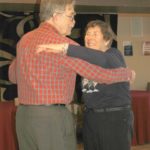
Participants in the Northern Center for Lifelong Learning's tango workshop simply learned a few basics, like the correct hold and body position.
Teaching the Monday workshop, which took place at the Dance Zone, were certified ballroom instructors Judy and Gilbert Martin of Harvey.
The married couple has performed a lot of tango, teaching dance in the Chicago area for a number of years before retiring to the Upper Peninsula.
The two taught the waltz for NCLL but focused on the tango this time around.
Seniors staying active through dance is something they advocate. Of course, it's good exercise, but as Gilbert Martin noted: "It's good for the mind."
Marge and Bill Sklar, owners of the Dance Zone, are two of those advocates.
"It'll stave off mental problems like Alzheimer's," Marge Sklar said.
She said dance also has been found to improve gait and balance as well as increase dopamine in the brain, which can aid people with Parkinson's disease.
"It's true for people who don't have Parkinson's," Judy Martin said. "It does all those same things."
Marge Sklar said that a few years ago, the New England Journal of Medicine published an article on how dancing improves the brain.
"Dancing has been shown to be 75 percent effective in holding off things like Alzheimer's, where reading and crossword puzzles and other kinds of things we can do are about 35 percent," Marge Sklar said.
Square dancing in particular is good for the brain, she said.
"You have to listen to the caller," Marge Sklar said. "You have to interpret what he's doing. You have to do it with seven other people."
As a result, dancing involves both physical and mental exercise.
"Learning new dance steps is one of the things that they say improves the brain, the body, the whole functioning system to keep yourself mentally and physically active at the same time," Judy Martin said. "And it's particularly important to learn new ones."
If a dancer performs the same three steps over and over, the physical exercise is gained but not the mental part, she said.
"It helps everybody, no matter what the age," Judy Martin said.
Variety is just plain good too.
"Some people like to do just one type of dance," Gilbert Martin said. "We had young lady call us and say, "I want to take a lesson in Viennese waltz.'"
He asked her if she had any experience, which she didn't, so the Martins taught her a Viennese routine.
"Towards the end, we realized that she was dancing on her toes all the time," he said. "You can't dance on your toes. You've got to be able to step on your heel."
Tango, though, was the focus on Monday. Marge Sklar provided this written definition of the tango, whose rhythm is denoted using 4/4 timing: "All forward steps are heel leads, side steps are inside edge of foot and closing steps are flat whole foot."
Foot placement in a closed position is slightly different from other rhythms. The right foot is placed a few inches back so that the right toe is level with the left instep to help hold the knees in a slightly flexed but firm position.
In the tango, each foot is picked up and placed deliberately, and the hold is compact with the woman farther into the man's right side. Bodies aren't allowed to go outside the feet, so there is turn but no flight or swing.
The Martins provided tips to the workshop participants as they took the dance floor.
Judy Martin talked about foot placement.
"They don't have to be tied up together, and the right foot is slightly back, and the knees are a little bent," she said. "Not real bent, but flexed."
The tips appear to have worked.
After one bit of advice, dancer Boli Soderberg, of Marquette, said: "That's much easier."
For people interested in dancing, the Dance Zone now runs Club Social to offer local residents a way to pursue their love of the activity. The club will offer the opportunity to learn and practice ballroom and social dancing in a friendly, comfortable format.
One or two dances a month throughout the year, for a total of 15 dances, will be offered, with the club including an annual gala featuring a local dance band. Regardless of their experience levels, members can learn dances like the rumba, samba and others.
Annual membership dues are $50 per person, and includes free admission to all Club Social events. Non-members may attend the dances for $5 per person for a regular dance and $15 per person for the annual gala.
For more information, contact the Dance Zone, located at 1113 Lincoln Ave., Marquette, at 906-236-1457 or visit www.dancezonemqt.org.
Christie Bleck can be reached at 906-228-2500, ext. 250.