What’s flying: Spring proves to be worth the wait
Trending
Knowledge is only one half. Faith is the other." – Novalis
Everyone knew Spring would make it here. It just seemed to take a little longer this year. After the last big snowstorm though it did seem to suddenly be making a lot more progress, ushering in the small leaves of aspen and maple, flowers, even hummingbirds!
The wet, heavy snow from last week was so dense it stopped plows on pick-up trucks. Luckily, like most May snows, most of it melted quickly. With some warmer temperatures and a sun just a bit higher in the sky, the green quickly returned to many lawns and fields, making hungry deer, woodchucks, and even a few bears happy.
New arrivals make it seem like the faucets of migration were turned on all the way. Some of the best indications of a big push this week can be seen in the daily tallies from Whitefish Point with the hawk counts, https://dunkadoo.org/explore/whitefish-point-bird-observatory/hawk-count-spring-2023 and the waterbird counts, https://dunkadoo.org/explore/whitefish-point-bird-observatory/waterbirds-spring-2023 . They provide a snapshot of some of the major waves of birds like broad-winged and sharp-shinned hawks, blue jays, sandhill cranes, evening grosbeaks, black-capped chickadees, common and red-throated loons.
Sandhill cranes have just rocked at Whitefish Point again this spring with over 9700 counted as of this past Wednesday. In a more recent push, through the same stretch 7200+ broad-wing and 5100+ sharp-shinned hawks have been counted crossing the point over the dunes at the Point. Wednesday seemed like a blue jay kind of day in Marquette, and sure enough, at the Point they counted 500 crossing over to Canada. The jays make for an impressive day. When they stop to rest they make the jack pines there look like Christmas with hundreds of blue ornaments! Evening grosbeaks did something similar as many birders noted small numbers at their feeders while WPBO had 50 Tuesday and 190 Wednesday.
The chickadee migration might come as the biggest surprise. With nearly 1000 counted so far it does appear many flew south this winter evidently have some send of the upcoming conditions endured by those who stayed! Most of the birds on both counts are ones headed to Canada for the summer, but they do provide some indications for the timing of this year's migration and how it has gotten squeezed into the timing it has, at least for some species.
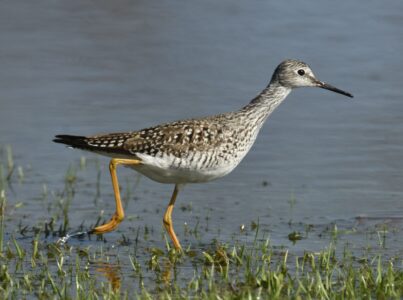
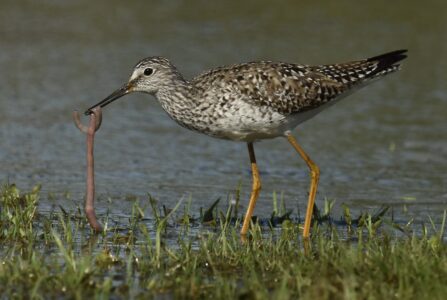
For many species there is not a single place to monitor large waves, but observations from many birders recorded at places like ebird and Discord for wider regions, and U.P. Birders listserve and WhatsApp for local reports provide clues. Many of the area's ponds have seen good numbers of solitary sandpipers, greater and lesser yellowlegs. They have been found along the pond edges and on small rock outcroppings feeding to a large extent on earthworms and other invertebrates.
A lovely flock of 17 American white pelicans showed up near Picnic Rocks last Tuesday evening. Most American white pelicans seen in the U.P. in May are bound for the Prairie Potholes of the Central States and Provinces from the southern coastal areas. They do nest in the Green Bay arm of Lake Michigan and several other locations in Wisconsin and are generally at least three to five years old when they start nesting so younger birds do "cruise the U.P." in summer. A second species, the brown pelican, has a range basically restricted to the ocean coasts, usually nesting only north to central California and Delaware, but wandering as far as British Colombia and Maine.
Hummingbirds made it to northern Marquette County around May 8th and 9th so hummingbird feeders can help them until more flowers open and insects and spiders become more active. Some willow, maple and other tree flowers do provide some nectar for hummingbirds, but they do feed actively on small spiders, and smaller insects like midges and aphids. Like other animals they need foods high in proteins and fats to maintain their health, to produce eggs, and feed growing chicks. Ruby-throated hummingbirds have been reported across the entire eastern U.S. all the way into Canada.
Many are waking up to the sounds of white-throated sparrows with their "Saaam, Peabody, Peabody Peabody, Peabody" songs. With them are dozens of dark-eyed juncos, plus vesper, white-crowned, savannah, song, Lincoln's sparrows, and even a Harris's sparrow or two. Warbler activity is picking up with an ever-larger diversity of species. Tree swallows are making it here too, and a half dozen chimney swifts were seen overhead on the east side of Marquette earlier this week.
Ducks are still moving through too. A number of large rafts have made brief stops in the area, and smaller groups of dabblers and a few divers are still turning up on the local ponds, rivers, and inland lakes. Canada geese arrived early last month and are already sporting lines of fuzzy, yellow goslings around town in Marquette too.
With warmer weather the warblers will continue to pick up, with wrens, more swallows, and flycatchers joining them. The last are the migrants travelling the farthest - the Neotropical migrants like tanagers, orioles, thrushes and some of the flycatchers and the true long-distance travelers, the shorebirds just getting started from Argentina and Chile, bring up the end of things through late May and even into early June.
Black flies are just starting to appear and the mosquito forecast - with all the standing water around the area is good for mosquitoes and mosquito eaters, but not so good for people. Now is the really the time to get out!
EDITOR'S NOTE: Scot Stewart is a teacher at Bothwell Middle School in Marquette and a freelance photographer.