
Northern Michigan Opioid Response Consortium holds community reentry simulation
Trending
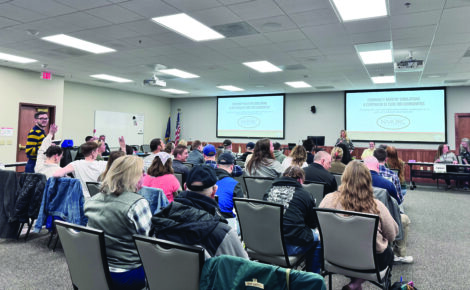
MARQUETTE -- The Northern Michigan Opioid Response Consortium, a federally grant-funded program under the Michigan Center for Rural Health, facilitated a community reentry simulation event at the MARESA office on Thursday.
The goal of the simulation was for participants to gain understanding of the significant obstacles faced by people attempting to navigate through life after being released from incarceration.
"To walk in the shoes of one released from serving their time gives valuable insight, both for professionals tasked with helping these individuals achieve a successful reentry as well as anyone from the community who wants to better understand this dynamic," said the Northern Michigan Opioid Response Consortium.
At the event, participants were each given a sheet with information about the person they'd be roleplaying as for the day. All of the roles were people recently released from incarceration. Each role faced a unique set of obstacles, such as homelessness, lack of transportation or unemployment. One obstacle that anyone released from incarceration in the Upper Peninsula faces is finding support in a rural area.
"About 20% of Michigan's overall population reside in rural areas," said Joyce Fetrow, director of the Northern Michigan Opioid Response Consortium. "The kicker to that is 94% of the state's landmass is considered rural. That includes most of northern lower Michigan as well as all of the Upper Peninsula."
That can put a strain on the agencies seeking to provide support to people in recovery or who have been recently released from incarceration, as the area of land they have to cover is significantly wider than in more populated areas.
"That's why we need the Michigan Center for Rural Health," said Fetrow. "Their work, essentially, helps shrink that area by providing opportunities to collaborate and learn best practices from each other. A network can provide a healthy safety net for communities we serve."
"95% of all jail and prison admissions result in release," said Fetrow. "In 2020, over five million people in the United States were incarcerated, and nearly 550,000 people were released from incarceration."
To avoid recidivism, or the tendency of people released from incarceration to reoffend and end up back behind bars, people have to handle a significant amount of adversity.
"Incarceration can be a revolving door for some individuals, and it is hard to break that cycle," said Fetrow. "You participants are going to walk through a month in the life of someone on that journey.
"Through this process, you'll help understand how easy it is to fall right back into that cycle. The activity today is designed to simulate one month in the life of someone trying to navigate his or her way through the system and comply with all the requirements expected of you."
Each role in the simulation was given a series of tasks to complete each week, from a $5 urine analysis test to attending a Narcotics Anonymous meeting to spending $25 on food. Some of the roles were given no money and no job, and so had to pawn belongings or donate plasma to afford to complete their weekly tasks.
Volunteers in the role of police officers mingled among the participants, stopping them at random to ensure they had completed their tasks for the week. If a participant failed to complete one of their required tasks, they could end up in "jail." If they failed to make a rent payment, they would be moved to the "homeless shelter." These outcomes were meant to demonstrate how difficult it is for people to avoid recidivism.
The event was well attended by community members, and staffed by a variety of volunteers playing roles such as landlords, parole officers and grocery store owners.
This event was sponsored by the Marquette County Health Department. More information about the Northern Michigan Opioid Response Consortium is available at mcrh.msu.edu/programs/nmorc.
Annie Lippert can be reached at 906-228-2500, ext. 550. Her email address is alippert@miningjournal.net.