
Michigan copper was critical to Union victory in Civil War
Trending
Editors note: Four Upper Peninsula newspapers are running companion pieces to our America 250 stories with a focus on the U.P.'s role in building America. This week's comes from the Mining Mining Gazette in Houghton.
By the mid-19th century, the United States had become an industrialized nation. Industrialization had begun in the 1790s with the domestic textile industry, which started using steam technology to replace water power. Eli Whitney's invention of the cotton gin (short for engine) allowed for the southern states to produce short-
staple cotton abundantly, which was processed in northern textile mills throughout New England.
Had it not been for Whitney's invention, the southern cotton agricultural system would not have developed into what it had become, and as Civil War historian Bruce Catton
commented: In the early 19th century, slavery was considered a dying institution, but the cotton gin, by efficiently processing cotton, "gave slavery a new lease on
life," making it what the south considered an economic necessity.
As history evolved, growing tensions between northern and southern regions, particularly over slavery, eventually led to the Civil War, or as it was called at the time, the War of the Rebellion. Between 1861 and 1865, the Union states ground down the states of the Confederate States of America, destroying much of what manufacturing capacity it had, as well as its over all economy.
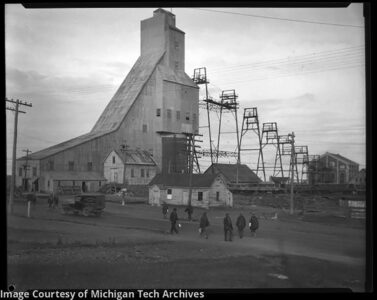
While sectional tensions increased between northern and southern states, the copper mining industry on the Keweenaw Peninsula was developing. As it turned out, Keweenaw copper production would be a determining factor in a Union victory in the Civil War.
In the early 1840s, the United States government had a keen interest in purchasing the western half of the Upper Peninsula from the Ojibway Indians, because of ever increasing reports of the abundant presence of copper throughout the region, particularly along the spine of the Keweenaw Peninsula extending southwest into the Ontonagon River region.
With the Copper Treaty of 1842, the Ojibway ceded the lands and in March the following year, the War Department established the Lake Superior Copper Mining District, and
made the lands available for mining. Within two years, copper mined in the region began to appear on the U.S. market.
Prior to the advent of copper production in the region, the U.S. had to rely on the importation of copper to fulfill domestic demand for the metal. The rise of the Industrial Revolution increased domestic demand for brass and bronze
and quickly outpaced domestic copper supply. By the 1850s, however, the exploitation of Michigan's massive copper deposits had begun to shift the U.S. from a copper importer
to a dominant exporter.
When considering the industrial capacity differences between two sections, it was inevitable the Union would be the victorious entity. It must be stated, without boast,
that copper production of the Michigan mines throughout the Keweenaw Peninsula cannot be understated in its contributions to the Union war effort, and ultimately, it’s
victory.
Domestically, the Lake Superior copper region fueled the American Industrial Revolution. By 1870, the region was producing more than 95% of the nations' copper.
The copper region hugely contributed to the Union victory of the Civil War, producing some 90% of the north's copper.
Michigan copper was used in the manufacture of everything from brass military buttons to musket caps without which the soldiers could not fire their guns, along with casting
of bronze artillery pieces. Brass and bronze were also used extensively in the construction of engine and machinery parts for U.S. naval vessels.
Michigan copper was used in the manufacture of everything from brass military buttons to musket caps without which the soldiers could not fire their guns, along with casting
of bronze artillery pieces. Brass and bronze were also used extensively in the construction of engine and machinery parts for U.S. naval vessels.
Because of the purity of Lake Superior copper, it was sought and extensively used for telegraph wire. In fact, the Union military utilized more than 15,000 miles of telegraph wire, which revolutionized military command and government information. The U.S. Telegraph Corps, established in 1861, enabled field commanders to communicate with each other, was responsible for rapid troop coordination and deployment, and allowed President Lincoln instantaneous communication between him, the War Dept. and field commanders.
Just as copper was crucial in the manufacturing of engines and parts for Naval vessels, it was equally important to locomotive manufacture. The Union War Department relied
heavily on railroads during the war, operating approximately 20,000 miles of track (70% of the national total) and 96% of the equipment, according to the Smithsonian Institution. Utilizing railroads, the Union efficiently transported troops and supplies, created hospital trains and reduced transportation costs by 95%.
Copper was crucial in the manufacture of locomotives and rolling stock, used for firebox components and boiler tubes, because of its superior heat transfer. Copper was
also used for brass fittings, valves and other components necessary to steam engine construction and rolling stock.
While the Keweenaw Peninsula was far and away the largest U.S. producer of raw copper during the war, California and Vermont were two other major sources. In the southern
states, only the basin mine in Tennessee produced copper in commercial quantities, providing 90% of the Confederacy's copper. The mines in Tennessee produced somewhere around 747,000 pounds, while Michigan produced alone 15 million pounds. Copper was consistently scarce in the Confederacy.
While the Ducktown mines, in the Chattanooga region of Tennessee, were valuable, production struggled due to labor shortages. To make matters worse for Confederate copper production, Chattanooga, and its copper mines, were captured by the Union Army in November 1863.
Orin Robinson, author of the article, “Recollections of Civil War Conditions in the Copper Country,” wrote: "Under the advanced price of copper and the demand for it, the
producing mines increased their out output as much as possible –"
Orin Robinson, author of the article, “Recollections of Civil War Conditions in the Copper Country,” wrote: "Under the advanced price of copper and the demand for it, the
producing mines increased their out output as much as possible –"
While the Lake Superior copper region continually increased its production of war-time copper, the Confederacy's access to the mineral continued to dwindle.
In the final tally, wrote Lance Hergegen for the National Conversation, the Union was restored not only by blood, but by the growing industrial and agricultural might of the
Upper Midwest. Raw materials such as copper and iron ore were mined to supply new shops and factories.