
Silver STARS
UNIVERSITY EARNS AWARD
Trending
MARQUETTE -- Northern Michigan University has earned a STARS Silver Rating -- only 4.8 points shy of Gold -- from the Association for the Advancement of Sustainability in Higher Education.
The AASHE's Sustainability Tracking, Assessment & Rating System program measures and encourages sustainability in all aspects of higher education, NMU said. Participating institutions report achievements through an audit of five overall areas: academics; engagement; operations; planning and administration; and innovation and leadership.
"The real game changer that brought us so close to Gold this year was developing an interim strategic plan for the university that includes a focus area of building a culture of sustainability on campus," said Jes Thompson, NMU public relations professor and director of the Sustainability Hub for Innovation and Environment, in a news release. "Having an action plan attached to that provided evidence that we were taking tangible, large and measurable steps toward improving sustainability in operations and organizational culture.
"Only three public universities our size have achieved a STARS Gold Rating. My mission is to get us there, hopefully by resubmitting next year rather than on the three-year auditing cycle we've been on."
Thompson said NMU has achieved nearly the maximum point potential in academics by launching three new programs since the last STARS audit: a master's degree in administration of outdoor recreation and nature-based tourism, a master of arts in English concentration in literature and the environment, and a bachelor's degree in sustainable business and enterprise creation.
"The fact three different colleges contributed points to our rating reinforces the interdisciplinary approach to sustainability at Northern," she said. "It also shows that students from all fields are seeking related content in their courses."
Of all university courses, 19% include a sustainability component and 80% of NMU's academic departments offer sustainability courses. Thompson said 25% of students graduate from a program that requires some knowledge of the topic.
Going green
The Green Fund, a $5 opt-out fee for NMU students implemented at the recommendation of the EcoReps student organization, also made a difference in 2022 by supporting the following projects: a demonstration solar array at a SHINE location on campus, clover lawn, beekeeping education, parking lot rain gardens and composting transport.
On Wednesday during Anderton's Earth Week -- named after the late John Anderton, an NMU professor and former head of the Department of Earth, Environmental and Geographical Sciences -- campus groups that focus on the environment and sustainability took part in a "tabling event" at Jamrich Hall.
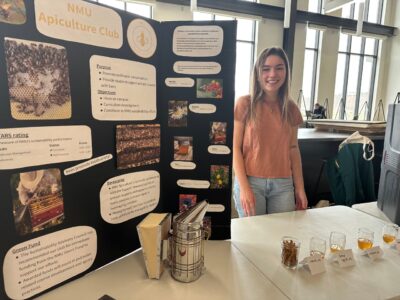
For instance, the NMU Apiculture Club educated people about the importance of pollinators and bees, and even provided samples of honey to taste from four areas: downstate Marne, Grand Rapids, Marquette and a location in the southern U.S.
Gracie Anzaldua, a junior majoring in environmental studies and sustainability, said the Marne honey, for example, was from a swarm hive -- and because of their different origins, the honey samples had different tastes.
One of the club's purposes, she said, is to show how bees work in various ways throughout the seasons.
She had a suggestion for how people can help bees.
"If you see a bee, don't kill it," Anzaldua said. "Leave it be. Plant flowers around that are helpful for pollinators."
Students also were to work with the Northern Lights dining facility to sort waste and weigh how much is compostable, how much is recyclable and how much goes to the landfill, Thompson said.
"With that data, the university will be able to develop a larger-scale composting plan with Dining Services," she said. "Dining has already transitioned to compostable paper and plastic ware, and the next step is to figure out how to transport the compost to Partridge Creek Farm."
NMU partnered with Michigan Tech University to perform reciprocal carbon footprint analyses to get a sense of baseline emissions, NMU said. Other notable achievements in university operations include: 15% of NMU's lighting is LED, with a multiyear plan to increase that percentage: green-house gas emissions and water use dropped by 31% and 37%, respectively, since 2010; 100% of ice melt used on sidewalks is certified eco/green; and 35% of food purchased is plant-based, including excess produce grown in the campus Hoop House and via the indoor agriculture program.
Thompson said NMU has established a task force to work toward the goal of carbon neutrality by 2050 in the most financially responsible way possible. An engineering consulting firm was hired last year to assist in developing a related plan with a transparent measurement and reporting system.
NMU previously earned a STARS Bronze Rating in 2017 and a Silver in 2020. Regarding what Thompson believes will take to earn enough points to achieve Gold, she pointed to several possibilities: from making sustainability part of the general education curriculum to more support for sustainability research and creating a committee on investor responsibility.
She also said innovative points of distinction could include a Bicycle-Friendly University distinction, carbon mitigation project development, certifications in Dining Services and well-being, and a commitment to textbook affordability via open source materials or NMU's Olson Library.
"When I first joined the faculty here a decade ago, two students came to me and asked where they could find the university's sustainability plan," Thompson said. "I said I'd look for it, but discovered there wasn't one. Some initiatives had started prior to its development, but I feel like we've moved from zero -- no committee, framework or guidance -- to STARS Silver and now approaching Gold.
"At bigger research and endowed institutions, sustainability is one person's sole job. Here at Northern, a lot of us take it on, and that collaborative approach has taken us far. It's not everyone's responsibility, but the people who take it on contribute immensely."
With more than 900 participants in 40 countries, AASHE's STARS program is the most widely recognized framework worldwide for publicly reporting comprehensive information related to a college or university's sustainability performance, NMU said.
"STARS was developed by the campus sustainability community to provide high standards for recognizing campus sustainability efforts," AASHE Executive Director Meghan Fay Zahniser said. "Northern Michigan University has demonstrated a substantial commitment to sustainability by achieving a STARS Silver Rating and is to be congratulated for their efforts."
Christie Mastric can be reached at 906-228-2500, ext. 250. Her email address is cbleck@miningjournal.net.