
What’s Flying: Spring brings surprises
Trending
"The joy of surprises in only increased by the unexpectedness of the smallest natural events we find." - Anonymous
Spring is full new changes coming almost nonstop, with wildflowers, tree flowers, new leaves, new butterflies and much more. While much of the progression of spring is greatly anticipated and even expected, the timing of events and arrivals is never certain, especially in the Upper Peninsula, where fluctuations in weather patterns, ebbs and flows in jet streams with their own temperature ranges and wind patterns are everything.
This is particularly true with areas of the U.P. close to the Great Lakes, like the Keweenaw, Big Ba in Marquette County and Whitefish Point where the winds off Lake Superior can. Be much cooler and delay wildflower blooming and even leaf-out by a week or more. While many maple trees in sheltered areas Marquette had a substantial canopy of new leaves this week, in Big Bay those same trees have just started to get their buds open. And at mid-week were beginning to show more significant signs of pastel rose, pea-green and silver-green hues.
Shorebirds and waterbirds have been moving a bit slowly so far this spring with just a few stopping at most of the classic rest areas in Marquette and Alger County, like the mouths of the Dead and AuTrain River on Lake Superior and the Lower Harbor breakwall. A few have stopped though and their discoveries have provided great surprises this spring.
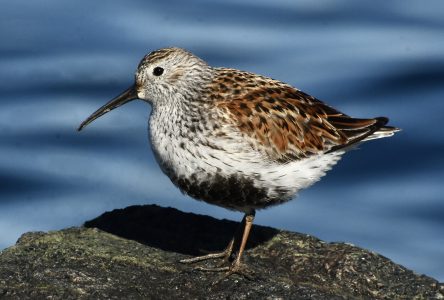
A single dunlin was found last week on the outside rocks of the Lower Harbor breakwall in Marquette. This bird seemed healthy but perhaps a bit low on energy, and possibly was unable to keep up with others on the flight north. Dunlin are striking sandpipers with black patches on their bellies, bright rusty brown backs and long slightly decurved bills. After wintering on the coasts, dunlin pass through most of the U.S. on their migration to Canada except the Rockies to summer on the Arctic Coast. Of Canada and breed. A separate population of dunlins that summers in coast of northern Alaska migrates directly across the Pacific and through Siberia to winter Japan and Eastern Asia.
Most foraging by dunlins is done in the soft soil or sand, usually quite close to the surface, despite their long bills. Their sensitive bills can detect worms, insects, snails, and other small invertebrates below ground, but they also pick up small animals on the surface too. On the breakwalls dunlins glean midges and other small insects resting on the rock surfaces and may remain several days if there is a good midge hatch.
Waterbirds have been more numerous at Whitefish with some good numbers this week. On May 25 there were 19 dunlin, 17 ruddy turnstones, 20 whimbrel and 11 black-bellied plovers seen. The previous day 75 dunlins passing the point and 63 the day before. Most of these sandpipers and plover were fly-bys, just passing the point on the wing and not stopping.
Another exciting bird seen on the water in Marquette late last week was a single American white pelican, found in the shallows of the Dead River near the mouth late last week. It appeared to be a breeding-age adult with a smallish bill plate, known as caruncle, nuptial tubercle, or epidermal plate, on its bill. Both males and females have them when they become adults during the mating season once they reach the age of three. The plates fall off after the breeding season. Sizes of the plates vary; their purpose seems to be tied to mate selection.
American white pelicans winter from the southern U.S. to southern Mexico. Two different groups of these pelicans are seen in U.P. in warmer months. Some seen in spring migration are headed to summer range in the prairie potholes from the Dakotas to northern Alberta. During summer months immature pelicans wander through from breeding. ranges to the south in several spots in Wisconsin, on the Upper Mississippi River, islands in Butte de Mortes area, Horicon National Wildlife Refuge, and Cat Island in Green Bay. The nonbreeding birds from the Green Bay rookery wander around the western end of Lake Michigan and locations to the north, occasionally stopping on Lake Superior and smaller lakes like Teal Lake in Negaunee. It may be part of an exploration by some individuals investigating sites for future use.
In Delta County a least bittern was at the Portage Point Marsh last Monday. They are the smallest relatives of the heron family, just 11-14 inches tall. Females look like miniature bitterns. Males have dark brown to black backs and chestnut sides and striped chests. While the summer range of least bitterns extends from the Gulf Coast to the edge of the U.P. sightings reports for them are rare in the U.P. Best chances for finding breeding pairs appears to be in the eastern. U.P. Their population in the U.S. appears to have been fairly stable for the past fifty years, concerns about loss of wetlands habitat always cloud the estimates of their future population. Because of their secretive nature, the opportunities to see them are limited and always a memorable experience.
Warblers have shown up on many bird reports recently following the huge waves seen last week hitting the Lake Michigan. Lots of Wilson's, Nashville, yellow-rumped, black-throated green, yellow, and common yellowthroats. The species heading farther north, like blackpolls and bay-breasted are through the U.P. although a few of the latter will stay to nest here. Good surprises may be just around the corner.
EDITOR'S NOTE: Scot Stewart is a teacher at Bothwell Middle School in Marquette and a freelance photographer.