
What’s Flying: Spring offers many delights as May approaches
Trending
"And a bird overhead sang follow, and a bird to the right sang here. And the arch of the leaves was hollow, and the meaning of May was clear." - Algernon Charles Swinburne
Despite the view from most windows this past Tuesday and Wednesday, it is spring and many of the expected delights of the season are in full gear despite evidence to the contrary. In just two days it will be May! Alder flowers with their long, dangling catkins full of bright yellow pollen and willow trees and shrubs with their fuzzy white flower coverings are beginning to bloom. Skeins of geese are passing, honking and saluting overhead as they push on north, with hope to more welcoming summer ranges. During the delightfully warm day last Sunday a number of V's was seen over the central portions of The Upper Peninsula and 133 geese were counted over Whitefish Point in Chippewa County. More of the summer cast - hermit thrushes, sapsuckers, wrens, white-throated sparrows and warblers are also moving through the area.
Migration always provides exciting, unexpected vignettes into the natural world for those who are observant, fortunate or just plain lucky. The past week has seen a wide array of waterfowl descent into local streams, ponds, and lakes (the ones warm enough to open up, anyhow – Teal Lake and nearby ponds were still frozen over earlier in the week).
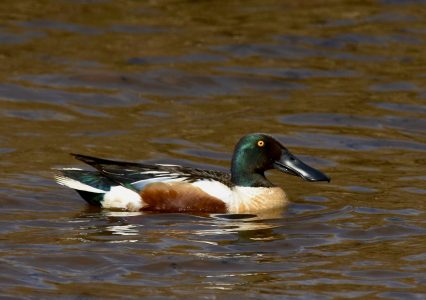
There is a small retention pond near the roundabout at Wright Street and Lakeshore Boulevard in Marquette. Even though it usually appears a bit muddy, it often hosts Canada geese, mallards and a few hooded mergansers. Last week a pair of northern shovelers showed up. They were joined by a second pair briefly last Sunday. Shovelers look similar to mallards, with green headed males and camouflage-designed brown and buff females. Their most distinguishing traits are their large, flattened bills. Nearly 2.5 inches long, the inside bill edges are lined with over one-hundred small points to help them filter small invertebrates, plant seeds and other food from the water.
They are frequently seen skimming the water surface and a fine layer of algae sits on the top of the Marquette pond where they have been apparently waiting for better weather before heading south. While they do nest In parts of central Wisconsin and Minnesota their primary range stretches from the pothole country of the western states all the way to the tundra of Alaska.
Sandhill cranes are beginning to fill their summer ranges in the northern Upper Peninsula. Several pairs have been seen recently along M-28 between Marquette and Munising, where they are typically seen every summer now, especially as their young get bigger, but many are still on their way farther north. During the snow last Tuesday over 900 were counted flying over Whitefish Point by the waterfowl counter and reported on their Dunkadoo live reports – https://dunkadoo.org/explore/whitefish-point-bird-observatory/waterbirds-spring-2022. Over one-hundred more were seen the following day.
With the warm weather expected to return, some birders will hope to get to Whitefish Point for one of their spectacular hawk migration days. Toward the end of April as the days warm and the winds become more favorable for hawk migration, hundreds of sharp-shinned hawks stream through the point on their way to Canada. More than 1,200 have already been counted at the point already this spring. Sharp-shins do nest in the northern tier states in the east and across the boreal forest of Canada into Alaska. They feed almost exclusively on other birds and like other hawks pluck their feathers away while eating. They, with Cooper's hawks and northern goshawks are accipiters, hawks recognized in flight by their wider wings and narrow tails While they will occasionally soar, they are more easily identified by their flap, flap glide pattern of flight when cruising.
Late arriving hawks are also showing up. Broad-winged hawks are among the last of the hawks to pass through. Just a handful have made it here so far, but as May rolls in there will be some warm days with strong winds coming in off Lake Superior. These conditions produce large flocks of hawks called kettles. As soaring hawks hit the edge of Lake Superior on windy days they circle in these kettles, hoping for weak or south winds. Otherwise they kettle, wait, and will settle into the trees at the end of the day if the conditions don't improve. On good days 400 hawks, vultures and eagles can be seen circling south of Whitefish Point in spring waiting for better conditions.
The cold weather has definitely kept hummingbirds at more southerly locations. They often depend heavily on the early blossoms of flowers like the willows that provide both nectar and some small insects on the flowers. Two separate migration maps, from Hummingbird Central, https://www.hummingbirdcentral.com/hummingbird-migration-spring-2022-map.htm, and Hummingbird Guide, https://www.hummingbird-guide.com/hummingbird-migration-map-2022.html#spring-migration-map-2022, show similar northward progress on the movement of these tiny summer residents. Based on reports in citizen science submissions, the birds are currently near the Wisconsin U.P. border have a single report from the northern tip of the Lower Peninsula.
A small wave of pine siskins has joined up with the remnants of the huge common redpoll flock that was here earlier this past winter. A few big flocks of redpolls are still trying to clear the area as they head into Canada. They are being replaced by plenty of juncos and now currently with white-throated, white-crowned, American tree, vesper and fox sparrows. Please get out and see the latest spring has to offer.
EDITOR'S NOTE: Scot Stewart is a teacher at Bothwell Middle School in Marquette and a freelance photographer.