
Northern Exposure winner has way with glass
Trending
ESCANABA -- Alexander Fekete aims to bring as much soul as possible to each of his metal and glass sculptures, which juxtapose ideas about strength and fragility and minimalism and substance.
"It's the pursuit of form, and pursuit of form that is very unique to molten glass or to blown glass," said Fekete.
Originally from what was formerly Czechoslovakia, Fekete came to America as a Fulbright Scholar. He learned about working with glass at the University of Illinois Urbana-Champaign, but says that the first five of six years of his time as a glass artist was mostly playing with the material.
That play transformed into a passion he has been developing over the last 30 years.
"It's like every day is a new day," he said of his glasswork.
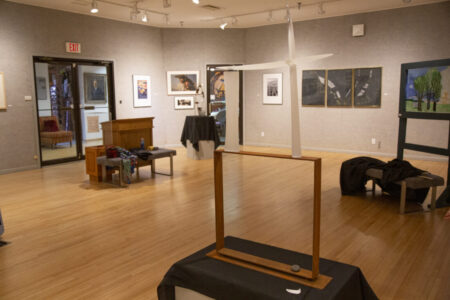
Last November, Fekete won the Daily Press Media Award at the Bonifas Arts Center's 30th Northern Exposure art show and competition, with his piece "Viva Reviva." The same piece won the show overall.
Viva Reviva is constructed of welded steel beams, pieces of frosted blown glass, and pebbles. Fekete describes the glass in more painterly terms, as brushstrokes that give the minimalist piece its soul.
"I probably spend more time editing visually what to leave out -- to get to the bottom, to the absolute minimum of that form that I'm looking for," he said.
He credits the frosted glass with providing much of the sculpture's energy, noting that the glass is able to capture light, giving both form and volume to the piece.
"It's that luminance that kind of stays and creates the experience," he said.
Fekete divides his work into to paths: pieces like Viva Reviva that aim to give as much soul as possible to minimalistic design, and more organic pieces that let the natural fluidity of the glass speak against decay and rust.
"(It's) that kind of focused, disciplined minimalism versus that abandoned destruction ... I like the dynamic of that."
Fekete submitted two other pieces to Northern Exposure, both of which followed a different path than Viva Reviva. "Hangster" and "Tri-Loop Strata" both featured shapes more reminiscent of broken vases, with portions of the exposed edge covered in rust and long, rusty wires helping to separate the glass onto different three-dimensional planes.
Both the process and the result are very different between the two paths. Fekete says many people want to reach out and touch a piece like Viva Reviva, but he thinks the rough and rusty look of Tri-Loop Strata and Hangster are too raw and dangerous seeming to invite touch.
Ironically, both Hangster and Tri-Loop Strata are the more fragile pieces. The areas where rust and glass seem most juxtaposed are actually glass coated with a metal coating.
"If that was to break, it would be just glass hitting the floor," said Fekete, who noted that it would be impossible to combine metal and glass any other way because of the differences in thermal expansion.
Both paths are rewarding for Fekete, but the mental energy of the paths is very different. One is about the pursuit of perfection. The other goes wherever the glass takes it.
"The Viva is near perfect before I can forget about it, and that takes a lot of effort. It seems like there's not much in there, but that not much takes way more time than the other ones. (In the others,) there's so much energy, there's so much of this and that going on in it. There I don't have to be so careful," he said.
Throughout his artistic career, Fekete has taught. He currently teaches design at Northern Michigan University.
He doesn't teach glass. He says it's too intimate.
"I don't know that I would ever be able to teach the glass. It's just too precious for me," he said.
Fekete says he enjoyed participating in Northern Exposure. For him, it was more than just the awards he won, it was the experience of working with the people at the Bonifas Arts Center.
"When I went in to install things, I met so many wonderful people there. And the whole vibe was just nice, just very nice," he said.