L. G. Kaufman – A builder of banks
Trending
By Sara Niemi
"I'm mighty proud of Marquette; proud to point to it as my hometown."
L. G. Kaufman, 1927
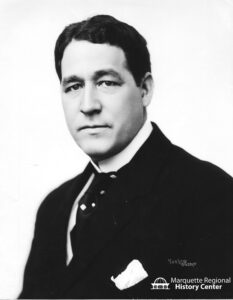
Marquette native Louis Graveraet Kaufman was a nationally recognized banker and financier. He used his leadership and fiscal knowledge to establish a renowned career, impacting banking and attaining considerable wealth. Wealth he would invest in his hometown.
Born in 1870, Louis was one of Samuel and Juliet (Graveraet) Kaufman's 12 children. Graduating from Marquette schools at 17, he was interested in mining engineering. After working for two years in mining related companies, however, he decided banking was a better fit.
In 1890, Louis' brother, Nathan Kaufman, successful in his own right, opened the Marquette County Savings Bank. Louis joined his brother at the bank. Beginning as a messenger, he would rise to vice president. Working his days at the bank, Louis studied banking practice and law in the evenings.
Louis married Marie Julia "Daisy" Young, of Chicago, in 1900 and they had 8 children. The same year another opportunity for Louis' advancement occurred when brothers Nathan and Samuel secured a majority interest in the First National Bank, established by Peter White in the 1860s. Beginning as a vice president, Louis became president in 1908 upon the death of President Peter White.
In 1910, Judge Elbert Gary, President of U.S. Steel, and a Director of Chatham National Bank in New York City took notice of Kaufman. Although Chatham Bank had been established in 1850, it was not a major New York City bank. Thinking Kaufman could make more of the bank, Gary brought Kaufman on as president.
Although the Federal Reserve Board didn't allow someone to head two banks, Kaufman applied and was granted special dispensation so he could remain president of the First National Bank in Marquette while also president of Chatham National Bank.
Within his first year at Chatham, Kaufman headed a merger with Phenix National Bank. The new organization, Chatham Phenix National Bank, became a major player in New York City banking.
Over Louis' tenure, additional banks merged with Chatham Phenix. Eventually, under Louis Kaufman's guidance, the bank became one of the largest banking institutions in the United States. Just before he retired in 1932, Kaufman oversaw the merger of Chatham Phenix with Manufacturers Trust.
As bank president, Kaufman discovered a forgotten law from 1865: a law he felt allowed national banks to operate branches. Beginning with the comptroller of currency, he eventually gained approval to establish branch banks. Opening 13 branches in New York City, he would become known as the father of branch banking.
In 1910 Kaufman joined the General Motors Board of Directors and was made chair of the finance committee. At a critical juncture, he helped manage the refinancing of the corporation. Kaufman also assisted the leaders of Chevrolet, a company GM would soon acquire, with the restructuring of that company.
In 1929, Kaufman joined a small group of investors, including other men with ties to GM and a former New York state governor, to erect the Empire State Building. Located in New York City, it was the tallest building in the world until the World Trade Center was completed in 1973.
With his career on track, Louis reconnected with his hometown. He purchased property on Lake Superior just north of Marquette, land he had explored as a child, to build his summer home. Kaufman and his wife completed their residence, Granot Loma, in the 1920's. At the same time, they established a farm on the estate called Loma Farms.
Louis purchased purebred livestock and constructed a state-of-the-art farming facility. In August 1930, he hosted an open house for U.P. farmers to share information on crops and livestock suitable for the U.P. climate. His objective was to assist the farmers in making their operations profitable.
Kaufman had a special interest in education, and when Marquette needed a new high school, he reimbursed the Marquette school system for the purchase of the land so that district's building fund could concentrate on building the finest facility possible. To encourage the creation of a music program he also purchased musical instruments and contributed to the cost of the auditorium. The district named the new school Graveraet, in honor of Kaufman's mother, and named the auditorium after him.
To continue his support, Kaufman established an endowment in 1927, with an initial contribution of $100,000 ($1.75 million today). The L.G. Kaufman Endowment Fund was to be used "for all time for the educational welfare of the children [of] the people of Marquette." The Fund remains active, every year granting more than $150,000 to a wide array of local educational and community groups.
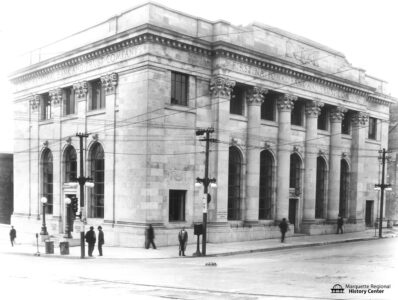
Graveraet School and the endowment are two ways Kaufman gave back to Marquette. His legacy includes a beautiful mausoleum at Park Cemetery, a backdrop for many prom and wedding photos, and the magnificent building Kaufman constructed for the First National Bank on the corner of Front and Washington.
Join the Marquette Regional History Center on Thursday, July 20, 2023, at 6:00 p.m. while we enjoy an evening in this historic building, now Flagstar Bank. Tour and learn about its architecture, women in banking, and a bit more about L.G. Kaufman, and his family legacy from presenters: Blaine Betts, Ann Fisher, and Susan Hornbogen, with special guest, Peter Kaufman. We'll share wine and enjoy small bites from The Northwoods Test Kitchen while listening to a musical performance by Bob Buchkoe and Blue Champagne. Tickets are on sale now: single $50, couples $85; $10 off per ticket for members. Visit marquettehistory.org or call 906.226.3571 for more info.
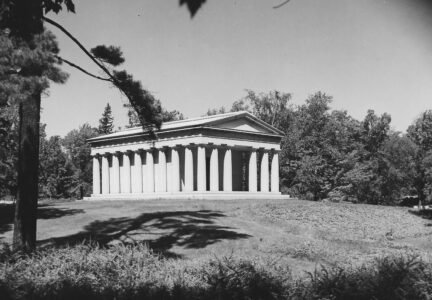
At left, is the First National Bank Building in Marquette, where L.G. Kaufman served as president in the early twentieth century. Above is a photo of the Kaufman Mausoleum at the Park Cemetery in Marquette. (Photos courtesy of the Marquette Regional History Center)