
Historically speaking
Ishpeming City Hall’s rich history
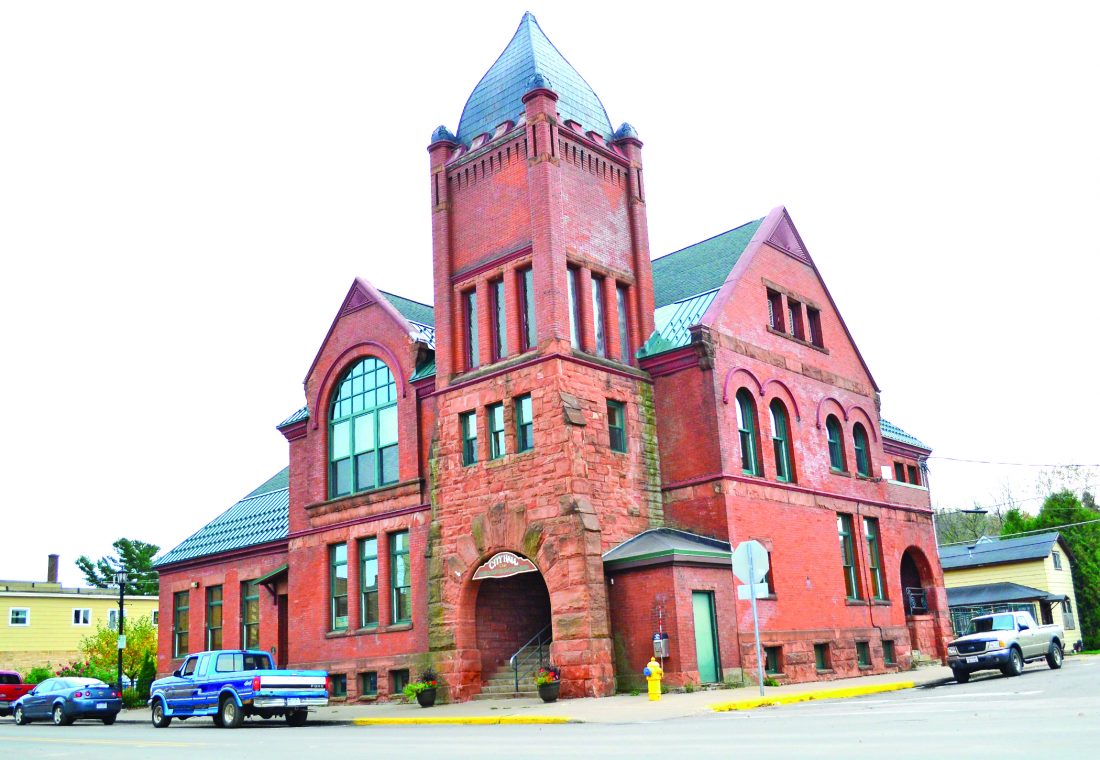
Shown is Ishpeming City Hall. The City released a report in September detailing the findings of an investigation into the city's over payment of health insurance premiums for more than two years in the amount of almost $200,000. (Journal photo by Zach Jay)
Ishpeming — In 1890, the residents of the city of Ishpeming had a choice. They could either put in a sewer system or build a city hall.
Many people in the city at that time did not think a city hall was needed. Its purchase price of $30,000 (876,326 in today’s dollars) was steep and many residents just did not see the need. But it was needed. The common council had recently grown to 14 members; two alderman for each ward, plus a separately elected mayor, which made that governing body too large for any other public space.
“For many years the meetings of the council were held in the library rooms in the Sellwood block. The accommodations were inadequate to the demand, the rooms were small and the place was decidedly unsuited for a council chamber.” (Iron Ore, November 14, 1891)
In addition, there was no place to keep the city records. “Another fact, and one that was more imperative than any other, perhaps, was the lack of a suitable place to keep the records of the city. A disastrous fire a number of years ago destroyed many of the public documents, and the change in the office of recorder at every election for that position brought about a corresponding change in the location of the recorders headquarters and with every move that was made some of the records succumbed to the unlucky condition and were forever lost to view.” (Iron Ore, November 14, 1891)
“In the fall of 1889, a resolution was presented to the common council by Alderman Routhier, reciting the needs of the city for a public building and recommending the appointment of a special committee to investigate the matter and report to the council. A committee was appointed consisting of Aldermen Routhier, Fitzpatric and Grip, to act in conjunction with Mayor C H Hall. They held several meetings and decided to report to the council that they favored the idea and recommended the purchase of a site for that purpose.” (Iron Ore, November 14, 1891)
While several sites were considered, the lot at the corner of Main and Division streets was considered to be the best possible site as both Main and Division streets were at that time, main throughfares in the city. The lot was owned by the Lake Superior company and cost $5,000.
“This report was presented in December 1889, and an invitation was extended to taxpayers to attend the council meeting and express an opinion on the question. A number of visitors were present and the weight of opinion was against the expenditure of a sum of money necessary to secure the building completed. The needs of the city for a sewerage system were presented as the great objection and the statement was made that the attempt would be too much to undertake at that time.” (Iron Ore, November 14, 1891)
“The idea of having the building was not abandoned because there was opposition to it, and the committee kept in continually in mind, formulating plans and devising means by which the desired structure could be secured. It was evident that a much less expensive building was the only one that could be erected, and in the meantime the committee worked on that plan.” (Iron Ore, November 14, 1891)
In April of 1890 a resolution was presented to build a jail and marshal’s residence on Second street with a cost not to exceed $10,000. “Before anything was done in accordance with this action a petition was presented to the council signed by 137 taxpayers, headed by the present mayor, asking that the city erect a building suitable for all purposes on the corner of Main and Division streets instead of putting up a jail and marshal’s residence as proposed by the recent act of the council. At the same meeting a resolution was presented stating the case very explicitly. It called attention to the necessity of a building for the permanent use of the city in all its departments and recommended the erection of one at a cost not to exceed $20,000 and that the lot at the corner of Main and Division streets be purchased for the sum of $5,000” (November 14, 1891)
“The resolution as passed called for an expenditure of not more than $20,000 for the building outside of the cost of the foundation and lot. The contract was let for the pile driving for $3,326 and for the stone work of the foundation $2,749 was paid. This work was completed in the fall of 1890 and in the spring of the following year the work on the building was commenced.
The contract had been let to Sinclair & Outerson for$18,196 and, for such a building as called for in the plans and specifications, was regarded as a very fair price.” (Iron Ore, November 14, 1891)
“The wisdom of the choice of the site appears more favorably now that the building is completed and occupied. It is in a conspicuous place and is easily accessible to al. It has met with such favor that the question is often asked why it was not made two stories throughout. The answer is a simple one. It was the best that could be secured with the money that was available for the purpose.” (Iron Ore, November 14, 1891.
That article does not mention that the building was designed by Marquette architect D. Frederick Charlton, who also designed other buildings in the city of Ishpeming. The building was constructed from pressed brick and Portage Entry brownstone, a sandstone building material quarried in the Upper Peninsula, in Jacobsville.
When it first opened, the council chambers were on the first floor, along with the police department, including jail and the city marshal’s residence and the second floor was occupied by the city library, run by Civil War veteran Eben W. Fiske.
For the grand opening, the city band and firemen escorted the common council from their old headquarters at the fire department (then on the corner of First and Bank.) The mayor made a few remarks and the building was opened for visitors and spectators.
Of course, there have been numerous renovations. “The city building is in need of repair. It never was what it should have been, and was an expensive edifice. The foundation has settled, and will have to be strengthened. Then there will be changes made by the reason of the transfer of the library to the new building.
The municipal court will be provided with (a) place in the city building, where it properly belongs, and there will be a remodeling and overhauling to make of the structure what is desired for the accommodation of the city’s business.” (Iron Ore, July 25, 1903)
West End
Remembering old businesses
Historically speaking – classic

Historically Speaking
Christmas was spectacular in one small corner of Marquette County
Peter Pan and Tinker Bell glide along the ceiling rafters. Captain Hook grimaces from a darker corner. Sylvester ...
Historically speaking classic