
Mexico City altitude challenge for World Cup teams
Trending
MEXICO CITY -- Heat won’t be the only environmental factor affecting players’ performance at the World Cup. Teams playing in two of Mexico’s host cities must adapt to another challenge: altitude.
The Azteca stadium in Mexico City sits at more than 7,300 feet above sea level, while Guadalajara is at 5,138 feet.
Visiting teams that aren’t used to those conditions may struggle with fatigue.
“We have a massive advantage as the host country because we’re playing at the Estadio Azteca with our fans and the altitude,” Mexican football commissioner Mikel Arriola said. “It is a very potent setting.”
In Mexico, leveraging that advantage is seen as key to the team’s chances. It is no coincidence that El Tri’s deepest World Cup runs occurred on home soil.
The last time Mexico hosted the tournament, in 1986, it advanced to the quarterfinals, ultimately falling to West Germany in a penalty shootout. That match was played in Monterrey, where altitude is not a factor.
Mexico plays South Africa in the World Cup opener June 11 at the Azteca -- which FIFA has renamed Mexico City Stadium during the tournament -- before facing South Korea just outside Guadalajara on June 18. It plays its last Group A game in Mexico City on June 24 against Czechia.
Altitude won’t be a factor in the games played in the United States and Canada. The highest-altitude U.S. host city is Atlanta, at just 1,050 feet above sea level, while Canada’s highest venue is in Toronto, at just 249 feet.
Deal with altitude
For elite athletes to perform at their peak at high altitude, a period of adaptation is required to reduce fatigue caused by lower atmospheric pressure and reduced oxygen availability.
“You would expect a faster onset of fatigue, higher heart rates at any given running intensity, and a reduced capacity to sustain the high-intensity efforts that define modern international football--including sprints, pressing actions, and rapid changes of pace,” said Sam Shepherd, head of sports science at sports nutrition company Precision Fuel & Hydration.
To mitigate the physiological toll of thin air, sports scientists generally recommend two contrasting approaches: an extended acclimatization period of at least two weeks, or the “fly-in, fly-out” method, arriving as close to kick-off as possible before acute symptoms set in.
The latter is favored by visiting American professional sports teams from the NBA, MLB and NFL, which routinely land in Mexico City the day before a game.
For a month-long tournament, however, long-term acclimatization is becoming the standard.
South Africa selected Pachuca -- a city sitting even higher than the capital at more than 8,000 feet -- as their base camp, arriving last Tuesday despite initial visa delays.
South Korea, facing two group-stage matches in Guadalajara, has chosen a similar approach.
“We’ll play at about 1,600 meters (5,250 feet),” said head coach Hong Myung-bo. “We’ve had very little exposure to this environment, so I’ve consulted with experts to determine our needs. We now have detailed plans not only for training but also for what happens off the pitch during our stay.”
To prepare, the Korean squad has been stationed at more than 4,300 feet in Salt Lake City, Utah, since May 18. According to Shepherd, that can make a significant difference.
No altitude for Czechs
The Czechs were among the last teams to qualify for the World Cup through the European playoffs at the end of March. Their base camp near Dallas was chosen by FIFA and is about 590 feet above sea level.
They will fly directly into the thin air of Mexico City for a high-stakes group finale against Mexico on June 24.
“It won’t be ideal,” Czechia coach Miroslav Koubek said after announcing his squad last month. “We would have to spend a month in the environment to get adapted to it but there’s no time for that. We have recommendations from experts on how to cope with that but we can’t cope with that for 100%, that’s for sure.”
___
Duerden reported from London. Associated Press writer Karel Janicek in Prague contributed to this report.
___
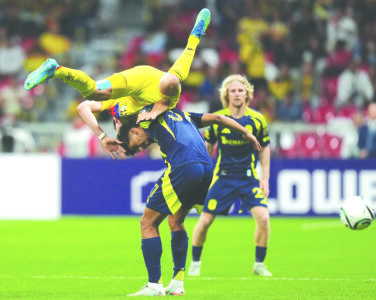
Israel Reyes of Mexico’s America team, top, jumps over Ahmed Qasem of the United States’ Nashville SC during a CONCACAF Champions Cup match in Mexico City on April 14. (AP file photo)