
Indigenous practices rein in Brazilian wildfires
Trending
TOCANTINIA, Brazil -- Fire began crackling like approaching rain on a recent morning in the Xerente Indigenous Territory in Tocantins in northern Brazil. But the Indigenous residents weren’t afraid and didn’t rush to put it out.
The flames were intentional as part of a wildfire prevention effort planned by the Xerente in coordination with environmental officials before the peak dry months of August and September.
The Xerente live in the Cerrado, a savanna in central and northern Brazil. Every year, villages face the threat of large-scale forest fires, a danger likely to worsen with the arrival of El Niño, a phenomenon that prolongs drought and pushes regional temperatures higher.
After decades of experiencing prejudice, Indigenous leaders now coordinate with the government to apply ancestral knowledge to prevent large wildfires.
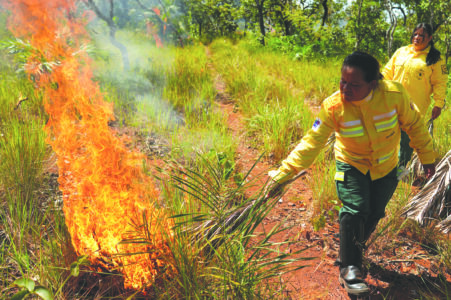
During the action, a joint brigade of IBAMA, Brazil’s environmental protection agency, and trained Indigenous people moved into the savanna. On the ground, part of the team used the traditional technique of igniting fires with drip torches or dry palm leaves. A smaller group dropped incendiary spheres from a government helicopter to target-mapped areas.
If a fire threatened to get out of control, crews intervened immediately. The result was a patchwork of burned areas across the savanna that should help protect the ecosystem in the months ahead.
“They know the region, the climate, the vegetation, and the best times to set fires. We began seeking traditional knowledge, learning from them and adapting it to our objectives, aligning with their use of fire,” said Marco Borges, an IBAMA agent coordinating fire prevention in Tocantins. “We’ve learned they are actually our best teachers.”
A natural protector
Brazilian officials long followed a “zero-fire” strategy, treating any small burn as a threat to be quickly suppressed and banned under all circumstances. Over time, that approach fell out of favor and authorities began embracing new land management approaches combining traditional knowledge with science. In 2014, the government began partnering with Indigenous communities on controlled burns.
Fire is part of the natural evolution of savanna forests like the Cerrado and several species benefit from periodic burns, said Leandro Maracahipes, a biologist and Yale University researcher.
Fires historically have occurred naturally, sparked by lightning, at the start of the rainy season between October and April. But human activity has led to more destructive fires during the peak drought months of August and September that often are linked to pasture clearing near Xerente territory, which is surrounded by soy and cattle farms.
In the early dry season, when vegetation isn’t yet fully arid, small controlled burns help reduce flammable grass buildup.
Exchanging knowledge
When official vehicles arrived in Xerente territory to begin their work, about 30 Indigenous people stood waiting, lined up at a wood-and-thatch tent used as the people’s association headquarters.
They formed two parallel lines, creating a corridor. On the left, a group wore official fire brigade uniforms: bright yellow shirts, green pants and protective boots. On the right stood mostly shirtless men, their bodies marked with traditional painted patterns, some wearing shoes and others with flip-flops. Facing each other, they chanted traditional songs, stomping their feet in rhythm.
At the end of the corridor, Chief Lazaro Xerente, 68, the eldest leader of his people, waited, also shirtless with his torso painted, wearing a feathered headdress. He thanked officials for their presence, but also expressed concern.
“People say, ‘Oh, it’s the Indigenous people who are causing fires,’ when in fact, since I was born, and long before me, my ancestors have always protected the forest,” he said in his native language with translation by Bolivar Rodrigues Xerente of Brazil’s Indigenous affairs agency FUNAI.
After major fires make headlines, out-of-context images of Indigenous people often circulate on social media in Brazil, falsely blaming them and officials for the destruction. In reality, every burn is carefully planned by fire departments.
High alert with El Nino
In regions like the Cerrado and the Amazon, El Nino usually brings higher temperatures and prolonged drought, creating conditions that allow wildfires to thrive. During the most recent event from 2023 to 2024, Brazil saw historic fires that burned more than 76.1 million acres in 2024, an area larger than Italy, according to MapBiomas, a nonprofit that tracks deforestation and fire.
The Amazon was hardest hit, accounting for nearly 60% of the burned area. The Cerrado ranked second with almost 25 million acres affected.
Brazil’s Environment Ministry said that it has tracked El Nino impacts since early this year, deploying more than 4,000 brigade members nationwide. Under President Luiz Inacio Lula da Silva, the government established a national fire management policy in 2024 to coordinate authorities and civil society, including the use of controlled burns with Indigenous communities.
Humidity has a dampening effect on wildfires, which normally helps protect the Amazon.
“However, in extreme years like the approaching El Niño, tropical forests become more susceptible to fire,” Maracahipes said, adding that the Amazon should remain protected by a zero-fire policy.
___
The Associated Press’ climate and environmental coverage receives financial support from multiple private foundations. AP is solely responsible for all content. Find AP’s standards for working with philanthropies, a list of supporters and funded coverage areas at AP.org.
Xerente Indigenous people, part of a fire brigade formed by women, ignite fires as part of a controlled burn with dry palm leaves during a fire prevention operation along with Brazil’s environmental protection agency, IBAMA, in the Xerente territory near Tocantinia, Tocantins state, Brazil, on May 19. (AP photo)