
What’s Flying: Summer seems to be in full swing
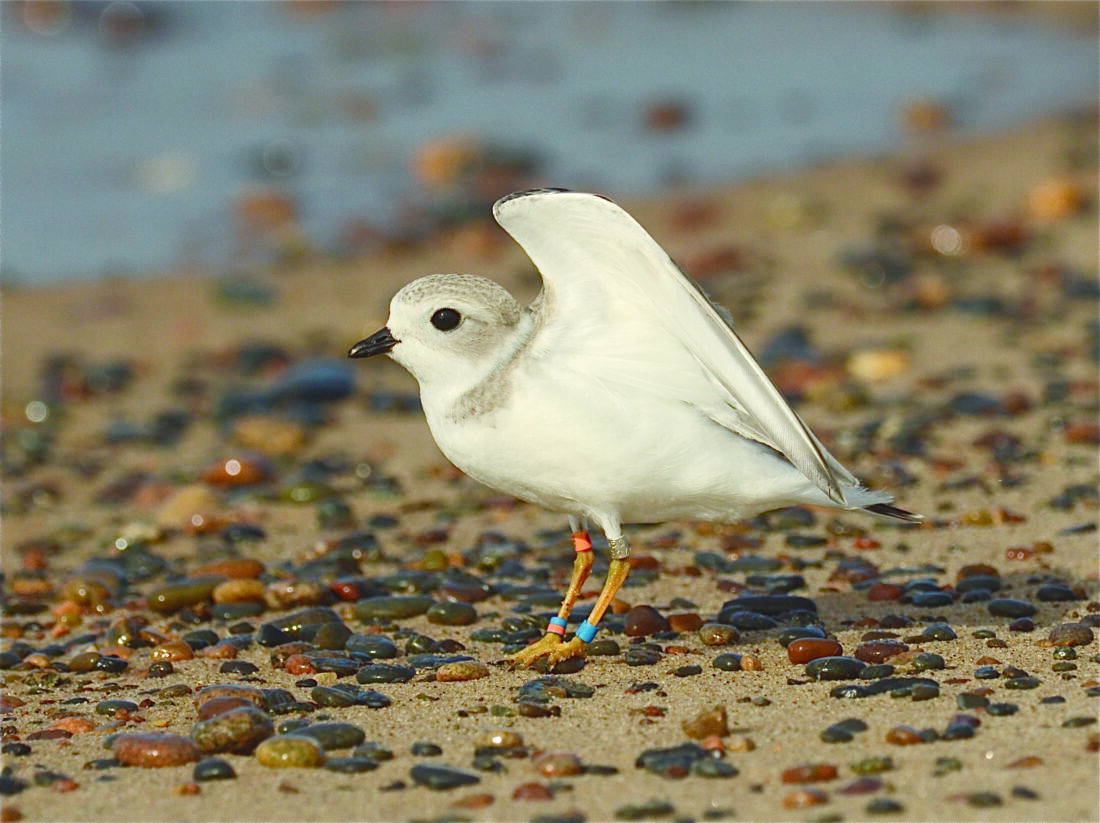
A piping plover looks on. (Scot Stewart photo)

STEWART
A piping plover looks on. (Scot Stewart photo)
STEWART
Trending
"In early June the world of leaf and blade and flowers explode, and every sunset is different." - John Steinbeck
Suddenly, summer! Leaf out appears to be complete for all but a few black locust trees. Lilacs are full and daisies are just about ready to bloom. Sadly, it looks like grass is ready to be cut. Tree leaves have filled out too.
Tent caterpillars have shown up in a few places in the U.P., like Seney National Wildlife Refuge already this summer. Groups of these moth larvae create enclosures made of their own silk to protect themselves from predators. After they eat the plant leaves inside the tent they must move out and create a new shelter, These moves by the caterpillars make them vulnerable to predators like cuckoos. There two species, yellow-billed and black-billed cuckoos in the Upper Peninsula. They are among the few birds willing to take on the hairy structures that cover the moth larvae. Equipped with long bills, the birds take the caterpillars to a nearby tree or bush and strike them against the branches, breaking off most of the outer surfaces of their prey before eating them.
As some areas have their caterpillar numbers reduced the cuckoos may move on to find other tent infestations. Several yellow-billed cuckoos, the rarer of the two, have been reported in Marquette County this month. Army worms and spongy moths (formerly called gypsy moths) are other species with larvae eaten by cuckoos. Obviously, cuckoos are great birds to have around.
The midge hatch has finally kicked into full gear on the Lower Harbor breakwall in Marquette. It is often an important place for shorebirds needing a refueling stop on the long haul from the farther end of South America as they head to northern Canada and Alaska. It seems a fair share of the shorebird migration is over, however. The long stretch of fair weather last week may have helped late migrants to continue without having to deal with adverse weather from big storms, at least in this area. A dunlin and one sandpiper were seen on the breakwall last Tuesday. A late white-crowned sparrow was also seen on the structure.
The current midge hatch has not gone unnoticed though. On Tuesday a lively flock of swallows was found zooming up and down the breakwall catching the midges on the wing. The flock included barn, cliff, and tree swallows, cutting low as they flew along the concrete to scoop the small insects hovering over the wall. The barn swallows and some cliff swallows may be nesting in the Lower Harbor ore dock downtown.
The barn swallows build mud, feather, and grass nests on ledges under eves and bridges that are similar to robins' in construction. Cliff swallow nests are built on perpendicular rock and building facing using mud to construct gourd-shaped nests. Many in town are on the sides of buildings like barns and on concrete bridges. Tree swallows are cavity nesters using bluebird boxes and cavity holes like old woodpecker nests.
All three species are extremely important in their roles as flying insect eaters. Besides the midges, they consume huge numbers of flies, mosquitoes, moths, and other insects. Unfortunately, their numbers in the U.P. have dropped considerably over the years due to the effects of insecticides, habitat loss. Like many birds wintering in Central and South America they face a double whammy from a variety of chemical pesticides both there and here.
Habitat loss for tree swallows comes from a more passive problem. Because a large percentage of their nests are in tree cavities, management of woodlots and removal of dead trees has reduced the number of nesting sites available to them. Their numbers have dropped by about 30% over the last 50 years. Placing nest boxes out for them can help the swallows and in the reduction of unwanted insects.
A small number of shorebirds was seen at the Portage Marsh on Lake Michigan last Friday. Along with summering killdeer and spotted sandpipers, a pair of semipalmated plovers and three semipalmated sandpipers were also seen. Some late sandpipers and plovers will continue to pop up through the end of the month. However, as July starts birders believe shorebirds seen here then are probably southbound. These may be birds that lost mates or had failed nests. Because of the short nesting window in the Arctic, these birds do not have the luxury of enough time for double clutches and must resolve to head back to their winter homes and try again next year.
Just a few shorebirds actually nest in the U.P., killdeers, spotted sandpipers, and piping plovers. The piping plovers are endangered in Michigan and are making a slow comeback in the state due to rigorous efforts being made to protect them and their nesting sites on beaches here. Currently one of the best known sites is at Whitefish Point where the birds are under a heavy watch in the attempt to improve nesting success.
Piping plovers nest on gravel beaches and attempt to blend into with the pebbles. To reduce the dangers to nest, eggs, and young birds, fencing is erected in a wide perimeter around the nests once they are started to reduce contact with beach walkers, vehicles, dogs, and wild animals like raccoons and foxes. At many sites volunteers also keep a watchful eye on nests. Birds are still vulnerable to predation from raptors like merlins and exposure to weather events like hailstorms that occasionally threaten birds on nests.
Plovers have nested on a number of beaches on Lakes Superior and Michigan in recent years. Nest watchers have noted unattached birds often hanging out nearby so long-term nesting may expand in the years to come! Looks like summer is in full swing!