
Copper Country conservation
Pilgrim River land protected, but open to public
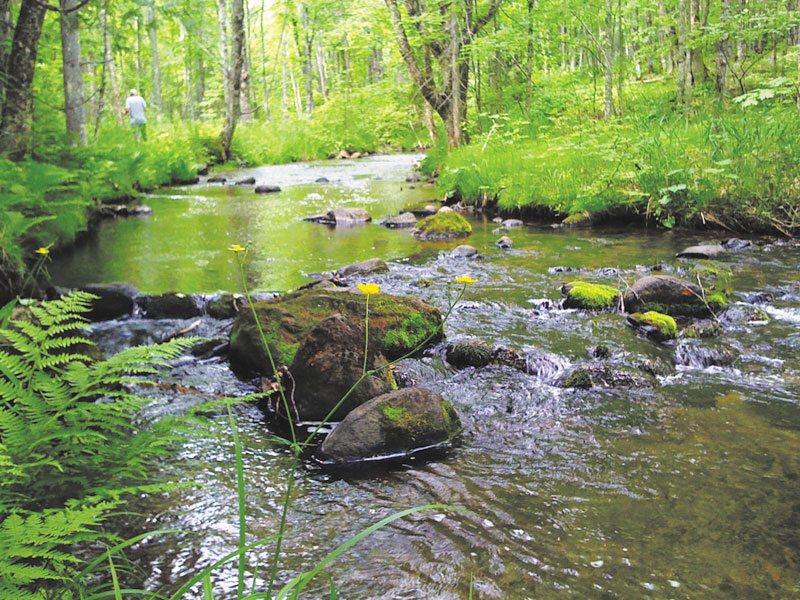
The Pilgrim River Forest includes conservation easements on almost 1,300 acres of forestland and 3.5 miles of the Pilgrim River corridor. It also provides habitat for many wildlife species. (Photo courtesy of the Michigan Department of Natural Resources)
MARQUETTE — Protected land usually just doesn’t happen by itself.
Case in point: The Pilgrim River Forest Project, an acquisition that includes conservation easements on nearly 1,300 acres of prime forestland and 3.5 miles of the Pilgrim River corridor, which is next to the Pilgrim River Community Forest.
Land along the Pilgrim River in Houghton County will be protected and open to the public, thanks to a recently completed project that partnered the Michigan Department of Natural Resources and the Keweenaw Land Trust.
However, the effort to create the conservation easements also involved years of hard work by the Copper Country Chapter of Trout Unlimited as well as conservation-minded private landowners and many community partners.
Bill Leder, president of the Copper Country Chapter of TU, spoke about the Pilgrim River protection efforts Wednesday at a meeting of the Fred Waara Chapter of TU, which took place at the Landmark Inn in Marquette.
“We’re kind of proud of this,” Leder said of the project, whose river lies near Houghton and Hancock.
The watershed encompasses about 15,000 acres, he said.
“It’s not the biggest watershed, but it’s fairly significant,” Leder said. “The Pilgrim River has a fairly steep gradient, so it cleans itself out generally most springs.”
He called the river’s location, which he said is 4 miles from his front door, an asset. However, that brings the potential of urbanization.
“We need to think, ‘What’s this area going to be like 100 years from now?'” Leder asked. “It’s not just for us. It’s not just for our kids and our grandkids.”
Thus comes the need for land protection, with the potential for growth one of the motivating factors for the project.
The project objectives, Leder said, are:
≤ to protect an excellent trout stream;
≤ to enhance general public, non-motorized uses in addition to fishing;
≤ to maintain a high-quality working forest based on sustainable practices;
≤ to maintain scenic views;
≤ to support the local economy; and
≤ to ensure there are no future land changes for the conserved land.
The land, according to the DNR, provides habitat for black bear, white-tailed deer, bald eagles, fishers, pine martens, beaver, mink, otters and migrating birds. The project promotes sustainable timber management, which benefits wildlife by creating forests in various stages of growth.
Evan McDonald, executive director of the Keweenaw Land Trust, said in a news release: “The waters of the Pilgrim River reach Lake Superior, so the health of this watershed is important for the health of the larger ecosystem.”
However, he noted the benefits reach far into the future too.
“It ensures that the Pilgrim River will flow with clean water supporting brook trout and that a healthy forest will provide timber products, wildlife habitat and special places for the generations ahead to enjoy,” McDonald said.
The DNR purchased conservation easements on 1,103 acres, using money from a $550,000 grant from the U.S. Forest Service’s Forest Legacy Program and a $170,000 contribution to the DNR from the Pilgrim River Watershed Project. The donation of conservation easements to the Keweenaw Land Trust contributed the remaining 192 acres of the project.
“The acquisition of this working forest conservation easement will provide numerous public outdoor recreational opportunities,” said DNR Forest Resources Division Chief Debbie Begalle in a news release. “It also will help sustain the forest products industry in Michigan.”
A majority of Michigan’s forests are in private ownership. A conservation easement allows landowners to retain ownership of property while requiring management that protects natural resources. In the Pilgrim River’s case, the easements also provide the public with access benefits.
The project area also includes 1,295 acres of prime forestland with varied topography. Most of this land offers public outdoor recreational opportunities such as hunting, fishing, trapping, birding, hiking, cross-country skiing, wildlife viewing and snowshoeing.
Leder said the project was 12 years in the making, conceived in 2005 by TU’s Copper Country Chapter. In 2009, the Hovel family bought the land and fundraising efforts began, and about five years later, a $286,000 Community Forest grant from the U.S. Forest Service was obtained. The $550,000 grant from the Forest Legacy Program — which is administered by the USFS but goes through the DNR, with funding coming from the DNR’s Land and Water Conservation Fund — came in 2015.
Before the easements and purchases were put in place, though, the Hovel family gave the OK to build trails, Leder said.
“With those trails there, we got people out there, and the project began to sell itself, and that was one of the keys, I think, to our success,” Leder said.
Also, he pointed out the USFS rated the project highly because the connection between two tracts through another tract was seen as a strategically important aspect, considering the proximity of attractions such as Michigan Technological University’s Portage Lake Golf Course and MTU’s trails as well as a nature area owned by the city of Houghton.
“One could almost envision eventually sort of a linear conserved area where you could literally start out in the morning at the mouth of the river, and if you had the time and energy, you could walk, you know, literally 10 or 12 miles upstream,” Leder said.
The Community Forest part of the project came first, he said, with the $286,000 grant providing 50 percent of the cost. The other 50 percent came from a match from the John A. Woollam Foundation.
“This was really key to getting a lot of local interest and a lot more local donations financially because we had a success under our belt,” Leder said.
That kind of success could have a greater purpose.
For instance, he pointed out the Pilgrim River is an experimental stream for coaster brook trout, with special regulations applying on a section of the river.
“We don’t have an infinite amount of natural resources and our population growth is following a power curve, so it’s a question of how we want to define our communities and ourselves,” Leder said.
Christie Bleck can be reached at 906-228-2500, ext. 250. Her email address is cbleck@miningjournal.net.
Friday: Outdoors

Iowa water pollution threatens health but summer fun, too
Michigan Tree Fruit Commission invests in productive MSU research

Reaching the crest of summer a once-a-year treat
It’s summertime and the bird sightings are only increasing

Weekly DNR fishing report