
It’s summertime and the bird sightings are only increasing

Scot Stewart
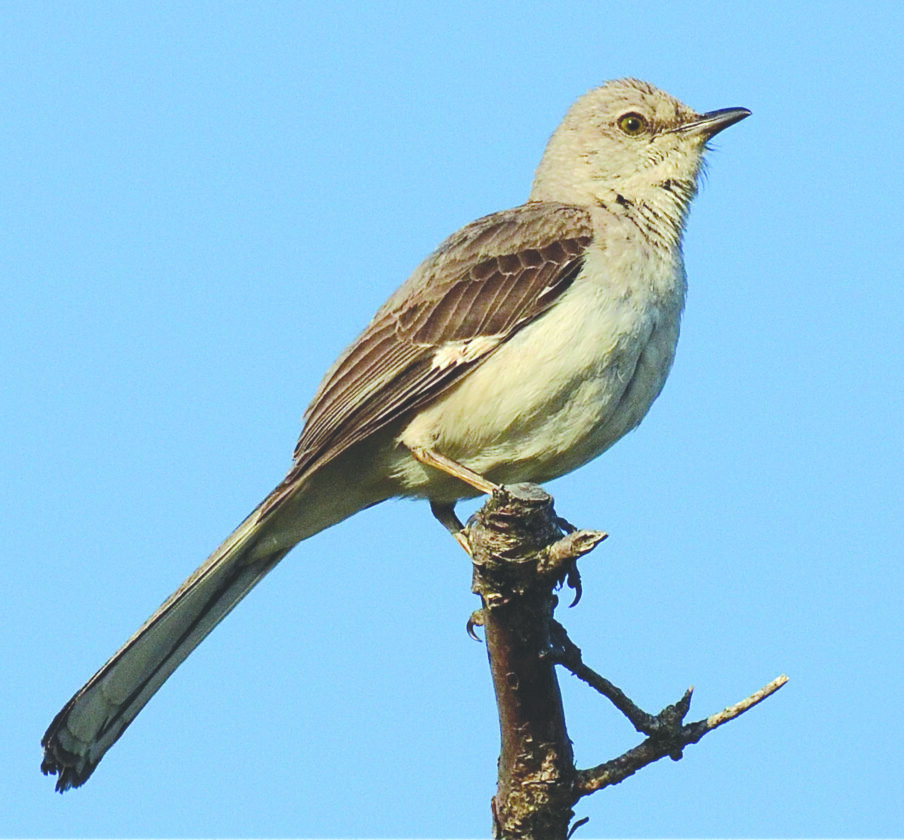
Northern mockingbirds like this one are an uncommon sight in the Upper Peninsula, despite the “northern” part of their name. (Photo courtesy Scot Stewart)
Scot Stewart
Northern mockingbirds like this one are an uncommon sight in the Upper Peninsula, despite the “northern” part of their name. (Photo courtesy Scot Stewart)
Trending
"Mockingbirds don't do one thing but make music for us to enjoy ... but sing their hearts out for us." -- Harper Lee
One of the best surprises that annually come to the Upper Peninsula in May and early June is an appearance of a northern mockingbird.
Despite their name, they are not commonly found this far north. Over the past 20 years, they have made more frequent appearances in Marquette County in May and early June. While there have not been many reports in other parts of the U.P., they have surely passed through.
Marquette County continues to have a stunning number of active and qualified birders out daily, so many short-termed visitors, like northern mockingbirds, do get a notice and several have been found already this spring.
Currently, a mockingbird has be seen daily in the fields on the east side of the Superior Dome in Marquette. In addition to its hunting technique of swooping to the ground to catch insects, it has been heard doing its rendition of singing over a dozen imitations of other bird songs and calls.
Twelve warbler species were seen on Tuesday at J.W. Wells State Park south of Cedar River in Menominee County, all locals. Cape May warblers do nest in the U.P., but many continue on farther north for the summer.
An eastern towhee was found in the park, and they become more challenging to find as searches for them head north in the area. Cornell's Lab of Ornithology doesn't include the northwestern part of the U.P. as part of the towhee's summer range, but Sibley's Guide does.
At one time, the eastern towhee and the spotted towhee, a western species, were lumped together as the rufous-sided towhee. Different plumages and songs led to advanced genetic examinations showing they were differentiated enough to be considered a separate species. According to the Cornell website, the differences were due to the separation of the population caused by glaciation. Enough differences developed to deem them two different species. Both species occur across the Great Plains, where they do interbreed.
A solitary sandpiper found at J.W. Wells was still probably trying to make its way north. Their summer range lies across central Canada and is about 100 miles north of Lake Superior. Ironically, they will nest in old nests of robins, eastern kingbirds and cedar waxwings, all species found in the U.P. in summer.
Six northern house wrens were also found at the park, but the eBird report did not note if wren houses were present. J.W. Wells is located right on Lake Michigan, so it is able to scoop up shorebirds and migrating warblers following the shoreline north. Both shorebird and warbler migrations are nearing an end, but with the unusual weather this spring some unusual appearances seem to be continuing,
A birder recently studying birds at the rocks in the Lower Harbor of Marquette where American herring gulls nest recently spotted a young double-crested cormorant on the rocks. The cormorants frequently rest there in springtime between foraging jaunts but nesting there is a relatively new development.
There can be some competition between the two species, but generally the gulls prefer higher spots with grass. If no grass is available, they will collect it on the hills onshore. The cormorants frequently end up on lower ledges in rock hollows.
Some bird name changes may be noticeable in conversations this spring. A number of local bird species were split, resulting in longer names here, like American herring gull, northern house wren, eastern warbling vireo and northern yellow warbler. This is good news to birders trying to add to their life lists!
A very ambitious crow has been making the rounds through the neighborhood around McCarty's Cove in Marquette in the past year. There are certainly good numbers of crows in town, and they are mostly indistinguishable.
This one is different. Apparently due to an injury to its left wing, it has not been seen in flight. It hops through yards and across streets and seems quite adept at using the same motion to climb high into trees, where it sometimes calls loudly for 15 or 20 minutes until other nearby crows join in the conversation.
The Whitefish Point Bird Observatory Spring waterbird and hawk counts concluded on Sunday, and their totals for the spring season have been posted online at https://www.trektellen.org/count/view/4562/20260531 for the hawk watch, and https://www.trektellen.nl/count/view/4209/20260531 for the waterbird watch. These links are on the research page of the WPBO website.
Selections of their numbers have been posted here through migration and now it is a great look back at the entire season. Some species numbers vary from the two locations at the point but many of the final numbers are quite impressive. The counts ran daily -- rain, blizzards or shine -- from March through May for waterbirds and April through May for the hawk watch, starting daily at official sunrise for eight hours.
More than 71,000 birds were tallied by the waterbird counter at the tip of the point with 209 species. Over 53,800 individual birds were counted by the hawk counter with 181 bird species. Bats, butterflies and dragonflies were also tallied.
Confirming a big year, 11,251 blue jays were counted, including 335 on the last day. Nearly 11,000 sharp-shinned hawks were also counted. Some 118 golden eagles passed the point during count hours, while 985 bald eagles were counted. Other impressive totals include 1,515 black-capped chickadees, 880 common ravens, 1,695 common grackles, 874 American kestrels, 3,288 common loons and 4,193 broad-winged hawks.
These totals help illustrate both the value of the annual census work conducted at Whitefish Point and the critical importance of the flyway used by so many species of birds each spring and fall.
The U.P. is an amazing place to observe the natural history of birds and the region.