
‘Clean, drain and dry’
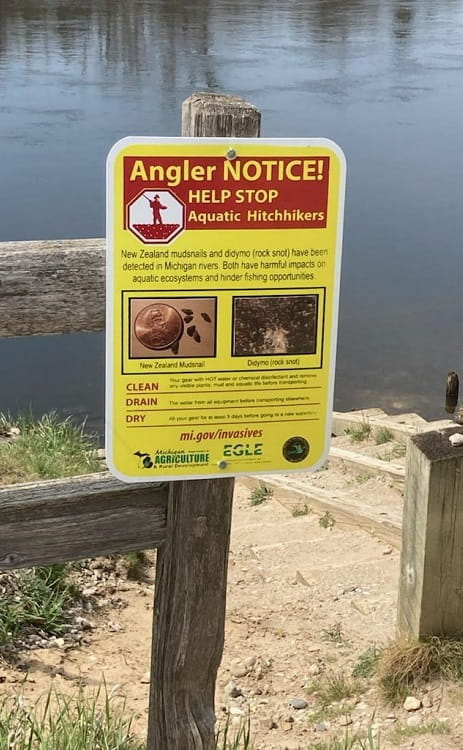
These signs alert recreationists to the potential problems of didymo. It also urges them to “clean, drain and dry.” (Photo courtesy of the state of Michigan)

Here is a didymo, an aquatic invasive species that has been detected in Michigan. (Photo courtesy of the state of Michigan)
These signs alert recreationists to the potential problems of didymo. It also urges them to “clean, drain and dry.” (Photo courtesy of the state of Michigan)
Here is a didymo, an aquatic invasive species that has been detected in Michigan. (Photo courtesy of the state of Michigan)
Trending
MARQUETTE -- "Why, Oh Why Won't They Clean, Drain and Dry?" is the clever title of the Aug. 10 NotMISpecies webinar, but the seemingly innocent plea could have bad implications if more boaters and anglers don't heed the call to change their behavior to mitigate the risk of aquatic invasive species.
Talking about her research into AIS, which are found throughout Michigan, was Carrie Meier, who is working on her master's degree in fisheries and wildlife at Michigan State University.
Current outreach focuses heavily on recommended cleaning steps, like "Clean, Drain and Dry," she said.
"These campaigns actually, of course, increase a wealth of knowledge, which is wonderful, but we're still seeing spread," Meier said. "So, there's a knowledge-to-action gap, that we want to figure out what that is, and combat that."
Evidence of the spread, she said, is the presence of didymo in the downstate Manistee River.
According to the Michigan Invasive Species website, didymo -- also known as "rock snot" -- is a microscopic algae (diatom) that produces stalks that form thick mats on hard surfaces like rocks in stream beds. Although it's also called rock snot, didymo is not slimy. Instead, it looks and feels like white or tan/brown wet wool and ranges from small cotton ball-sized patches to thick blankets and long ropy strings that flow in currents.
These mats change habitat and food resources for fish and can foul water intakes and fishing gear, among other unpleasant effects.
Didymo cells can be transported on boats, anchors and fishing gear.
"All it needs is one cell, and it can spread widely," Meier said.
Through her research, she wants to discover why more people aren't taking proactive steps to stop the spread of aquatic invasives.
In that vein, Meier wants to figure out things such as what encourages positive behaviors as well as boater and angler perceptions and knowledge.
There were three phases of research, she said: face-to-face interviews in lower Michigan, follow-up surveys and cleaning stations.
In 2021, there were 499 angler surveys and 488 boaters, she said. Among boaters, about 34% indicated they always clean their boats, with only 13% never cleaning their vessels. Among anglers, about 34% acknowledged always cleaning their equipment, while almost 25% said they never clean it.
The top three reasons boaters gave for not cleaning, Meier said, were lack of time, the inconvenience and not seeing the need. For anglers, the top three reasons were inconvenience, seeing no need and lack of time.
Combating the spread of AIS, Meier said, involves addressing two major issues: time and inconvenience.
"It's going to take time," she said. "There's no way of getting around that. We can't fast-forward life."
However, Meier stressed that people must understand that cleaning equipment is important.
And it doesn't take too many minutes off the clock.
"Maybe giving some demonstrations might help out more," she said. "People can see, 'Oh, it takes just a couple of minutes to do this. I can totally do that.'"
Wash stations at access points could help anglers, Meier said, plus they can keep a spray bottle of Dawn dish soap and water to clean after they leave the water.
Having the common understanding that it is a personal responsibility of every angler to protect the waterways is important, Meier said.
"You go out to fish," she said. "You want to enjoy that nice, beautiful river or lake, and if it's mucked up with AIS, it's not going to be as enjoyable."
People talking with each other about AIS is helpful, she said, and spreading the word will have a snowball effect.
Follow-up surveys also were conducted as well, with some encouraging results.
After the 5- to 10-minute discussions she had with people on the water, many people indicated that they talked with other people about it, she said.
Did people start cleaning more?
The surveys also showed that people started to increase their cleaning efforts
"It did have an impact," Meier said.
The research program was funded by the Michigan Invasive Species Grant Program.
The NotMISpecies webinar series is run by the Michigan Department of Environment, Great Lakes, and Energy. For details on upcoming webinars, visit https://www.michigan.gov/egle/outreach/not-mi-species-webinar-series.
Christie Mastric can be reached at 906-228-2500, ext. 550. Her email address is cbleck@miningjournal.net.