

Trending
By Fahad Abdullah
8-18 Media
The conflict unfolding in the Middle East isn't something I'm watching from a distance; it's something I'm living in real time. Messages come in at all hours. Updates from my family. Each notification carries a quiet gravity that stays with me long after the screen goes dark. "We're okay." "Did you see what just happened?" "There was another explosion."
Conversations that once felt ordinary don't feel that way anymore. Regardless of where they begin, they all bounce back to the same question: Are you safe? Sleep has become a luxury. Families lie awake through the night, phones in hand, waiting. Not for answers... just for reassurance.
There is no clear beginning or end to the fear. It exists in between moments, in silence, in waiting, in the seconds before opening the next message.
In recent weeks, rising tensions across the region have begun to disrupt everyday life in ways that extend beyond what is immediately visible. Universities and schools in some areas have shifted to online learning as a precaution, flights have been diverted, and security measures have intensified. Routines that once felt stable are now uncertain. While these countries are not directly involved in the conflict, the effects have become increasingly difficult to ignore.
What is often framed as a conflict between nations has spilled far beyond the parties directly involved. In countries such as Kuwait, Bahrain, Qatar, Saudi Arabia, the United Arab Emirates, and others long known for their stability and peace, daily life has been profoundly shaken. Innocent lives have been lost and even those not directly involved are living in the shadow of a war that refuses to stay contained. Important government officials in many of these countries have taken time from their daily schedules to visit people injured in the conflict.
There is loss. There is fear. And even for those not directly involved, there is no real distance from it. And yet, much of this reality exists outside global attention, unseen, unspoken, and often misunderstood.
These examples offer only a small glimpse into a much larger reality across the region. Numbers can outline the situation, but they cannot explain what it feels like to live through it.
But statistics and reports alone cannot capture the full weight of what this moment feels like;
because beyond the numbers are people, waiting, worrying, and holding onto anything that sounds like safety.
For many, the hardest part is not being there. For those studying abroad, distance does not mean detachment. If anything, it makes the waiting heavier.
"I just came back to London like a week ago or so. The conflict has made a huge dent on my family from getting siren ptsd when I came back to London to feeling worried sick about my family back home, however, we always checked on each other and made sure that the other was okay. All we can do is pray for the best and hope this ends as quick as possible."
-Rakan Alsaleh
Civil Engineering student (studying in London)
Conflict Unfolding in the Middle East
"This war has taken me away from my normal routine at university and the hospital, and shifting online has made learning feel isolating. Waking up to the sound of sirens has made me realize how fragile stability is, and I no longer take even the simplest routines for granted."
-Dora Safar
4th year medical student (studying in Bahrain), currently in Kuwait
“Kuwait is a land of peace and humanity, and our safe home. We are grateful for this blessed nation and will always stand united against any aggression. O God, preserve our country with safety and stability, protect us and all Muslim lands, and keep us safe from all harm.
For others, there is no distance at all. For those still in the Middle East, the impact is not something they hear about, it is something they live through, moment by moment.”
-Monira Alkidim (translation summary)
Industrial and Systems Engineering student, University of Southern California (USC)
"I think the media can sometimes present a different picture of what daily life is actually like in the region. From the outside, it may seem as though all Arab countries are constantly under threat... which isn't entirely accurate. While it's important to take precautions, people are still able to carry on with their daily lives and feel safe doing so. Although the war has been challenging, there have been moments of uncertainty, especially when missile or drone interceptions occurred close by, which at times affected my sleep and focus. Despite this, I've worked to maintain consistency in my routine. The impact is visible in quieter roads, malls, and parks, however, we remain hopeful, supported by constant prayer and reassured by leadership efforts to keep us safe."
-Abdullah Qussay Hajjiri
Medical student, Jordan
"Here in Kuwait, daily life continues normally, but the ongoing tensions create uncertainty about the future, especially economically and geopolitically. It also makes people follow the news more closely and think more carefully about regional stability. While Kuwait remains safe and stable, any conflict in the region naturally raises concerns and reduces the sense of normalcy. People in the Gulf value stability, so even distant tensions can create psychological pressure and a cautious outlook. People often think the impact is immediate, but in reality, it's the long-term uncertainty and regional tension that affect us the most."
-Mohammed Fahad Almarshoud
Kuwait citizen, Kuwait
"Although my daily routine hasn't changed drastically, the situation has definitely affected me mentally. Important school examinations have been cancelled as a precaution, and I often wake up in the middle of the night to emergency alerts about possible incoming threats, usually between 1 and 3 am. Even though nothing has happened, the repeated alarms make it hard to feel completely at ease."
-Malek Rahim
Student, Saudi Arabia
"The war brought my life and daily routine to a halt. It felt like everything had been put on hold. Back then, I was busy with college, and life felt exciting. Now, I'm just at home, waiting for all of this to end."
-Abdullah Alkhalifa
Medical student, Bahrain
"This war in the region has been the most shocking experience in my life. Siren alarms waking us in the middle of the night, explosion sounds jolting me out of bed almost every single night! With the thought that I have to focus and have a clear mind to attend to my patients the day after. The result is total exhaustion. It’s difficult to assure my patients and myself that all is OK, which is not. I fear the worst yet coming, water+energy disconnection or shortage in necessary supplies. Shifts have doubled in the hospital due to current circumstances. Daily meetings on updated emergency procedures take place in case of possible ongoing disaster.
All I can do is do my job, focus on patients, pray and hope for the best."
-Dr. Sarah M. Jumah
General Physician, Qatar
These experiences may differ in distance, but they are united in one thing: uncertainty.
At its core, this is not only a story of conflict, but of proximity, uncertainty, and the quiet ways in which it reshapes everyday life.
And for many, even from thousands of miles away, it is a story they are still living, one message, one call, one night at a time.
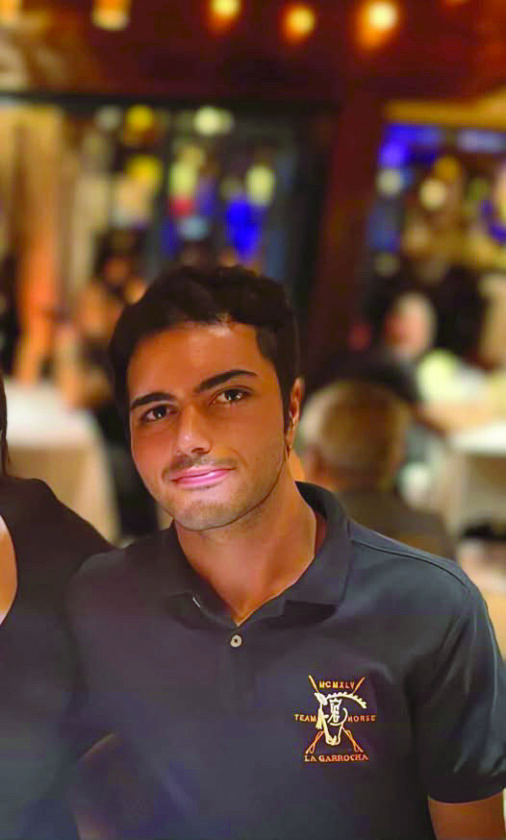
Fahad Al Abdullah is a Kuwaiti-American student at Loyola Marymount University, majoring in Biology and Biochemistry. His father is from Kuwait and his mother is from Michigan.