
A deep dive into the Olympic journey of U.S. women’s hockey team

Boston Mayor Michelle Wu, right, laughs while feeling the weight of an Olympic gold medal as U.S. women's gold medal hockey player Megan Keller looks on during a gathering with fans on March 2 in Boston. (AP file photo)

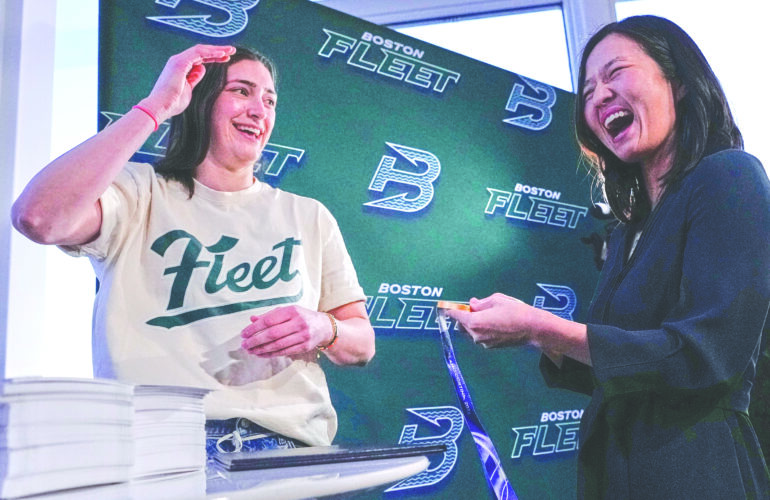 Now that the 2026 Winter Olympics have concluded, as a hockey player, one of my favorite sports to watch is hockey, especially women’s hockey.
It’s been 28 years since women’s hockey was introduced to the Olympics. The main rivalry is the United States vs. Canada. Considered the top teams in the Olympic lineup, they have battled each other for years.
Let’s take a look at the last two Olympics and how this rivalry has played out.
In a very close game in 2018, the U.S. beat Canada 3-2 in a shootout to take the gold in Pyeongchang, South Korea. Then, in 2022, Canada beat the U.S. 3-2 in the final in Beijing, China, securing the gold for that Olympics.
This year, the intensity was high.
Some of the top American players are team captain Hilary Knight, who wears jersey No. 21, a five-time Olympic medalist, who, this year, broke the record for the most Olympic goals by a U.S. women’s hockey player, with 15.
Forward Abbey Murphy, No. 37, known for her competitive play, had two goals and five assists over the seven games and was a key source of offensive playmaking with her aggressive style.
Defender Laila Edwards, No. 10, who, as of this year, made history as the first Black woman to represent Team USA in hockey, ended the tournament with two goals and six assists, including a crucial assist for the game-tying goal in the gold-medal final.
Now, let’s get into the games. On Feb. 5, the U.S. played Czechia in a preliminary game and dominated with a final score of 5-1, with Alex Carpenter scoring the first goal on a power play. Joy Dunne scored just 3:13 into the second period. Just over a minute later Hayley Scamurra scored, making it 3-0. On a breakaway, Barbora Jurickova scored Czechia’s single goal about 8 1/2 minutes into the second period.
Two days later on Feb. 7, in another preliminary game, the U.S. beat Finland 5-0. Carpenter scored the first goal with an assist from Laila Edwards at 15:19 of the first period. In the second period, Taylor Heise scored on a 3-on-1 just 2:31 in. Then, 66 seconds later, defender Megan Keller scored, making it 3-0. With an impressive final score, this set off a thrilling winning streak for the U.S. team.
On Feb. 9, the Americans beat Switzerland 5-0, setting the U.S. up for its final preliminary game against their Canadian rivals the next day.
The first goal vs. Canada was scored by Caroline Harvey early on at 16:15, assisted by Hilary Knight. At 2:42, Hannah Bilka scored her first goal of the game, making it 2-0. Just a minute and a half into the second period, Kirsten Simms scored on a power play, followed by Bilka’s second goal of the game at seven minutes, assisted by Abbey Murphy.
Edwards scored the final goal at 8:07 of the third. Finishing with five goals, Team USA clearly dominated. This was the first time Canada has ever been shut out — scored no goals — in an Olympic game. Team Canada was also missing its team captain, Marie-Philip Poulin, due to an injury, which put their players at a disadvantage.
The U.S. advanced to play Team Italy in the quarterfinal on Feb. 13, easily winning 6-0. The first goal was scored by Keller at 13:41, and the last by Bilka in the second period. Italy’s goalie Gabriella Durante made 19 saves in the first period, only letting in one goal.
No goals were scored in the third period, and the game began to get scrummy; a few fights almost broke out. This win secured the Americans a match against Sweden in the semifinals on Feb. 16. If they could win there, they would go on to the gold medal game.
I am happy to say that they did, winning 5-0 vs. Sweden to begin to prepare for the final.
In that last game against Team Canada, there was plenty of excitement. The first period held no goals, the first being scored by Kristen O’Neill of Team Canada just 54 seconds into the second period. It was a shorthanded goal, meaning Canada scored while having a player in the penalty box and one less player on the ice than the U.S.
Canada protected its net for most of the game until Team USA captain Knight scored a thrilling record-breaking goal with just 2:04 left in the game. She deflected a pass from Edwards, scoring her 15th Olympic career goal, the most of any U.S. women’s hockey player in the Olympics.
This tied the game, making it go into a 3-on-3 sudden death overtime. At 4:07 into OT, Keller scored on a breakaway using her backhand, passed to her by Heise.
With a final score of 2-1, this secured the U.S. team the gold medal to close off an amazing tournament.
I hope this column satisfied the hockey players out there and interested the nonhockey players as well!
Ondine Clark-Bonk is a 12-year-old with a passion for food, hockey and painting strange scenes. She is an old soul and only wears comfortable clothes.
Morning UP
NASA still puzzled by astronaut’s quick onset of sickness in space
Even long ago, U.P. weather could be rather fickle
A deep dive into the Olympic journey of U.S. women’s hockey team

Jehovah’s Witnesses ease policy on transfusions a bit

NASA brings moon rocket back to launching pad
Upcoming activities at your library
These are activities scheduled at the Peter White Public Library in Marquette through Thursday: • Art with Ella ...