Goodall’s death brings focus to her wide-ranging influence
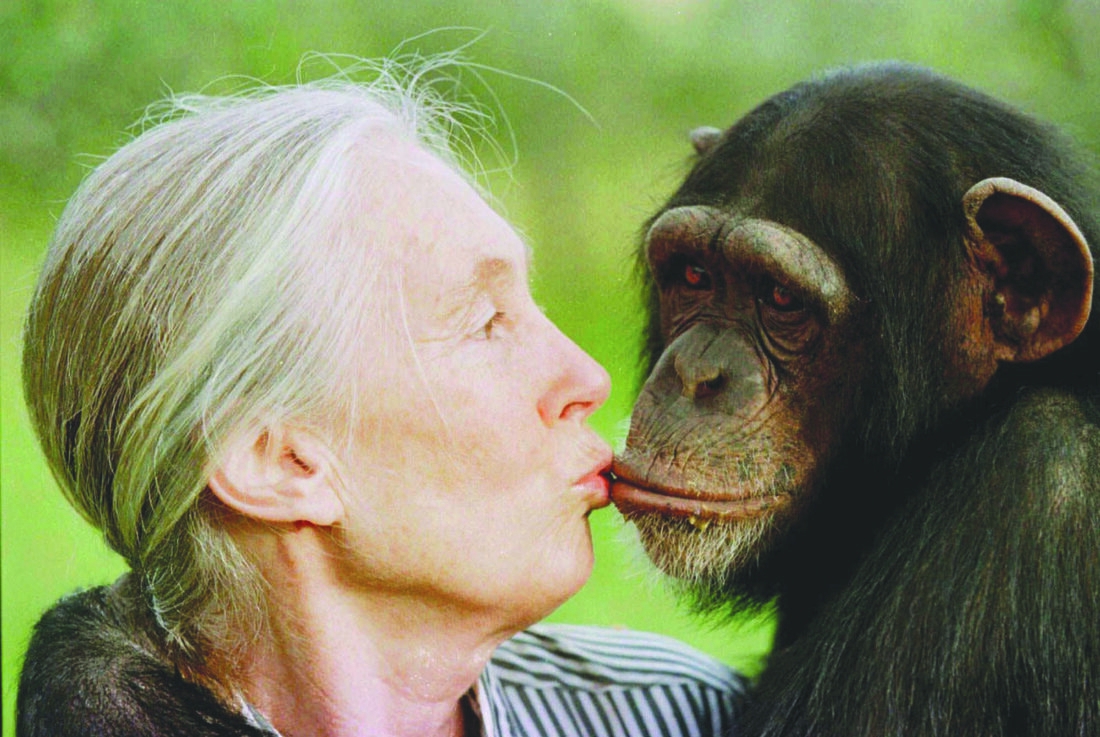
Jane Goodall kisses Tess, a female chimpanzee, at the Sweetwaters Chimpanzee Sanctuary near Nanyuki, north of Nairobi, Kenya, on Dec. 6, 1997. (AP file photo)
In her 91 years, Jane Goodall transformed science and humanity’s understanding of our closest living relatives on the planet — chimpanzees and other great apes. Her patient fieldwork and tireless advocacy for conservation inspired generations of future researchers and activists, especially women and young people, around the world.
Her death on Wednesday set off a torrent of tributes for the famed primate researcher, with many people sharing stories of how Goodall and her work inspired their own careers. The tributes also included pledges to honor Goodall’s memory by redoubling efforts to safeguard a planet that sorely needs it.
Minds, emotions
“Jane Goodall is an icon – because she was the start of so much,” said Catherine Crockford, a primatologist at the CNRS Institute for Cognitive Sciences in France.
She recalled how many years ago Goodall answered a letter from a young aspiring researcher. “I wrote her a letter asking how to become a primatologist. She sent back a handwritten letter and told me it will be hard, but I should try,” Crockford said. “For me, she gave me my career.”
Goodall was one of three pioneering young women studying great apes in the 1960s and 1970s who began to revolutionize the way people understood just what was — and wasn’t — unique about our own species. Sometimes called the “Tri-mates,” Goodall, Dian Fossey and Biruté Galdikas spent years documenting the intimate lives of chimpanzees in Tanzania, mountain gorillas in Rwanda, and orangutans in Indonesia, respectively.
The projects they began have produced some of the longest-running studies about animal behavior in the world that are crucial to understanding such long-lived species. “These animals are like us, slow to mature and reproduce, and living for decades. We are still learning new things about them,” said Tara Stoinski, a primatologist and president of the Dian Fossey Gorilla Fund. “Jane and Dian knew each other and learned from each other, and the scientists who continued their work continue to collaborate today.”
Goodall studied chimpanzees — as a species and as individuals. And she named them: David Greybeard, Flo, Fifi, Goliath. That was highly unconventional at the time, but Goodall’s attention to individuals created space for scientists to observe and record differences in individual behaviors, preferences and even emotions.
Inspiring a wide range
From the late 1980s until her death, Goodall spent less time in the field and more time on the road talking to students, teachers, diplomats, park rangers, presidents and many others around the world. She inspired countless others through her books. Her mission was to inspire action to protect the natural world.
In 1991, she founded an organization called Roots & Shoots that grew to include chapters of young people in dozens of countries.
Stuart Pimm, a Duke University ecologist and founder of the nonprofit Saving Nature, recalled when he and Goodall were invited to speak to a congressional hearing about deforestation and extinction. Down the marble halls of the government building, “there was a huge line of teenage girls and their mothers just waiting to get inside the room to hear Jane speak,” Pimm said Thursday. “She was mobbed everywhere she went — she was just this incredible inspiration to people in general, particularly to young women.”
Goodall wanted everyone to find their voice, no matter their age or station, said Zanagee Artis, co-founder of the youth climate movement Zero Hour. “I really appreciated how much Jane valued young people being in the room — she really fostered intergenerational movement building,” said Artis, who now works for the Natural Resources Defense Council.
Legacy goes forward
Goodall’s legacy and life’s work will continue through her family, scientists, her institute and legions of young people around the globe who are working to bridge conservation and humanitarian needs in their own communities, her longtime assistant said Thursday.
That includes Goodall’s son and three grandchildren, who are an important part of the work of the Jane Goodall Institute and in their own endeavors, said Mary Lewis, a vice president at the institute who began working with the famed primatologist in 1990.
Goodall’s son, Hugo van Lawick, works on sustainable housing. He is currently in Rwanda. Grandson Merlin and granddaughter Angelo work with the institute, while grandson Nick is a photographer and filmmaker, Lewis said. “She has her own family legacy as well as the legacy through her institutes around the world,” said Lewis.
___
The Associated Press Health and Science Department receives support from the Howard Hughes Medical Institute’s Department of Science Education and the Robert Wood Johnson Foundation. AP’s climate and environmental coverage receives financial support from multiple private foundations. AP is solely responsible for all content. Find AP’s standards for working with philanthropies, a list of supporters and funded coverage areas at AP.org.
Morning UP

SpaceX launch of bigger Starship scuttled Thursday
FDA blindsided by OK for more e-cigs, nicotine pouches
El Nino lessens Atlantic hurricane forecast
US teen Buddhist lama now studies in Himalayan foothills
Spacecraft buzzes Mars on way to rare metal asteroid