Whitman Whirl-A-Ways
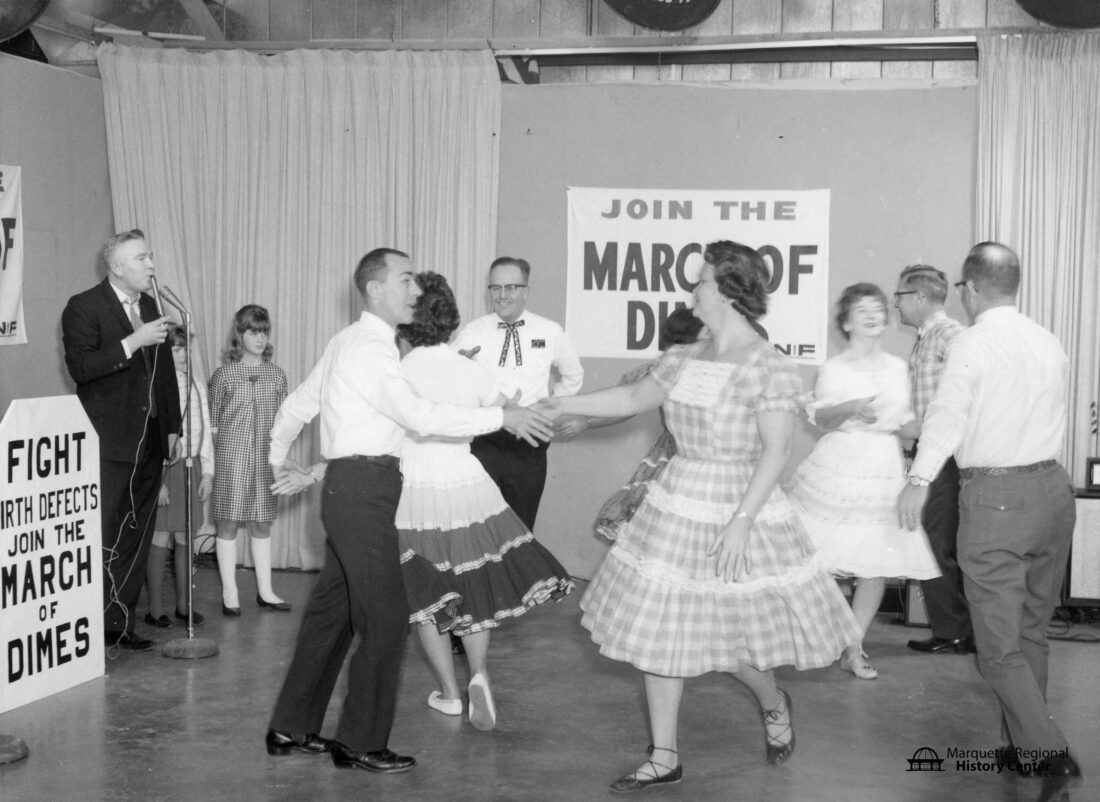
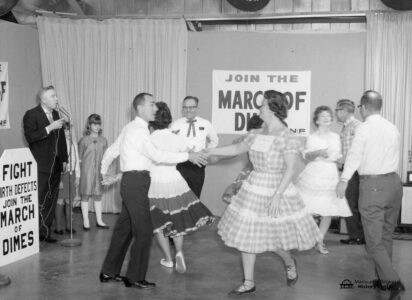
Pictured above is a photo from the Gordon and Mary Yates Square Dancing Scrapbook at the John M. Longyear Research Library. (Courtesy photo)
During the mid-20th century, the Upper Peninsula was home to many square dancing clubs- the Copper Hoppers (Keweenaw), the Keweenaw Kapers, the Blueberry Balancers (Champion), the North Star (Menominee), the Cottons ‘N’ Jeans (Iron Mountain), the Delta Merry-Mixers (Escanaba), the Swinging Sawyers (KI Sawyer AFB), the Straits Squares (St. Ignace), the Red Rockers (L’Anse), the Jolly Squares (Gwinn), and even the Centennial Hoedown Club (Sault Ste. Marie, Ontario). Marquette appears to have had the greatest number of clubs, including the Gad-A-Bouts, the Circle Four, the Northern Promenaders Knights of Columbus Saws, Happy Hashers and the Whitman Whirl-A-Ways.
Square dancing evolved in America taking influence from several older forms of dance, including European folk dances, such as English country dances, Scots-Irish reels, French quadrilles and cotillions, and African, African American and Native American traditions. In particular, the “calling” of steps was an African American innovation, which allowed lower- and middle-class dancers to participate without having to learn the dances from an instructor.
Modern Western square dancing consists of a set of 51 movements in the basic program with an additional 18 movements in the mainstream program. Rather than learning a complete routine, modern western square dancers learn basic movements and calls but do not know in what order they will be called.
While dancing, a square often consists of four couples. Using a visiting-couple structure, each couple takes turns leading the dance figure. The lead couple dance or visit with each of the other couples as they work their way counterclockwise around the set.
In early 1956 several people approached the Marquette City Recreation Department about sponsoring lessons in square dancing. An article in The Mining Journal generated enough response and the lessons started on the first Saturday of March 1956. After ten lessons, each couple was awarded a diploma of completion. The graduates then set out to organize a club to continue their dancing.
Initially the City Recreation Department intended to back the club financially but there were so many interested couples that the club was independent from the very beginning. In all, there were 48 couples when the group officially organized on May 28, 1956. The first caller was Dr. Bill West, later the Dean of Men at Northern Michigan College (now NMU).
The group met twice a month on Saturday evenings in the all-purpose room at Whitman Elementary (now NMU’s Whitman Hall). Dancing began promptly at 8:00 p.m. and lasted until 10:30, followed by a “lunch” and business meeting. Couples took turns hosting the dances, providing pop for the intermission along with coffee, tea, and some form of suitable food for the lunch afterwards.
The rules were quite strict – membership was limited to 60 couples and there were no single members. They had to “have the ability to dance on par with the group or have graduated from a series of lessons comparable to those sponsored by the City Recreation Department.” Dues were $6 per couple per half year.
Couples could only miss three consecutive meetings without an adequate excuse before being dropped from the membership. Arriving with alcohol on your breath or consuming alcohol during the dance would also result in being barred from the club.
The Whirl-A-Ways promoted their club, calling it “the couple hobby” and “Worldwide Hobby of Millions.” They also described it as “fun – easy – popular – fun – relaxing.” (Yes, they said it was fun twice). There was a waiting list for interested couples to join when a vacancy in the membership occurred.
The club evolved over the years. Following Bill West’s death in early 1960, Steve Baltic took over as caller for the Whirl-A-Ways. It was quite a commitment for him, driving in from Escanaba twice a month. Other callers included Russ Smith from Houghton and Dale Bocklund of Marquette. Meetings moved from Whitman Elementary to Silver Creek Elementary, Bothwell Middle School, and the Jacobetti Veterans Facility.
In 1981, the Whitman Whirl-A-Ways celebrated their 25th anniversary. At the time, there were still two of the original 48 couples dancing, Eileen and Ellsworth Johnson and Dorothy and Frank Schwemin. By the mid-1980s, the rules had relaxed a bit. Dances were now open to all square dancers.
Today, square dancing in Marquette continues in several settings. In September, the Marquette County Habitat for Humanity hosted their 2nd Annual Square Dance Fundraiser. The Hiawatha Music Co-Op holds dances on 2nd Thursday of the month (through May) at 6-8 p.m. in the Fold in the Village Mall. The dances feature the Hiawatha House Band and caller Jo Foley, and no partner is needed to participate. Classes are held at the Dance Zone in Marquette, with a new 12-week class which started in early January. They also hold dances on Monday evenings at 7:30 p.m.
To learn more about how dance can affect your health and find out about dance opportunities in the community, join the Marquette Regional History Center in collaboration with Mapping Medicare as we welcome Marge Sklar, owner and instructor at the Dance Zone.
Dance Zone at the Museum, a Senior Support Series event, is a one-time dance and movement class on Wednesday, Feb. 4 at 1:30 p.m. at the History Center. This opportunity will be accessible to those who can and cannot stand. As Marge says: “Life is short! Prolong your life and your zest for life, learn to dance!” All ages welcome. Win door prizes and enjoy complimentary Dead River Coffee. Free program.