
Explosion at Miner’s National Bank in Ishpeming, Nov. 5, 1905
Trending
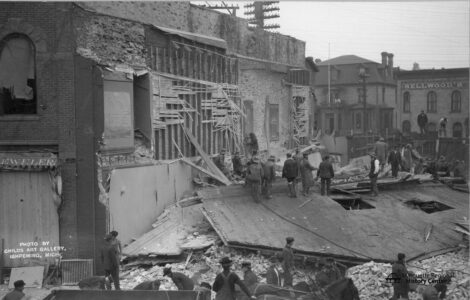
Today marks the 120th Anniversary of a deadly explosion at Miner's National Bank in Ishpeming.
It was a little past 9 a.m. on Sunday, Nov. 5, 1905. Mass had just been let out at St. Joseph's Catholic Church, a block south of the bank in downtown Ishpeming. Parishioners were standing in front of the bank, or sitting on nearby windowsills, waiting for a freight train to clear the tracks that ran along what is now Hematite Drive so they could head home for breakfast.
Three men were in the bank when the explosion occurred. James Mullins, who ran the bank's insurance department, had gone to church with his wife before unlocking the building so that two steam-fitters (plumbers), Fred Anderson and Erick Peterson, could get in to repair a grate in the boiler that provided heat to the building. The basement was dark and when one of the plumbers lit a match to light the gas light, the building exploded.
The entire front of the building crashed down onto Main Street. The Mining Journal said the bank was leveled "as if it were a structure of straw." The paper continued "walls were hurled out; roof, ceilings, and partitions were thrown skyward, falling back into the street and the basement in a shower of dangerous debris." Three children waiting to cross the tracks were killed. Alice McGee and Stephen Goodman were 12; Edmond "Eddie" McGrath – the only child of his widowed mother – had just turned 13.
Miraculously, Mullins, Anderson, and Peterson survived. The two plumbers were hurled out of the basement through the coal chute (the paper said "like a bullet out of a gun”) and into the side of a boxcar on the railroad tracks. Though both were badly bruised, burned, and covered with dust, they were able to walk to the hospital.
Mullins was in his office and was buried up to his neck by the falling debris. His spine and both his legs were broken, but he survived and eventually was able to return to work. Eleven others were also seriously injured, including two other twelve-year-old boys, and the ten-year-old sister of Alice McGee.
Another survivor was Hans Gunderson, an insurance and real estate agent who was in his office above the bank. He had smelled gas and was putting on his coat to leave when the explosion occurred but was able to climb out of the debris pile despite a broken leg and collarbone. Congressman H.O. Young, an attorney, also had an office above the bank. He had an appointment scheduled for 10:00 that morning but had not yet arrived when the building exploded. However, his law library, "one of the best in the Peninsula" was badly damaged.
A few hours later, after enough of the debris had been hauled away, the fire chief and one of the firemen entered the basement to examine the scene. The chief's lit lantern caused a second explosion. Both men were burned, but not as seriously as the others injured in the original explosion.
The property damage extended well beyond the bank itself. Windows were shattered as far as two blocks away. One door smashed into the front of the Union Tea Store across Main Street and destroyed it. Another door was found a full block away.
The offices of the Marquette County Telephone Company were in the building next door to the bank, but the entrance to the office was through the back of the bank building. The day shift operator had just arrived, and the night shift operator had put on her coat to leave when the bank exploded. Both women were carried down a ladder "completely prostrated" and telephone service was halted until another operator volunteered to climb the ladder to restore service.
But the bank's safe, which held all the bank's books as well as all its money, was intact. The time clocks which limited access to the safe were advertised as dynamite proof and indeed, when the bank reopened at 9:00 on Monday morning in borrowed space, the safe was opened without trouble.
There was never any doubt that it was a gas explosion. The newspapers had been quick to absolve the plumbers from any blame, noting that while it was true that they had smelled gas, "we have been used to gas smells in Ishpeming. The old water-oil gas was most vile in its odors, as residents near the manufacturing plant know. It gave off bad odors even when it did not leak, the burners and meters gumming up and giving offensive smells. Steam fitters here are familiar with it and pay no heed to it."
Water-oil gas referred to a manufactured fuel made from coke and steam, and then enriched, or carbureted, with petroleum oil. This method replaced traditional coal gas as a major source of fuel. Its popularity came from being more economical and efficient than coal gas production, particularly for smaller utility plants.
Obviously, there was a leak somewhere. The question was whether the leak was inside the bank, in the line coming into the bank, or in the street. The gas pipes from the building and the street were boxed up after the explosion and kept in the prosecutor's office as evidence. The boxes were opened up in front of the jury empaneled for the coroner's inquest later that month.
The pipes from the bank building to the main were in good condition, but one of the gas mains in the street had been bent to follow a bend in the street and showed a break three to four inches long. The jury, which also heard from eight witnesses, concluded that the leak began in that spot.
Unlike the vile-smelling manufactured gas used in Ishpeming 120 years ago, the natural gas that now heats many of our homes and offices is naturally odorless. The skunk-like odor that we associate with natural gas, mercaptan, was added after a 1937 explosion in a Texas school killed almost 300 people. If you ever smell it in your home, evacuate immediately and call 911.