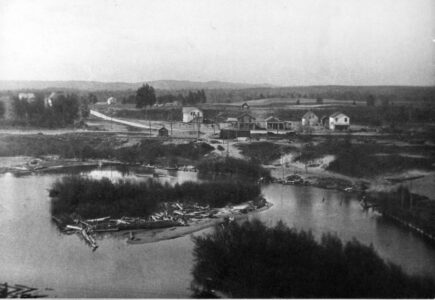
Forgotten neighborhood on Blaker Street
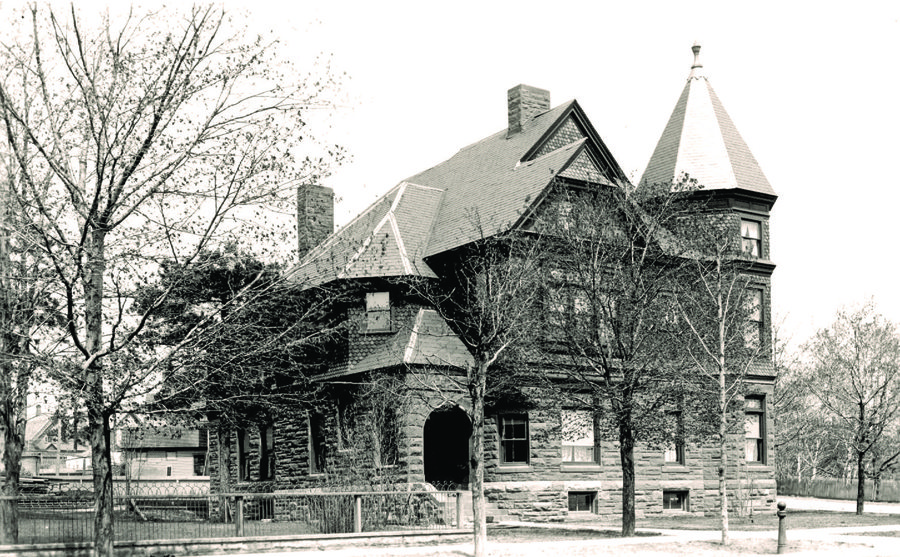
The Matthews house on the corner of Blaker and Bluff streets in the city of Marquette is pictured. (Photo courtesy of the Marquette Regional History Center)
MARQUETTE — Blaker is a short, one-wayThe Matthews house on the corner of Blaker and Bluff streets in the city of Marquette is pictured. (Photo courtesy of the Marquette Regional History Center) street, hidden behind the Landmark Inn. It begins at East Bluff and ends at East Ridge. As a child, I would take Blaker Street when walking from my home to downtown Marquette. Recently I was amazed to learn this street, which is lined by parking lots, was once lined with beautiful homes.
Blaker Street was named after physician Gilbert Blaker who came to Marquette in 1856 and purchased land near the area. In August 186,2 he enlisted in the Union Army as a surgeon. On his return trip to Marquette in 1865 he passed away while visiting relatives in Philadelphia. The land he purchased became known as the Blaker Bacon Edition and it was sold to Marquette families desiring to build homes overlooking the bluff.
In the 1870s, Henry Stafford owned the property on Blaker where the former Christian Science Church stands, which was recently purchased by Temple Beth Sholom. The Staffords lived in a beautiful three story Victorian home with a triangular yard on the corner of Blaker and East Ridge. Henry, a druggist, came to Marquette in 1859 and opened H.H. Stafford, a drug and stationary store. In public life Henry filled a number of offices, including chairman of the County School Board. Henry and his wife Catherine raised six sons. Two of their sons became pharmacists and the name of the family business changed to H. H. Stafford & Sons.
Frank B. Spear came to Marquette in 1864. In 1875, he purchased property on Blaker from Henry Stafford. The lot was located just south of the Stafford home, where the Landmark Inn parking lot is today. Frank and his wife Sara lived in a two-story Victorian home. Frank owned F. B. Spear & Co. and was a dealer in general merchandise such as coal, flour, cement, and feed, and an agent for the Lake Michigan and Lake Superior Transportation Co. steamers. He was also involved in many civic and religious endeavors. Mr. and Mrs. Spear raised two sons. F. B. Spear & Co. became Spear & Son’s when the boys grew up and joined their father.
The Spear’s neighbor to the south was the James Wilkinson family. In an edition of the Weekly Mining Journal in July 1875, the James M. Wilkinson home was near completion. The Mining Journal noted about the home, “It’s appearance and location are exceedingly fine and pleasant.” James came to Marquette in 1864. He practiced law until 1873 when he became involved in banking and organized Citizen’s Bank and later the private banking firm of Campbell & Wilkinson. James was active outside of work, serving as an alderman and as a member of the board of fire and water commissioners. James and Hattie raised three children.
Homes on Blaker Street overlooked the bluff. The view of the bluff toward East Ridge was of Sidney Adams’ beautiful tiered gardens, located in the rear of his large sandstone home on East Ridge, which still stands today. South of the Adams’ gardens was a lightly wooded area which allowed for a pleasing view of Lake Superior. At the corner of East Bluff and Blaker, by the First Presbyterian Church, a wooden stairway was available for families to walk down the bluff to the harbor.
These homes were in a wonderful location for families. They were within a block of churches and schools, and downtown Marquette was a block south on Front. The Ridge Street School was around the corner for school aged children and Mr. Spear had only a short walk behind his home to the First Baptist Church on the southeast corner of Front and Ridge to fulfill his duty as Superintendent of the Sunday School.
A fourth home was built over a two-year period, from 1889 to 1891, at the corner of Blaker and East Bluff. Until they built this home, Abraham and Nellie Mathews lived next door at 101 E. Bluff, where the Longyear Building is located. A successful real estate man, who at one time was in business with John M. Longyear, Mathews was able to build a home that The Marquette Mining Journal in March 1891 described in as an elegant residence with a magnificent interior finish in native hardwoods. A two-story home, with a lower sandstone exterior, it was located on a sizable grassy lot extending up Blaker Street. The home had large octagon bay windows providing magnificent southeast views of Lake Superior and the Marquette Harbor.
For expanding communities it is not unusual for homes built in and near downtown areas to be replaced by public and commercial buildings and to have outlying properties developed as residential areas. As it grew, that phenomenon occurred in Marquette. The Blaker Street neighborhood remained a residential area into the early 1900s. Around 1920 some of the homes began to be purchased by developers and torn down. The Mathews house remained intact until 1968, however, it even succumbed to development becoming a funeral home shortly after Abraham’s death in 1920.
If you would like to learn more about the hidden history of Marquette’s neighborhoods, join us on the History Center’s Historical Marquette Bus Tours. Take an entertaining, narrated journey through town. You will learn interesting historical facts about the Queen City of the North as you hear a general history narration throughout the journey from your tour guide. Through colorful characters that hop on the bus to share their stories, you will learn how the people of Marquette were affected by World War I, and also what everyday life was like here 100 years ago.
For more information or to purchase tickets, call 906-226-3571, visit marquettehistory.org, or stop by the Marquette Regional History Center during regular operating hours. These tours are sponsored by Checker Transport, Travel Marquette, and Sanders & Czapski Associates.
Superior History
U.P. Moments in History
A World War II love story
History Quiz
History quiz
QUESTION: Which Upper Peninsula business received an order to assemble 10,000 white cotton nurses’ uniforms ...
Meet Joe Fine, barkeeper and mayor