
A NEW APPROACH
Scientists study love potion to trick invasive sea lamprey into traps
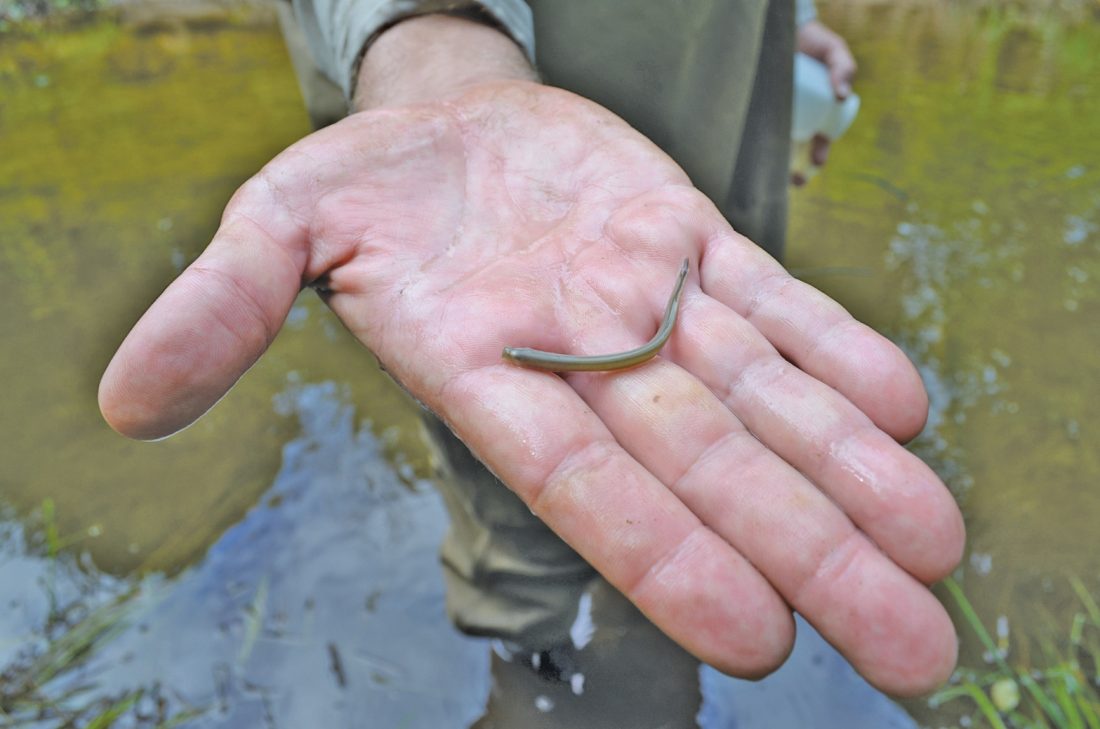
A larval sea lamprey from Bismark Creek is held by U.S. Fish and Wildlife service biological science technician Kevin Hensiak. A crew administered lampricide to Bismark Creek — which is located near Harlow Lake off of County Road 550 — in 2019. This is one of many Great Lakes tributaries the U.S. Fish and Wildlife Service treated with lampricide in 2019 in an effort to remove the lampreys at their larval stage and reduce the adult population that will eventually reach the Great Lakes and harm fish. Tributaries with infestations are typically treated every three to five years due to the lamprey life cycle. (Journal file photo)
-
- A larval sea lamprey from Bismark Creek is held by U.S. Fish and Wildlife service biological science technician Kevin Hensiak. A crew administered lampricide to Bismark Creek — which is located near Harlow Lake off of County Road 550 — in 2019. This is one of many Great Lakes tributaries the U.S. Fish and Wildlife Service treated with lampricide in 2019 in an effort to remove the lampreys at their larval stage and reduce the adult population that will eventually reach the Great Lakes and harm fish. Tributaries with infestations are typically treated every three to five years due to the lamprey life cycle. (Journal file photo)
-
- U.S. Fish and Wildlife Service biological science technician Kevin Hensiak takes a water sample during a 2019 lampricide treatment of Bismark Creek, which is located near Harlow Lake off of County Road 550 in Marquette County. The crew administered lampricide and continually monitored concentrations in the creek for two 12-hour periods over two days. This work is key to protecting the Great Lakes fisheries, U.S. Fish and Wildlife Service officials said, as lampreys have no natural predators in the Great Lakes and each can destroy up to 40 pounds of fish over their adult life. Scientists are now researching use of the 3kPZS pheromone, a chemical released by males to guide females for mating, to determine if it can be used to lure invasive lampreys into traps. (Journal file photo)
Sea lamprey harm Great Lakes fisheries by feeding on the blood of native fish, and the 3kPZS pheromone, a chemical released by males to guide females for mating, could be used to lure them into traps, experts say.
Marc Gaden, the communication director and legislative liaison for the Great Lakes Fishery Commission, said scientists are experimenting with 3kPZS to understand how strongly it attracts females.
“Scientists will drip very small amounts of the pheromone into a stream, miles away from the mouth of the stream, and the female sea lamprey will find their way to the drip tube,” Gaden said. “We can potentially use this pheromone as a control technique to attract sea lamprey into traps.”
Gaden said scientists are working to discover what pheromone combinations will attract sea lamprey and how much should be deposited into the water.
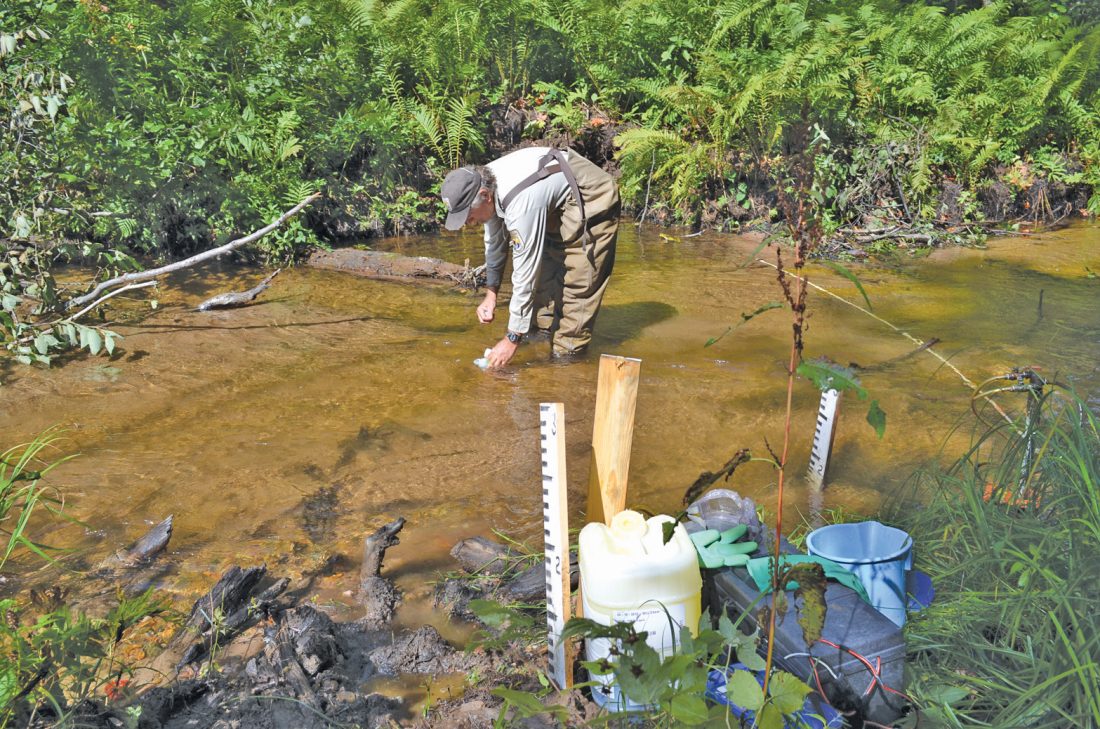
U.S. Fish and Wildlife Service biological science technician Kevin Hensiak takes a water sample during a 2019 lampricide treatment of Bismark Creek, which is located near Harlow Lake off of County Road 550 in Marquette County. The crew administered lampricide and continually monitored concentrations in the creek for two 12-hour periods over two days. This work is key to protecting the Great Lakes fisheries, U.S. Fish and Wildlife Service officials said, as lampreys have no natural predators in the Great Lakes and each can destroy up to 40 pounds of fish over their adult life. Scientists are now researching use of the 3kPZS pheromone, a chemical released by males to guide females for mating, to determine if it can be used to lure invasive lampreys into traps. (Journal file photo)
3kPZS has been registered by the Environmental Protection Agency as the first pheromone considered to be a biopesticide. Biopesticides are naturally occurring substances from animals, plants and bacteria that control pests.
However, some native lamprey also use 3kPZS for mating, said Tyler Buchinger, a researcher for Michigan State University’s Department of Fisheries and Wildlife and coauthor of a new pheromone pollution study in the journal Current Zoology. Researchers from MSU and the U.S. Geological Survey’s Great Lakes Science Center in downstate Millersburg did the study.
Chestnut lamprey, one of the four native lamprey species in the Great Lakes, often respond to 3kPZS from sea lamprey, Buchinger said. The study found that the 3kPZS pheromone released by the sea lamprey misguided the chestnut lamprey to the wrong nest.
“What we ended up seeing was pretty remarkable,” he said. “All of the female chestnut lamprey that we released in the stream first went to the sea lamprey nests instead of to their own species.”
Buchinger said that although the sample size was small, the findings still indicate that pheromone pollution can be a problem. Since lamprey die after mating season, only about 10 females made it upstream and only four made it to the correct nest.
The research was done near downstate Rogers City, a place where pheromones and sea lamprey have been studied since the early 2000s, Buchinger said.
“I’m pretty convinced that chestnut lampreys are strongly attracted to sea lamprey pheromones over their own species,” he said. “I’m less convinced that 100% of females go to the wrong nest. It’s hard to say without some follow-up work.”
Despite that, Gaden said that using 3kPZS as a biopesticide without harming chestnut lamprey is still possible.
According to Gaden, native and sea lamprey don’t usually share the same habitat. In areas inhabited by the invasive lamprey, pesticides called lampricides have been used to reduce populations since the 1950s.
“The lampricide would kill native lamprey, but the overlap is minimal,” Gaden said.
Using 3kPZS as a biopesticide can be successful and safe in areas where sea lamprey coexist with any of the three other native lamprey species, he said.
According to Weiming Li, a coauthor of the study and a professor in MSU’s Department of Fisheries and Wildlife, more research is needed to understand how 3kPZS affects native species, but the biopesticide appears to be a safer alternative to lampricides.
“Our experiments so far have only focused on the simple attraction of females to 3kPZS,” he said.
Li said using 3kPZS to trap sea lamprey may have little effect on chestnut lamprey since they can be rereleased into rivers or are small enough to escape traps.
While using 3kPZS as a biopesticide is still in the experimental phase, Buchinger said there are other ways to reduce invasive sea lamprey populations.
“Along with lampricides, creating barriers and releasing sterilized sea lamprey males are other ways of controlling the population,” Buchinger said.
Kristia Postema writes for Great Lakes Echo.
Front Page News

Iran fully closes Strait of Hormuz over US blockade and fires on ships
MCEM, MSP reminds public to take flood safety precautions
FROM A NEWS RELEASE MARQUETTE — Officials with Marquette County Emergency Management and the Michigan State ...
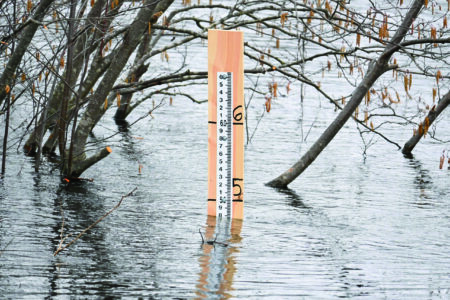
Marquette officials declare state of emergency due to widespread flooding

Copper Country holds place of primacy in U.S. history

As colonies revolted from Britain, Frederick played an active role in Revolutionary War