
SHIRAS HONORED
Contributions commemorated with historical marker at park
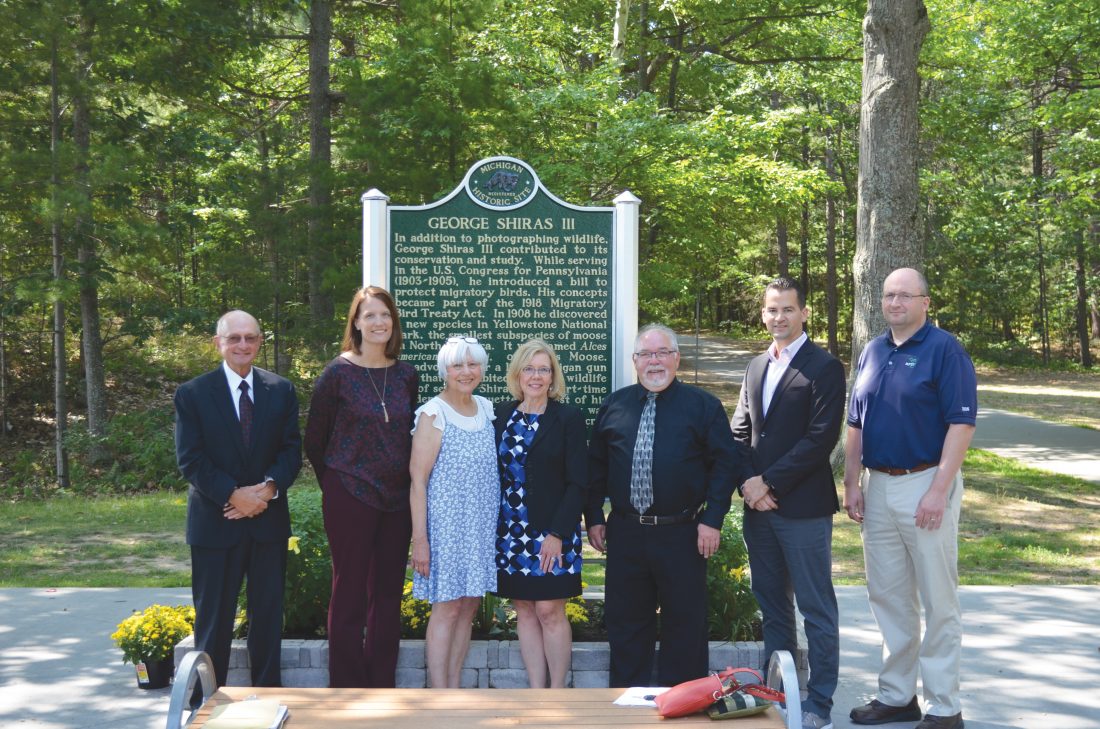
Pictured from left in front of the newly dedicated historical marker at Shiras Park are Shiras Institute Board Members Ward Rantala and Laura Katers Reilly, retired Northern Michigan University professor and project leader Dr. Diane Kordich, Shiras Institute Board members Judge Cheryl Hill, Jim Reevs and Andrew Wallner, and city of Marquette Public Works Director Scott Cambensy. (Journal photo by Ryan Spitza)
EDITOR’S NOTE: While he was commonly referred to as George Shiras III, Shiras signed his name as George Shiras 3rd, according to Shiras Institute Board member Cheryl Hill. His name is also spelled George Shiras 3rd on his gravestone at Park Cemetery in Marquette. This style differs from the Roman numeral “III” used in this report due to Associated Press style conventions and on the historical marker sign recently placed in his honor.
MARQUETTE — If you’ve lived in Marquette for any length of time, you’re almost sure to be familiar with the name Shiras for one reason or another.
That family name has graced several places in the city of Marquette, such as Shiras Hills, Shiras Park, Shiras Planetarium, Shiras Pool and the Shiras Zoo.
All of these locations are named after George Shiras III, a man who made countless contributions to the city of Marquette over the years.
Shiras passed away at the age of 83 on March 24, 1942. Five years prior, a trust was created and funded by Shiras and his wife Frances “for the benefit of the public in the fields of beautification, recreation and cultural activities in the city of Marquette and the Upper Peninsula,” officials said.
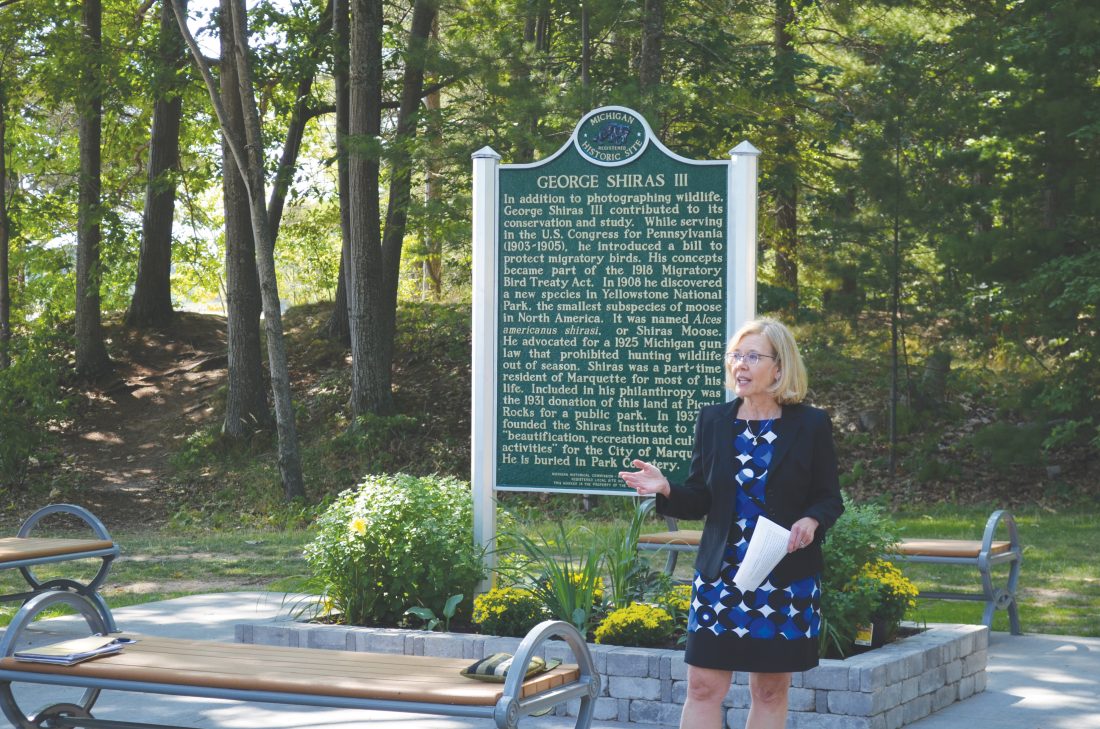
Shiras Institute Board member and Marquette County Probate Judge Cheryl Hill speaks at a dedication for a historical marker in honor of George Shiras III on Monday afternoon. The sign honoring Shiras was officially dedicated at Shiras Park. The sign recognizes the park as a registered Michigan historic site. (Journal photo by Ryan Spitza)
Now in 2021, Shiras’ contributions to the city are permanently commemorated within Shiras Park. On Monday, the park for which he donated the land was dedicated as a registered Michigan historic site.
Shiras Institute board members Ward Rantala, Jim Reevs, Laura Katers Reilly, Andrew Wallner and Cheryl Hill, along with retired Northern Michigan University professor and project leader Diane Kordich, Michigan Historical Commission board member Tom Truscott, and city officials, attended the dedication and unveiling of the sign.
Hill spoke at the dedication about the contributions Shiras made to the region, saying that it was a long time coming for him to be recognized in this manner.
“George Shiras was a remarkable man, a lawyer, a legislator, and a groundbreaking photographer,” she said, noting that Shiras was described by National Geographic as “the father of wildlife photography.”
“He was also a philanthropist, in fact, he gave the land we are standing on to the city of Marquette,” Hill said.
“It has been the duty and the honor of the present board members of the Shiras Institute to work with Diane Kordich, (
“Through the generosity and planning of George Shiras, the Shiras Institute has been able to provide funding throughout the area for things such as the Peter White statue restoration, the Iron Ore Heritage Trail historic kiln site, the Marquette-area skate plaza, the tennis courts on Ohio Street, and the history museum capital campaign, among many other causes that fit the direction of the trust. We are now working to assist with the updating of the Shiras Planetarium.
“We urge everyone in the area to come and take a walk in Shiras Park and read about this remarkable man, George Shiras. Our many thanks to Diane Kordich and the city of Marquette in partnering with the Shiras Institute to bring this piece of history to our community.”
Kordich spearheaded the two-phase project beginning roughly five years ago. The first phase entailed installing a new red, white and blue Shiras Park sign, while Monday’s dedication of the new historical marker signaled the project’s completion. Kordich prepared all of the paperwork to apply for the park to become a Michigan historic site.
“It feels wonderful,” Kordich said. “Today was a wonderful culmination of all the work that everyone did. I’m very happy and it’s a good addition to our community.”
Kordich, Hill, Truscott and Marquette City Commissioner Evan Bonsall all spoke at the dedication.
While not officially dedicated until Monday, the site was listed on the Michigan registry of historical markers in 2019 and the sign was erected in 2020.
According to a previous Journal article, the city of Marquette contributed materials, labor and equipment to the project. The Shiras Institute contributed materials, signs and benches.
The sign sits adjacent to the city’s multiuse path at Shiras Park, which is part of the North Country National Scenic Trail that spans 4,600 miles from New York to North Dakota.
Both sides of the sign’s full text are listed below.
Side one
George Shiras III (1859-1942) was born in Allegheny, Pennsylvania. He developed an interest in wildlife at the age of 11 when his father took him hunting and fishing near Marquette.
Shiras received his law degree from Yale and practiced law in Pittsburgh. Near the turn of the 20th century, Shiras and his guide, John Hammer, developed innovative flash and camera equipment that allowed them to take photos of wildlife in a natural habitat at night.
Shiras won a gold medal at the Paris Exposition in 1900 and the grand prize at the 1904 World’s Fair in St. Louis for his images, several of which were captured in the Marquette area.
In 1906, President Theodore Roosevelt wrote Shiras and asked him to compile his photographs and notes on wildlife behavior into a book. Shiras published “Hunting Wild Life with Camera and Flashlight” in 1935.
Side two
In addition to photographing wildlife, George Shiras III contributed to its conservation and study. While serving in the U.S. Congress for Pennsylvania (1903-1905), he introduced a bill to protect migratory birds. His concepts became part of the 1918 Migratory Bird Treaty Act.
In 1908 he discovered a new species in Yellowstone National Park, the smallest subspecies of moose in North America. It was named Alces americanus shirasi, or Shiras Moose. He advocated for a 1925 Michigan gun law that prohibited hunting wildlife out of season.
Shiras was a part-time resident of Marquette for most of his life. Included in his philanthropy was the 1931 donation of this land at Picnic Rocks for a public park.
In 1937 he founded the Shiras Institute to fund “beautification, recreation and cultural activities” for the City of Marquette.
He is buried in Park Cemetery.
Ryan Spitza can be reached at 906-228-2500, ext. 248. His email address is rspitza@miningjournal.net.
Front Page News

EPA move on microplastics, pharmaceuticals draws mixed response in Michigan

Jandrons Fine Jewelry: Three generations of women in business
April ice storm
Distributor responds to Bark River Knives closure

Arrest made in Chippewa County drug overdose death