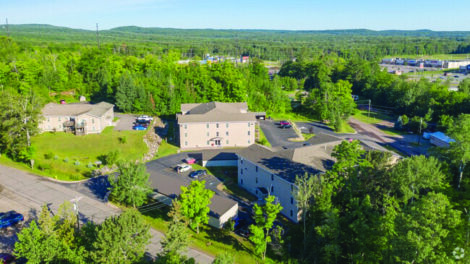
Cleaning Cliffs-Dow
Commission hears update on property’s environmental assessment
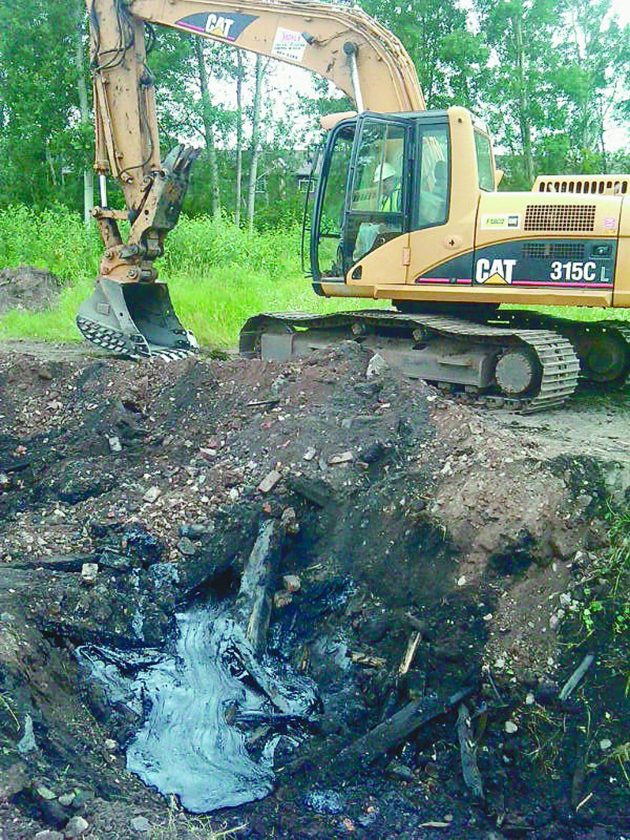
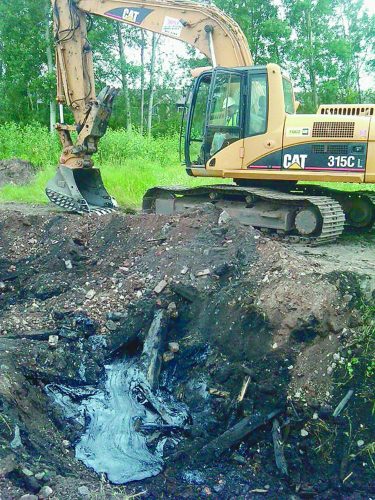
Tar contamination is pictured oozing out of the ground at the former Cliffs-Dow site when the city of Marquette previously performed limited excavation at the former industrial site on Lakeshore Boulevard. (Journal file photo)
MARQUETTE — With the city of Marquette currently negotiating the sale of a portion of the former Cliffs-Dow site for a potential residential development, some have posed concerns and questions about the current environmental status of the property due to chemical contamination.
Nearly 20 years after part of the former industrial property was sold to the city for $1, the city commission in July began moving forward with preliminary steps in negotiating the sale of the center parcel to the Marquette-based developer Veridea Group, which plans to build up to 500 residences there.
However, a “no residential uses” deed restriction is in place and efforts by the city to remove that and obtain a “no further action” determination at the site from the Michigan Department of Energy, Great Lakes and Environment have been denied.
Following the resolution of intent to sell, the parcel was approved for rezoning from municipal to mixed-use, contingent upon remaining exposure pathways being addressed, the “no residential uses” deed restriction being lifted by the state and appropriate engineered controls being in place.
The city commission received an annual environmental update on the status of the site Monday, presented by Marquette Community Development Director Dennis Stachewicz; Richard Baron of Foley, Baron, Metzger & Juip PLLC, which serves as special counsel to city; and Tom Anthos and Ryan Whaley of TriMedia Environmental & Engineering.
History:
From 1903 to 1969 the site was used primarily for industrial purposes, with activities such as charcoal manufacturing and extraction of wood chemical derivatives taking place on the property for decades.
“It is a legacy site of contamination,” Baron told the commission.
It was operated by Cleveland-Cliffs Inc. for the first three decades, then the Cliffs-Dow Chemical Co. was formed and began operating in 1935. The site was sold to Georgia Pacific in 1968 and closed the following year, Baron said.
In 1997, the city paid $1 for part of the Cliffs-Dow property.
That property was divided into three parcels, with the northern section eventually housing BioLife Plasma services after a U.S. Environmental Protection Agency Superfund cleanup was completed. The southern section was purchased by Northern Michigan University, which was subject to a remedial action plan.
Liability:
The center parcel, which includes the land authorized for rezoning and will potentially be sold, is still owned by the city.
However, with the city’s purchase of the site, it accepted responsibility and liability for the contaminants present at that time, meaning “the city of Marquette is a liable party at this site and will continue to be liable for existing contamination even if the property is sold,” information from DEGLE to the commission states.
There are two separate issues at the city-owned property the city is responsible for, DEGLE representative Steve Harrington emphasized: what’s actually on the land and what’s currently leaving the site via groundwater and entering Lake Superior.
Baron explained: “When the city purchased the site, the city, by matter of contract, agreed to take on liability for what was actually on the site at the time they purchased the site … They didn’t take on liability for what had already been dumped out into the lake, they didn’t take on liability for whatever might have been transported by the Cliffs-Dow company off site somewhere.”
Environmental assessments:
The city has monitored the site since 2009 as requested by DEGLE, hiring TriMedia Environmental and Engineering and a special counsel to obtain data by testing the groundwater and soil.
Nearly 100 monitoring wells have been used to assess the extent and location of groundwater contaminants, Baron said.
In 2011, “limited source removal” of around 845 tons of tar conveyance materials, wood tar and impacted soil was done at a specific place that was believed to be a “preferential pathway” for contaminants to flow, Baron said. The timbers and piping were found to originate off site near the former lagoon, which is currently Presque Isle Place Apartments, and has been monitored by DEGLE since then, according to officials.
“Following that work, the data that we were obtaining from the monitoring wells showed a gradual decrease in some of the dissolved constituents,” Baron said.
Since then, monitoring efforts throughout the site have continued. The city has been addressing the issue with contaminated groundwater leaving the site and entering Lake Superior by monitoring wells placed at the groundwater-surface water interface.
The city has sought mixing zone determination for the discharge into Lake Superior, which essentially would mean the contaminants are at a level consistent with discharge parameters permitted by DEGLE.
As of July, groundwater concentrations about acute mixing zone based criteria were found at some groundwater-surface interface wells, they said.
While the levels of dissolved contaminants in groundwater had stayed relatively steady for years, increases in some were observed following storms in late 2016 and late 2017, with the concentrations of several compounds in some wells during 2018 and 2019 reaching the highest recorded levels since monitoring began.
“We also have during that same time frame lake levels going up, and then we see groundwater levels going up as well,” Baron said. “And with that, we see the data points for the dissolved contaminants that are of concern to us, the ones that we are monitoring, that are above criteria, also taking a spike.”
One theory is that “the lake level and storm events and groundwater fluctuations ultimately impact how things migrate into the lake and migrate through the site as well,” as higher hydraulic head pressure may make it more difficult for groundwater to migrate, meaning contaminants might be “sitting” in groundwater for longer periods, he said.
Site reuse:
In terms of reusing the site, Harrington said “any new proposed use of this property by any owner” would involve “very stringent criteria.”
The state could lift the “no residential uses” deed restriction, but “only if sufficient detailed remedies are designed and implemented,” regulatory notes from DEGLE state.
All potential exposure pathways — which in the case of this site include direct contact, inhalation, groundwater-surface water interface, as well as drinking water and drinking water protection — “must be considered and effectively controlled so that no unacceptable risks are posed by the particular land use” the notes state.
These can be addressed through engineered controls, officials said, and the drinking water issue is largely resolved by the fact that the site would use municipal water.
“I’ve heard it implied that it would be impossible to remove every bucket of tar, every location where there’s contamination throughout the property. And while that is very true, the complete removal of the contamination is not a requirement to reuse this property,” Harrington said. “There are many, many technologies available that would allow for the safer use of this property for any purpose. Those include capping, all sorts of other approaches, sub-slab ventilation, there are construction methods and engineering controls, which if properly implemented — and believe me, they will be carefully monitored — would allow for the reuse of this property by any current or future owner.”
Furthermore, “a new owner or operator of this site may establish liability ‘protection’ by completing a ‘baseline environment assessment’ but they would have continual and stringent ‘due care obligations,'” the notes state.
The Marquette Brownfield Redevelopment Authority Revolving Loan Fund has been used to finance the environmental activities at the site, city officials said, as the property is currently subject to an Act 381 brownfield plan.
While environmental obligations would continue after the sale of the site, the brownfield plan could be a mechanism to get some of these expenses reimbursed, city officials said.
“If the site is sold and a person is developing the site … and they find another trench of tar, that is still the city’s obligation,” Stachewicz said. “However, it also becomes an eligible activity, which would be reimbursed under the existing brownfield that is on the site.”
Marquette Mayor Jenna Smith asked Stachewicz what the next steps might be moving forward.
“We’re waiting on another round of results that were pulled about a month or so ago. We’ll get those analyzed, and then we’ll sit down with (DEGLE) and talk about them,” he said. “And currently, as we’re moving forward, where it’s our plan to refine some of the locations and a little bit of the monitoring and a little bit of modeling so we can get a better understanding.”
In addition, there is an intake pipe from the Cliffs-Dow operation that extends around 1,000 feet into state-owned bottomlands. Harrington said there is a “process in progress to get it removed by the causative party,” but it’s not a city responsibility, as it’s not on city-owned property.
In regards to the actual sale of the property, which City Manager Mike Angeli is currently negotiating, Angeli said: “indications are that we’re moving in that direction.”
He said the sale will likely include a development agreement “because the two kind of go hand-in-hand, and then the commission will vote on both of those. But that’s probably a few months away.”
Cecilia Brown can be reached at 906-228-2500, ext. 248. Her email address is cbrown@miningjournal.net.
Front Page News

Upper Peninsula Peace Officer’s Memorial honors fallen officers
MAPS Superintendent Zack Sedgwick releases statement on bond recount
MARQUETTE — On Monday night, Marquette Area Public Schools Superintendent Zack Sedgwick released a statement on ...
Roundabout planned for crossroads intersection

New Michigan tax system sparks confusion for 27,000 taxpayers

GOP governor candidates pledge to overhaul Michigan schools at forum