
‘Pure Impact’ tour makes stop in downtown Marquette
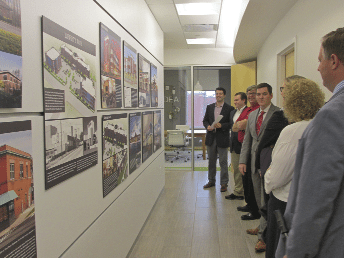
State officials tour the Veridea Group’s Liberty Way redevelopment site in Marquette last week during a “Pure Impact” tour, highlighting the economic impact of the Michigan Community Revitalization Program. (Journal photo by Mary Wardell)
MARQUETTE — State and local officials toured the Liberty Way development in downtown Marquette Wednesday as part of a “Pure Impact” tour that’s traveling around Michigan to highlight the economic impact of the five-year-old Michigan Community Revitalization Program.
The MCRP, an incentive program designed to promote community revitalization and private investment, contributed a $6 million loan to the Veridea Group’s $43 million development on West Washington Street.
Liberty Way, which also received $10 million through the Marquette Brownfield Redevelopment Authority, has created 225 new jobs and raised the taxable value of the site from about $230,000 to more than $10 million.
The development, replacing a former functionally obsolete bread factory, creates a pedestrian linkage to the downtown and neighborhoods by connecting to the city’s bike path and Iron Ore Heritage Trail, according to a press release from the Michigan Economic Development Corporation.
“From the outset, our vision was to create a development that would transform the neighborhood into a vibrant gateway into downtown Marquette, while at the same time establishing this area as a legitimate part of ‘downtown Marquette,'” Veridea Group founding President Robert Mahaney said in the release. “Four years later, reality has far outpaced our most optimistic dreams.”
Located at 857 W. Washington St. across, from Lincoln Avenue, Liberty Way includes the regional headquarters for mBank and Upper Peninsula Health Plan, along with the 102-unit extended-stay hotel Staybridge Suites, above 64,500 square feet of underground parking.
The MCRP awarded the loan for the underground parking, without which, officials said, the project would have been much smaller.
Charles Holsworth, vice president of hospitality at Veridea Group, said parking was a major challenge on the 5-acre parcel.
Traditional lenders don’t like to fund non-revenue generating assets, Holsworth said, but the underground parking was the “only way the project would work.”
Holsworth thanked officials from the MEDC for seeing what “a lot of people could’ve missed.”
“You deserve a tremendous amount of credit for seeing the potential in what this project could be,” Holsworth said.
Liberty Way, originally set for completion in 2019, was finished three years ahead of schedule with $12 million more in private investment than originally projected, Holsworth said.
“Instead of being an mBank building and another retail strip, today the Liberty Way site has four buildings totaling over 200,000 square feet. It’s home to companies that employ over 225 people combined on this site, and it’s received, instead of the initially projected $30 million in private investment, over $42 million,” Holsworth said. “None of that would’ve been posible without the people in this room.”
Greg Tedder, MEDC executive vice president and chief community development and marketing officer, explained the origin of the funding for the MCRP. When Gov. Rick Snyder eliminated the Michigan business tax, he said, tax credits that had been repealed were replaced with the general fund appropriation now going to the Michigan Strategic Fund. The MSF is split between community and business development.
Business development funds are used to bring jobs to Michigan, Tedder said, and “we take, the community development team, the other half of the money and help make great communities great places to live, work and play.”
In the last five years, MCRP performance-based awards have supported 114 projects, 58 completed and 56 underway, according to the MCRP release. Awards of $195 million have leveraged more than $1 billion in private investment.
Marquette City Manager Mike Angeli at the event recalled the smell of baking bread and the significance of the old facility and its neon Bunny Bread sign.
“I remember it because as a child, … we had our parents drive down Washington Street just to see the ears go back and forth,” Angeli said.
He later learned the economic significance of the factory, Angeli said, recalling the impact of its closure and how it fell into disrepair.
Angeli said he’s “more than impressed” with the design and final outcome of the project, and he praised the public-private partnership.
“From time to time, we’re criticized about that because it seems to be there’s, which I don’t agree with, … this attitude that maybe public and private shouldn’t mix … or somehow we’re in cahoots if we’re together,” Angeli said. “I see it as, the only way we can accomplish a lot of this, is together.”
He pointed to neighboring developments and increased property values in the area, and touted the impact of an expanded downtown corridor to other local businesses.
“We’re growing towards a more walkable community, and I can only see positive things coming from that,” Angeli said.
Sen. Tom Casperson, R- Escanaba, Rep. Scott Dianda, D-Calumet, and Rep. Beau LaFave, R-Iron Mountain, also toured the facility.
Casperson said public-private partnerships work very well, and he is working to apply that idea to roads and highways.
Dianda said development like Liberty Way shows Michigan is “open for business” and that the Upper Peninsula has hope for growth and expansion.
“It shows that the U.P. is more than fudge, pasties and tourism,” Dianda said. “It shows that we’re here for the long-term.”
LaFave said the biggest thing to him is the removal of blight that is now “a taxable base that provides vital services to the residents as opposed to being an eyesore.”
Mary Wardell can be reached at 906-228-2500, ext. 248. Her email address is mwardell@miningjournal.net.
Front Page News

EPA move on microplastics, pharmaceuticals draws mixed response in Michigan
Jandrons Fine Jewelry: Three generations of women in business
April ice storm
Distributor responds to Bark River Knives closure
Arrest made in Chippewa County drug overdose death