
Short-term rental debate
Issue to be discussed at joint work session
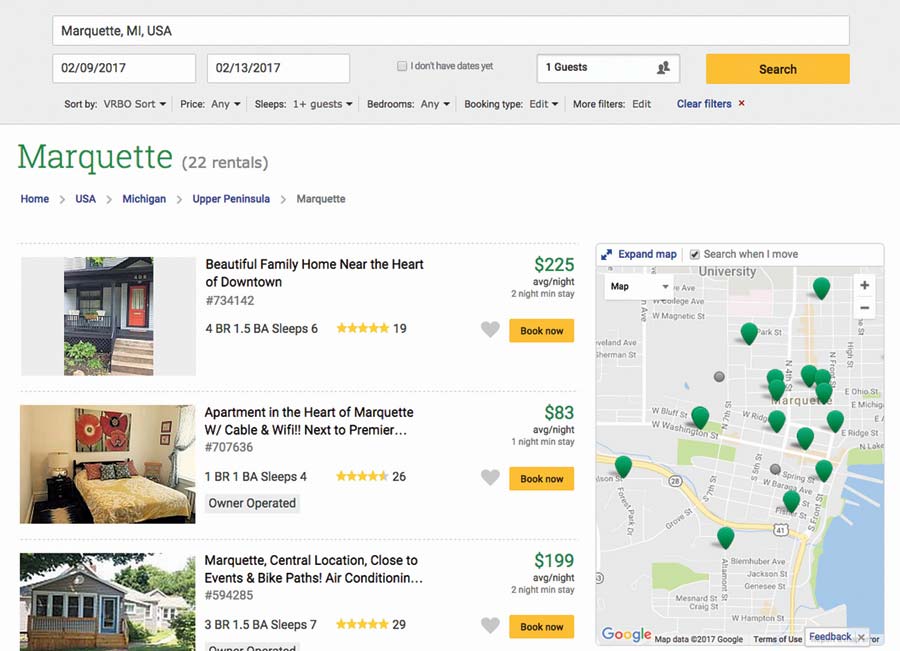
Seen is a screenshot of the vacation rental website VRBO, which stands for Vacation Rental By Owner, one of a number of peer-to-peer markets that have become popular for arranging short-term vacation rentals and homestays around the world. Companies, of which there are a growing number, collect fees from guests and/or hosts for advertising and/or booking on the sites. (Journal screen shot)
MARQUETTE — Headway is anticipated on the contentious issue of how to regulate short-term rental properties in the city of Marquette at a joint session of the planning commission and the Marquette City Commission Thursday.
The public work session is scheduled for 5:15 p.m. at the Citizen’s Forum of Lakeview Arena at 401 E. Fair Ave.
The Marquette Planning Commission drafted a recommended ordinance amendment to address the issue at the beginning of November, but instead of holding a public hearing and making a final decision, the city commission opted to schedule a joint work session to discuss the topic further.
Sticking points in the debate include the number of rentals allowed, how they are regulated, the cost of a permit and the effect of short-term rentals on the city.
City Planner and Zoning Administrator Dave Stensaas said in an email the likely outcome of the meeting will be a clearer understanding of what type of limitations will be imposed, such as a numerical cap, an increase in the minimum distance between them, a restriction on which zoning districts would allow them or where they may be allowed within a zoning district.
The planning commission, through about 20 work sessions and two public forums, has researched and worked on policy to address the issue since September 2015.
“This is time-consuming because of all the different aspects of our codes it will affect,” Stensaas said, adding that the planning commission is a volunteer board that deals with a variety of business.
The growing popularity of internet forums like AirBnB and VRBO (Vacation Rental By Owner) is fueled by what some have termed, perhaps euphemistically, the “sharing economy.”
The peer-to-peer markets help arrange short-term vacation rentals and homestays around the world. These companies collect fees from guests and/or hosts for advertising and/or booking on the sites.
The debate about how cities should deal with short-term rentals has various stakeholders bringing different perspectives to the table.
A number of property owners see them as a potential source of revenue and economic opportunity.
Others, like owners of traditional bed and breakfasts and hotels, risk being priced out by the largely unregulated market.
And still others have concerns about the negative impact on housing and long-term rental markets seen in some other cities.
For local municipal bodies, it’s complicated to balance the competing interests.
On top of policy and political challenges, the phenomenon has posed more concrete concerns, officials say, from safety and fire codes, to parking, to complaints and alleged degradation of neighborhoods.
Stensaas said zoning and fire department staff have heard concerns that people are worried about not knowing who might be staying in their neighborhood.
“Early on there were several parties that came to the Planning Commission work sessions to support allowing (short-term rentals), including owners of existing rentals and realtors,” Stensaas said. “Now late in the process there is more concern being expressed by those that are less receptive to there being many of these type of rental units.”
Ahead of action to register and monitor short-term rentals, there are about 60 known to be operating in the city without a license, officials have said.
Stensaas said many city planners are calling the issue the most complex to confront communities in this era, as it shows up in conferences, seminars, training and guidance documents, as well as the creation of software for finding listed properties without addresses and compliance monitoring.
A questionnaire distributed at the public forum in May showed there were nearly twice as many people who thought the impact of short-term rental properties was “significant/more than other non-rental properties” (13 replies) as there were those who thought their impact was “insignificant/same as non-rental properties” (seven replies), Stensaas said.
“The concerns that were recorded on those questionnaires ranged from nine of 24 people having a negative view overall regarding the impacts or potential impacts of rentals, to eight of 24 expressing concern for making sure that rules and regulations would be adequate and enforced, and to five of 24 expressing that they feared their rights to use their property freely for rentals would be jeopardized,” Stensaas said.
Mary Wardell can be reached at 906-228-2500, ext. 248. Her email address is mwardell@miningjournal.net.
Front Page News

EPA move on microplastics, pharmaceuticals draws mixed response in Michigan

Jandrons Fine Jewelry: Three generations of women in business
April ice storm

Distributor responds to Bark River Knives closure

Arrest made in Chippewa County drug overdose death